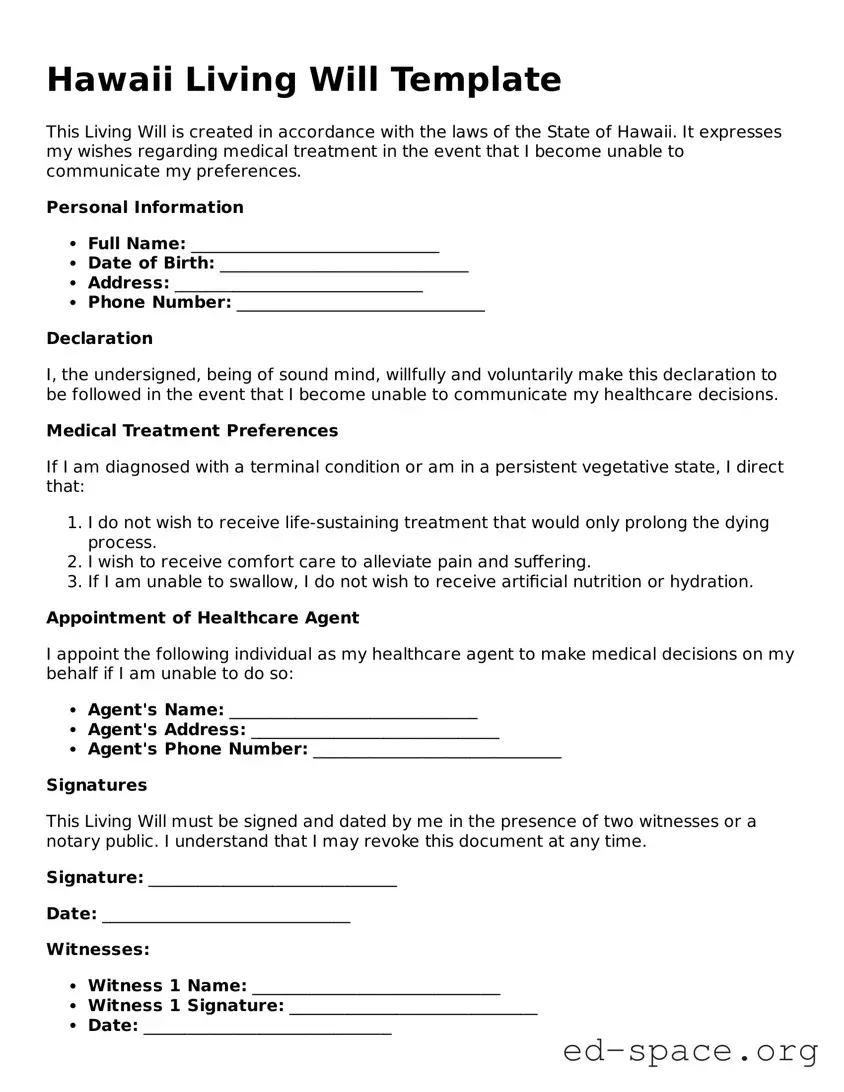
In Hawaii, the Living Will form serves as an important tool for individuals to express their healthcare wishes in advance, particularly in situations where they may be unable to communicate their preferences due to illness or injury. This document allows individuals to specify the types of medical treatment they would or would not want to receive, ensuring that their values and beliefs are honored. Key aspects of the form include the ability to designate a healthcare proxy, who can make decisions on behalf of the individual if they are incapacitated. Additionally, the Living Will addresses various medical scenarios, such as the use of life-sustaining treatments, resuscitation efforts, and palliative care. By completing this form, individuals can provide clear guidance to their loved ones and healthcare providers, reducing uncertainty and emotional stress during difficult times. Understanding the nuances of this form is crucial for anyone looking to safeguard their healthcare preferences in Hawaii.
Hawaii Living Will Template
This Living Will is created in accordance with the laws of the State of Hawaii. It expresses my wishes regarding medical treatment in the event that I become unable to communicate my preferences.
Personal Information
Declaration
I, the undersigned, being of sound mind, willfully and voluntarily make this declaration to be followed in the event that I become unable to communicate my healthcare decisions.
Medical Treatment Preferences
If I am diagnosed with a terminal condition or am in a persistent vegetative state, I direct that:
Appointment of Healthcare Agent
I appoint the following individual as my healthcare agent to make medical decisions on my behalf if I am unable to do so:
Signatures
This Living Will must be signed and dated by me in the presence of two witnesses or a notary public. I understand that I may revoke this document at any time.
Signature: ______________________________
Date: ______________________________
Witnesses:
This Living Will reflects my wishes and intentions regarding my medical care. It is my hope that my preferences will be respected and followed.
| Fact Name | Details |
|---|---|
| Purpose | A Hawaii Living Will allows individuals to outline their preferences for medical treatment in case they become unable to communicate their wishes. |
| Governing Laws | The form is governed by Hawaii Revised Statutes, Chapter 327E, which details the requirements and validity of advance health care directives. |
| Signature Requirements | The Living Will must be signed by the individual and witnessed by two adults who are not related to the individual or beneficiaries of their estate. |
| Revocation | Individuals can revoke their Living Will at any time, either verbally or in writing, as long as they are competent to do so. |
Filling out a Living Will form in Hawaii is an important step in ensuring your healthcare wishes are respected. Once you have completed the form, it is essential to keep it in a safe place and share copies with your healthcare provider and loved ones.
What is a Hawaii Living Will?
A Hawaii Living Will is a legal document that allows individuals to outline their preferences for medical treatment in case they become unable to communicate their wishes. This document specifically addresses end-of-life care and can guide healthcare providers and family members in making decisions that align with the individual's values and desires.
Who should consider creating a Living Will in Hawaii?
Any adult who wishes to have a say in their medical treatment in the event of a serious illness or injury should consider creating a Living Will. It is especially important for individuals with chronic health conditions, those undergoing surgery, or anyone who wants to ensure their healthcare wishes are known and respected.
How do I create a Living Will in Hawaii?
To create a Living Will in Hawaii, individuals can use a state-approved form or draft their own document. It is essential to clearly state your wishes regarding medical treatment and end-of-life care. After completing the form, it must be signed and dated in the presence of two witnesses or a notary public to be legally valid.
What should be included in a Living Will?
A Living Will should include specific instructions regarding medical treatments you wish to receive or refuse. This may encompass preferences for life-sustaining treatments, resuscitation efforts, pain management, and organ donation. Clarity and detail in these instructions can help ensure that your healthcare providers understand your desires.
Can I change or revoke my Living Will?
Yes, individuals have the right to change or revoke their Living Will at any time, as long as they are mentally competent. To make changes, a new Living Will can be created, or an existing one can be amended. It is advisable to inform your healthcare providers and family members of any changes to ensure that your current wishes are known.
Is a Living Will the same as a Durable Power of Attorney for Healthcare?
No, a Living Will and a Durable Power of Attorney for Healthcare are different documents. While a Living Will specifies your wishes regarding medical treatment, a Durable Power of Attorney for Healthcare designates a person to make healthcare decisions on your behalf if you are unable to do so. Many people choose to have both documents to ensure comprehensive planning for their healthcare needs.
Do I need a lawyer to create a Living Will in Hawaii?
It is not necessary to hire a lawyer to create a Living Will in Hawaii. However, consulting with a legal professional can provide guidance and ensure that the document meets all legal requirements. Individuals may also find it helpful to discuss their wishes with family members and healthcare providers.
Where should I keep my Living Will?
Your Living Will should be stored in a safe yet accessible location. It is advisable to provide copies to your healthcare providers, family members, and anyone designated as your healthcare agent. Keeping a copy in your medical records can also ensure that your wishes are easily available when needed.
Failing to clearly state personal wishes regarding medical treatment. This can lead to confusion and unintended outcomes.
Not signing the document in the presence of witnesses. In Hawaii, two witnesses are required to validate the Living Will.
Using outdated forms or templates. Laws and requirements may change, so it is essential to use the most current version.
Overlooking the need to date the document. A date helps establish when the Living Will was created and can affect its validity.
Not discussing the Living Will with family members. Open communication can prevent misunderstandings and disputes later on.
Failing to review the document periodically. Personal wishes may change over time, and it is important to keep the Living Will updated.
Neglecting to include specific instructions about organ donation. This can lead to complications if the individual's wishes are not clearly stated.
Assuming that a Living Will is the same as a Power of Attorney. These documents serve different purposes and should be understood as such.
Not seeking guidance when needed. Consulting with a professional can help clarify any uncertainties about the form or its implications.
A Hawaii Living Will is an important document that outlines an individual's preferences regarding medical treatment in situations where they may be unable to communicate their wishes. It is often used alongside other forms and documents that provide additional clarity and support for healthcare decisions. Below is a list of related documents that are commonly used with the Hawaii Living Will.
Using these documents in conjunction with a Hawaii Living Will can help ensure that an individual's healthcare preferences are clearly communicated and respected. It is advisable to review and update these documents regularly to reflect any changes in personal wishes or circumstances.
A Living Will is an important document that outlines an individual's wishes regarding medical treatment in the event they become unable to communicate those wishes themselves. There are several other documents that serve similar purposes in the realm of healthcare decisions. Here are four documents that are comparable to a Living Will:
When filling out the Hawaii Living Will form, it is essential to approach the process with care and consideration. Here are ten things to keep in mind:
Understanding the Hawaii Living Will form is essential for making informed decisions about healthcare preferences. However, several misconceptions can cloud this understanding. Here are seven common misconceptions:
Clearing up these misconceptions can empower individuals to make informed choices about their healthcare preferences. A living will is an important tool for ensuring that your wishes are known and respected.
In Hawaii, a Living Will is a legal document that outlines an individual's preferences for medical treatment in the event they become unable to communicate their wishes.
It is essential to clearly specify the types of medical interventions one does or does not want, such as life-sustaining treatments, resuscitation, or artificial nutrition.
To ensure the document is valid, it must be signed by the individual and witnessed by at least two adults who are not related to the individual or named in the will.
Individuals should keep copies of their Living Will in accessible locations and share them with family members and healthcare providers to ensure their wishes are known.
Regularly reviewing and updating the Living Will is advisable, especially after significant life changes, such as marriage, divorce, or the diagnosis of a serious illness.