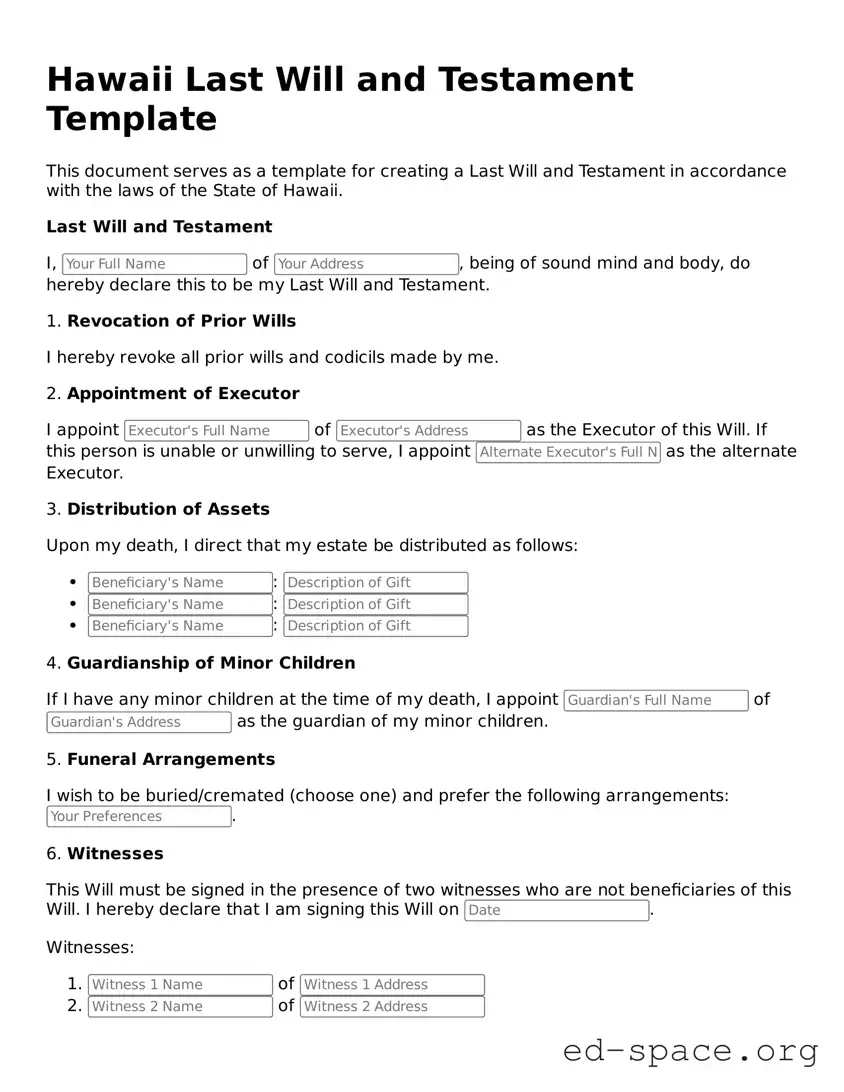
Creating a Last Will and Testament is an essential step for individuals in Hawaii who wish to ensure their wishes are honored after their passing. This legal document allows a person to outline how their assets will be distributed, appoint guardians for minor children, and designate an executor to manage the estate. In Hawaii, the form requires specific information, including the testator's name, address, and a clear declaration of intent. Additionally, it must be signed by the testator in the presence of two witnesses, who also sign the document to validate it. The state recognizes both handwritten and typed wills, provided they meet the necessary legal criteria. Understanding the components of the Hawaii Last Will and Testament form is crucial for anyone looking to secure their legacy and provide for their loved ones effectively.
Hawaii Last Will and Testament Template
This document serves as a template for creating a Last Will and Testament in accordance with the laws of the State of Hawaii.
Last Will and Testament
I, of , being of sound mind and body, do hereby declare this to be my Last Will and Testament.
1. Revocation of Prior Wills
I hereby revoke all prior wills and codicils made by me.
2. Appointment of Executor
I appoint of as the Executor of this Will. If this person is unable or unwilling to serve, I appoint as the alternate Executor.
3. Distribution of Assets
Upon my death, I direct that my estate be distributed as follows:
4. Guardianship of Minor Children
If I have any minor children at the time of my death, I appoint of as the guardian of my minor children.
5. Funeral Arrangements
I wish to be buried/cremated (choose one) and prefer the following arrangements: .
6. Witnesses
This Will must be signed in the presence of two witnesses who are not beneficiaries of this Will. I hereby declare that I am signing this Will on .
Witnesses:
IN WITNESS WHEREOF, I have hereunto set my hand this day of , .
_____________________________
| Fact Name | Description |
|---|---|
| Governing Law | The Hawaii Last Will and Testament is governed by Hawaii Revised Statutes, Chapter 560. |
| Age Requirement | Testators must be at least 18 years old to create a valid will in Hawaii. |
| Signature Requirement | The will must be signed by the testator or by someone else in their presence and at their direction. |
| Witness Requirement | At least two witnesses must sign the will in the presence of the testator. |
| Revocation | A will can be revoked by a later will, physical destruction, or by a written statement signed by the testator. |
| Holographic Wills | Hawaii recognizes holographic wills, which are handwritten and signed by the testator, without the need for witnesses. |
| Self-Proving Wills | A self-proving will includes a notarized affidavit from the witnesses, simplifying the probate process. |
| Probate Process | Wills must go through probate in Hawaii, where the court validates the will and oversees the distribution of assets. |
After obtaining the Hawaii Last Will and Testament form, it is essential to complete it accurately to ensure that your wishes are clearly articulated and legally recognized. This process involves several steps that guide you through providing the necessary information about your assets, beneficiaries, and any specific instructions you wish to include.
What is a Last Will and Testament in Hawaii?
A Last Will and Testament is a legal document that outlines how a person wishes to distribute their assets after their death. In Hawaii, this document must be signed and witnessed according to state laws to ensure it is valid. It allows individuals to express their wishes regarding their property, guardianship of minor children, and other important matters.
Who can create a Last Will and Testament in Hawaii?
Any person who is at least 18 years old and of sound mind can create a Last Will and Testament in Hawaii. This includes residents of Hawaii as well as individuals who may own property in the state. It is important that the individual understands the nature of their decisions when creating the will.
What are the requirements for a valid Last Will and Testament in Hawaii?
For a Last Will and Testament to be valid in Hawaii, it must be in writing, signed by the testator (the person making the will), and witnessed by at least two individuals. These witnesses must be present at the same time when the testator signs the will. It is advisable that witnesses are not beneficiaries of the will to avoid any potential conflicts of interest.
Can I change my Last Will and Testament after it is created?
Yes, you can change your Last Will and Testament at any time while you are still alive. This can be done by creating a new will or by adding a codicil, which is an amendment to the original will. It is important to follow the same formalities as the original will to ensure that the changes are legally binding.
What happens if I die without a Last Will and Testament in Hawaii?
If you die without a will, you are considered to have died intestate. In this case, Hawaii's intestacy laws will determine how your assets are distributed. Typically, your property will be distributed to your closest relatives, which may not align with your personal wishes. This underscores the importance of having a will in place.
Can I include specific wishes for my children in my Last Will and Testament?
Yes, you can specify your wishes regarding the guardianship of your minor children in your Last Will and Testament. It is crucial to name a guardian who you trust to care for your children. Additionally, you can set up trusts for their financial support if needed.
Is it necessary to have a lawyer to create a Last Will and Testament in Hawaii?
While it is not legally required to have a lawyer to create a Last Will and Testament, consulting with one can be beneficial. An attorney can help ensure that your will complies with state laws and accurately reflects your wishes. They can also provide guidance on complex situations, such as blended families or significant assets.
How can I ensure my Last Will and Testament is kept safe?
It is important to store your Last Will and Testament in a safe place, such as a fireproof safe or with a trusted attorney. Inform your loved ones about its location. Regularly reviewing and updating your will is also crucial to ensure it remains aligned with your current wishes and circumstances.
Failing to properly identify beneficiaries. It’s crucial to clearly name the individuals or organizations you wish to inherit your assets. Ambiguities can lead to disputes among family members.
Not signing the will in the presence of witnesses. In Hawaii, a valid will must be signed by the testator (the person making the will) and at least two witnesses. Neglecting this step can render the will invalid.
Overlooking the need for a self-proving affidavit. While not mandatory, including a self-proving affidavit can simplify the probate process. This document confirms that the will was executed properly, which can save time and reduce complications later.
Using outdated forms or templates. Laws and regulations can change. It is important to ensure that you are using the most current version of the Hawaii Last Will and Testament form to avoid legal issues.
When preparing a Last Will and Testament in Hawaii, it’s essential to consider other legal documents that can complement your will and ensure your wishes are honored. These documents can help clarify your intentions and provide guidance for your loved ones. Below is a list of commonly used forms and documents that often accompany a will.
Understanding these documents can help you create a comprehensive estate plan that reflects your wishes. By considering them alongside your Last Will and Testament, you can ensure that your intentions are clear and that your loved ones are supported during a difficult time.
When filling out the Hawaii Last Will and Testament form, it is crucial to follow specific guidelines to ensure that the document is valid and reflects your wishes. Below is a list of important dos and don'ts.
Things You Should Do:
Things You Shouldn't Do:
Following these guidelines will help ensure that your Last Will and Testament accurately reflects your wishes and complies with Hawaii law.
Understanding the Hawaii Last Will and Testament form is crucial for effective estate planning. However, several misconceptions can lead to confusion. Here are seven common myths about this important legal document:
This is not true in Hawaii. A will can be valid without notarization as long as it is signed by the testator and two witnesses who are present at the same time.
While it is advisable to consult a lawyer, individuals can create their own wills in Hawaii. They must follow specific guidelines to ensure it meets legal requirements.
A will only takes effect after the testator's death. Until then, it can be changed or revoked at any time.
There is no mandated form for a will in Hawaii. As long as the document meets the legal criteria, it can be in any format.
Wills can also include instructions for guardianship of minor children and funeral arrangements, not just the distribution of assets.
This misconception is false. A will can be amended or revoked at any time, as long as the testator is competent.
Not all assets are subject to probate. Certain assets, such as those held in a trust or jointly owned property, can bypass the probate process.
Being informed about these misconceptions can help individuals make better decisions regarding their estate planning in Hawaii.
When filling out and using the Hawaii Last Will and Testament form, there are several important points to keep in mind. Here are some key takeaways:
By keeping these takeaways in mind, you can create a clear and effective Last Will and Testament that reflects your wishes.