Homepage Free Homeschool Letter of Intent Form for Hawaii
Content Overview

Hawaii offers families the opportunity to educate their children at home, and a key step in this process is the Homeschool Letter of Intent form. This form serves as a formal notification to the state that you intend to homeschool your child. It's important to note that this document must be submitted annually, and it provides essential information such as the names and ages of the children being homeschooled, as well as the educational approach you plan to take. Additionally, the form allows you to outline the curriculum or subjects you intend to cover, ensuring that your educational plan aligns with state requirements. By completing and submitting this form, you not only comply with state regulations but also set the foundation for a successful homeschooling journey. Understanding the specifics of this form can help you navigate the homeschooling landscape in Hawaii with confidence.

Document Preview

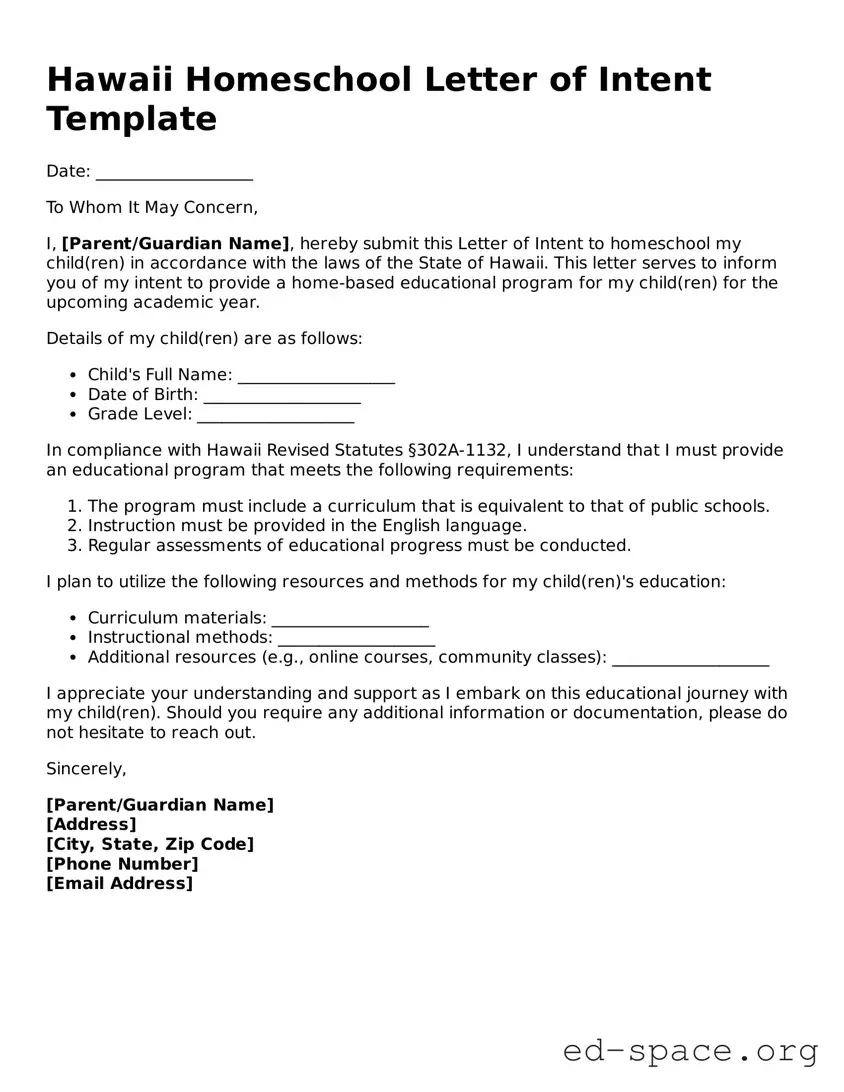
Hawaii Homeschool Letter of Intent Template

Date: ___________________

To Whom It May Concern,

I, [Parent/Guardian Name], hereby submit this Letter of Intent to homeschool my child(ren) in accordance with the laws of the State of Hawaii. This letter serves to inform you of my intent to provide a home-based educational program for my child(ren) for the upcoming academic year.

Details of my child(ren) are as follows:

  • Child's Full Name: ___________________
  • Date of Birth: ___________________
  • Grade Level: ___________________

In compliance with Hawaii Revised Statutes §302A-1132, I understand that I must provide an educational program that meets the following requirements:

  1. The program must include a curriculum that is equivalent to that of public schools.
  2. Instruction must be provided in the English language.
  3. Regular assessments of educational progress must be conducted.

I plan to utilize the following resources and methods for my child(ren)'s education:

  • Curriculum materials: ___________________
  • Instructional methods: ___________________
  • Additional resources (e.g., online courses, community classes): ___________________

I appreciate your understanding and support as I embark on this educational journey with my child(ren). Should you require any additional information or documentation, please do not hesitate to reach out.

Sincerely,

[Parent/Guardian Name]
[Address]
[City, State, Zip Code]
[Phone Number]
[Email Address]

PDF Form Details

Fact Name Description
Governing Law The Hawaii Homeschool Letter of Intent is governed by Hawaii Revised Statutes §302A-1132.
Purpose This form notifies the state of your intention to homeschool your child.
Submission Deadline The form should be submitted within 10 days of beginning your homeschool program.
Age Requirement The child must be between the ages of 6 and 18 to be eligible for homeschooling in Hawaii.
Content Requirements It must include the name and address of the child, the name of the parent or guardian, and the educational plan.
Annual Assessment Parents are required to provide an annual assessment of their child’s educational progress.
Record Keeping Parents must keep records of educational activities and progress, as these may be requested by the state.
Notification of Changes If there are any changes in the child's educational status, parents must notify the state promptly.
Resources Many local organizations and online resources can assist families with homeschooling in Hawaii.

Hawaii Homeschool Letter of Intent: Usage Guidelines

Once you have decided to homeschool your child in Hawaii, you need to complete the Homeschool Letter of Intent form. This form is essential for notifying the state of your intent to homeschool. After submitting the form, you will receive confirmation, and you can begin your homeschooling journey.

  1. Download the Homeschool Letter of Intent form from the Hawaii Department of Education website.
  2. Open the form and read the instructions carefully to ensure you understand what is required.
  3. Fill in your personal information, including your name, address, and contact details.
  4. Provide the name and age of the child or children you intend to homeschool.
  5. Specify the educational curriculum you plan to use for homeschooling.
  6. Sign and date the form to confirm that the information is accurate and complete.
  7. Submit the completed form to your local school district office. You can do this by mail or in person.

Your Questions, Answered

What is the Hawaii Homeschool Letter of Intent?

The Hawaii Homeschool Letter of Intent is a document that parents or guardians must submit to formally notify the state of their intention to homeschool their children. This letter serves as an official declaration that the child will not be attending a traditional public or private school and will instead receive education at home. It is a necessary step to comply with Hawaii's homeschooling laws.

Who needs to submit the Letter of Intent?

Any parent or guardian who wishes to homeschool their child in Hawaii must submit the Letter of Intent. This requirement applies to children who are of compulsory school age, which typically includes those between the ages of 6 and 18. If a family decides to homeschool a child during this age range, they must complete and file the letter to ensure they meet state regulations.

When should the Letter of Intent be submitted?

The Letter of Intent should be submitted at the beginning of the homeschooling process. Ideally, it should be filed before the start of the school year or as soon as the decision to homeschool is made. This ensures that the family is in compliance with state requirements and allows for a smooth transition from traditional schooling to homeschooling.

What information is required in the Letter of Intent?

The Letter of Intent typically requires basic information about the student, such as their name, age, and address. Additionally, parents must provide their contact information and indicate the educational approach they plan to use. It's important to ensure that all required details are included to avoid any delays or issues with the submission.

Common mistakes

  1. Incomplete Information: One of the most common mistakes is failing to provide all required information. Ensure that every section of the form is filled out completely. Missing details can lead to delays or even rejection of your application.

  2. Incorrect Dates: Many people overlook the importance of accurate dates. Double-check the start date for your homeschooling program and make sure it aligns with your educational plans. Incorrect dates can cause confusion and may impact your homeschooling status.

  3. Signature Issues: Forgetting to sign the form is another frequent error. Always review the document to confirm that all necessary signatures are present. An unsigned form will not be processed, which can set back your homeschooling journey.

  4. Not Keeping Copies: After submitting the form, many individuals neglect to keep a copy for their records. It’s essential to have a copy for your files in case you need to reference it later or if there are any questions about your submission.

Documents used along the form

When families decide to homeschool in Hawaii, they often need to complete the Hawaii Homeschool Letter of Intent form. This form is a crucial step in the homeschooling process, but it is not the only document that may be required. Below is a list of other forms and documents that are commonly used alongside the Letter of Intent. Each plays a significant role in ensuring a smooth homeschooling experience.

  • Curriculum Plan: This document outlines the educational materials and subjects that will be covered throughout the school year. It helps parents organize their teaching strategy and provides a framework for educational goals.
  • Attendance Record: Keeping track of attendance is essential for homeschooling. This record documents the days of instruction and can be useful for demonstrating compliance with educational requirements.
  • Assessment Records: These documents include results from standardized tests or other assessments. They help gauge the student's progress and can be submitted to the local education authority as proof of educational achievement.
  • Portfolio of Work: A collection of the student's work samples, projects, and assignments. This portfolio showcases the learning journey and can be used for evaluations or assessments.
  • Notification of Withdrawal: If a child is transitioning from public school to homeschooling, this document formally notifies the school of the withdrawal. It ensures that the school is aware of the change in the child's educational status.
  • Health and Safety Records: These may include immunization records or health assessments. They can be important for ensuring the child's well-being while being educated at home.
  • Extracurricular Activity Forms: If a homeschooling family wishes to participate in community sports or activities, these forms may be required. They help facilitate involvement in social and physical development opportunities.

Each of these documents plays a vital role in the homeschooling process in Hawaii. By preparing and organizing them alongside the Letter of Intent, families can ensure they meet all necessary requirements and provide a comprehensive educational experience for their children.

Similar forms

  • Notice of Intent to Homeschool: This document serves a similar purpose by formally notifying the school district of a parent's intention to homeschool their child. It typically outlines the educational plan and may include details about the curriculum and teaching methods.
  • Withdrawal Form from Public School: When parents decide to homeschool, they often need to submit a withdrawal form to their child's current public school. This document officially removes the child from the school rolls and ensures that the school is aware of the change in educational status.
  • Educational Plan: Similar to the Homeschool Letter of Intent, an educational plan outlines the curriculum and educational goals for the year. It may include subjects to be taught and methods of assessment, providing a clear roadmap for the homeschooling journey.
  • Curriculum Outline: This document details the specific courses and materials that will be used throughout the homeschooling year. Like the Letter of Intent, it helps to clarify the educational approach and ensure compliance with state regulations.
  • Attendance Records: Keeping track of attendance is often required by state law for homeschooling. These records document the days of instruction and are similar to the Letter of Intent in that they serve to demonstrate educational commitment.
  • Progress Reports: These documents provide updates on a child's academic progress and are often submitted to the school district. They serve a similar function to the Homeschool Letter of Intent by ensuring that educational standards are being met.
  • Assessment Results: Some states require standardized testing or other forms of assessment for homeschooled children. These results can be submitted to the school district, similar to the Letter of Intent, to demonstrate educational effectiveness.
  • Notice of Educational Philosophy: This document outlines the educational philosophy guiding the homeschooling approach. It shares similarities with the Homeschool Letter of Intent by providing insight into the parent’s educational values and goals.

Dos and Don'ts

When filling out the Hawaii Homeschool Letter of Intent form, it is important to follow specific guidelines to ensure a smooth process. Here are some key dos and don'ts to consider:

  • Do provide accurate information about the student, including their full name and date of birth.
  • Do submit the form within the required timeframe to avoid any delays in the homeschooling process.
  • Don't leave any sections blank; incomplete forms may lead to processing issues.
  • Don't forget to keep a copy of the submitted form for your records.

Misconceptions

Homeschooling in Hawaii can be a rewarding experience for families, but there are several misconceptions surrounding the Hawaii Homeschool Letter of Intent form. Understanding the facts can help parents navigate the process more effectively. Here are eight common misconceptions:

  • 1. The Letter of Intent is a complicated document. Many believe that the form is difficult to fill out, but it is actually straightforward and requires basic information about the child and the educational plan.
  • 2. You need a teaching degree to homeschool. Some think that only certified teachers can homeschool their children. In Hawaii, parents do not need a teaching degree to educate their children at home.
  • 3. Submitting the Letter of Intent is the only requirement. While submitting the form is essential, families must also ensure they meet other educational requirements throughout the year.
  • 4. The Letter of Intent must be submitted every year. It is a common belief that parents must submit a new form annually. In fact, once the initial Letter of Intent is accepted, it remains valid until the child reaches high school age.
  • 5. The form requires a detailed curriculum plan. Many assume that a comprehensive curriculum outline is necessary. However, the form only asks for a brief description of the educational approach.
  • 6. Homeschooling means isolation from other students. Some think that homeschooling isolates children from their peers. In reality, many homeschool families participate in co-ops, sports, and community events.
  • 7. The state monitors homeschooling closely. There is a misconception that the state closely oversees homeschooling activities. While there are guidelines, parents have the freedom to choose how to educate their children.
  • 8. Homeschooling is only for certain types of families. Many believe that only specific families can homeschool, but families from various backgrounds and circumstances successfully educate their children at home.

By debunking these misconceptions, families can better understand the homeschooling process in Hawaii and feel more confident in their educational choices.

Key takeaways

When considering homeschooling in Hawaii, filling out the Homeschool Letter of Intent form is an important step. Here are some key takeaways to keep in mind:

  • Understand the Purpose: The form serves as a formal notification to the state that you intend to homeschool your child. It’s essential for complying with state regulations.
  • Provide Accurate Information: Ensure that all details, such as your child's name and age, are correct. Inaccuracies can lead to complications down the line.
  • Submit on Time: The form should be submitted within the required timeframe, typically at the beginning of the school year or when you decide to start homeschooling.
  • Keep a Copy: Always retain a copy of the submitted form for your records. This can be useful if any questions arise regarding your homeschooling status.

By following these guidelines, you can navigate the process more smoothly and focus on providing a quality education for your child.