In the beautiful state of Hawaii, a General Power of Attorney form serves as a crucial legal document that empowers individuals to appoint someone they trust to make decisions on their behalf. This form is particularly important for those who may be unable to manage their affairs due to health issues, travel, or other circumstances. By designating an agent, or attorney-in-fact, the principal can ensure that their financial, legal, and personal matters are handled according to their wishes. The General Power of Attorney can grant broad authority, allowing the agent to manage bank accounts, sign contracts, and handle real estate transactions. It is essential for individuals to understand the specific powers they are granting, as well as the responsibilities that come with this role. Additionally, the form must be completed and signed in accordance with Hawaii's legal requirements to ensure its validity. Knowing how to properly execute this document can provide peace of mind, knowing that trusted individuals can step in when needed.
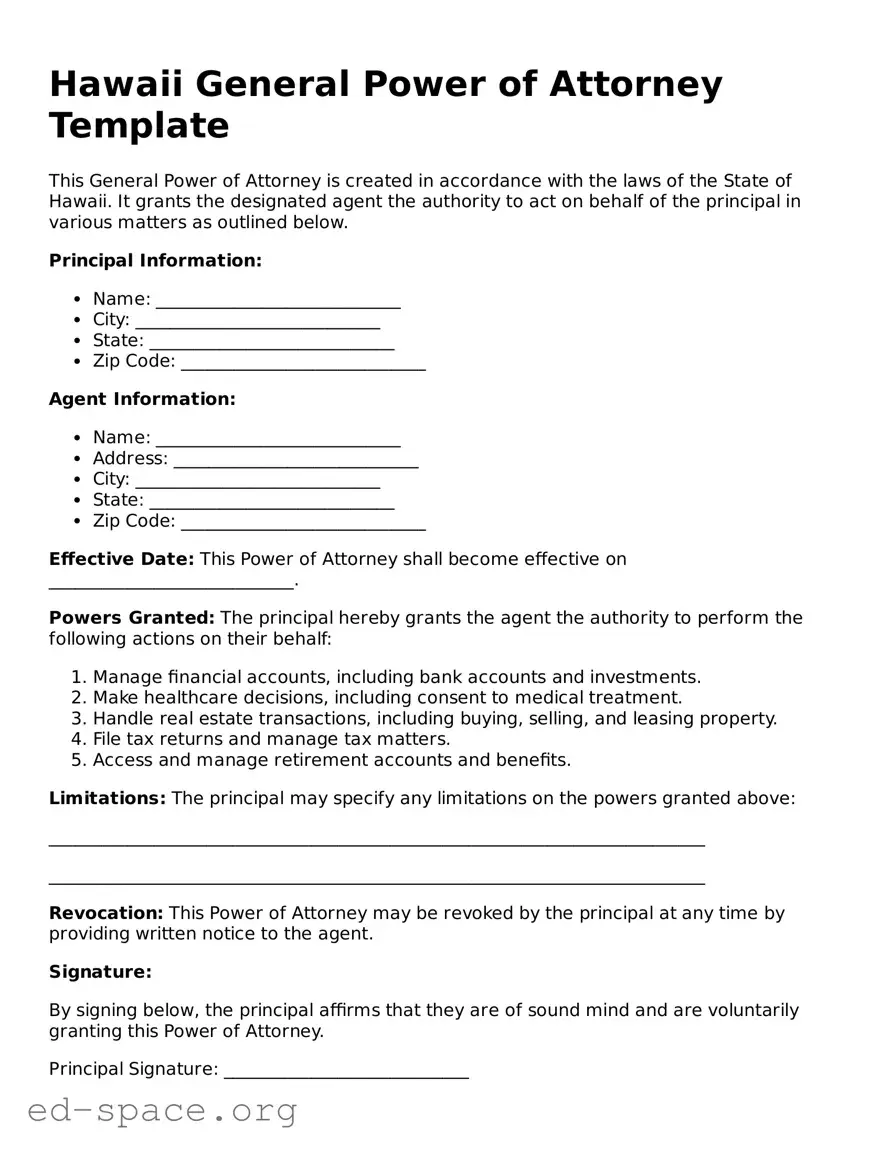
Hawaii General Power of Attorney Template
This General Power of Attorney is created in accordance with the laws of the State of Hawaii. It grants the designated agent the authority to act on behalf of the principal in various matters as outlined below.
Principal Information:
Agent Information:
Effective Date: This Power of Attorney shall become effective on ____________________________.
Powers Granted: The principal hereby grants the agent the authority to perform the following actions on their behalf:
Limitations: The principal may specify any limitations on the powers granted above:
___________________________________________________________________________
___________________________________________________________________________
Revocation: This Power of Attorney may be revoked by the principal at any time by providing written notice to the agent.
Signature:
By signing below, the principal affirms that they are of sound mind and are voluntarily granting this Power of Attorney.
Principal Signature: ____________________________
Date: ____________________________
Witness Information:
This document is intended to comply with the laws of the State of Hawaii and should be executed in accordance with those laws.
| Fact Name | Description |
|---|---|
| Definition | A Hawaii General Power of Attorney form allows one person to grant another person the authority to act on their behalf in financial and legal matters. |
| Governing Law | This form is governed by Hawaii Revised Statutes, Chapter 551E. |
| Durability | The general power of attorney can be durable, meaning it remains effective even if the principal becomes incapacitated. |
| Principal | The individual who creates the power of attorney is referred to as the principal. |
| Agent | The person designated to act on behalf of the principal is known as the agent or attorney-in-fact. |
| Signature Requirement | The principal must sign the document for it to be valid, and it may require notarization or witnesses. |
| Scope of Authority | The form can specify the powers granted to the agent, which may include managing bank accounts, signing checks, and handling real estate transactions. |
| Revocation | The principal can revoke the power of attorney at any time, as long as they are mentally competent. |
| Limitations | Some actions, such as making medical decisions, typically require a separate medical power of attorney. |
| Usage | This form is commonly used for estate planning, financial management, and in situations where the principal cannot be present to make decisions. |
Filling out the Hawaii General Power of Attorney form is an important step in designating someone to make decisions on your behalf. After completing the form, you will need to sign it in the presence of a notary public to ensure its validity.
What is a General Power of Attorney in Hawaii?
A General Power of Attorney is a legal document that allows one person, known as the "agent" or "attorney-in-fact," to act on behalf of another person, called the "principal." This authority can cover a wide range of financial and legal decisions, such as managing bank accounts, signing contracts, and handling real estate transactions. In Hawaii, this form provides flexibility and convenience, especially if the principal cannot be present to make decisions themselves.
Do I need to have a specific reason to create a General Power of Attorney?
No specific reason is required to create a General Power of Attorney. Many people choose to set one up for convenience, especially if they travel frequently or have health concerns. It allows someone they trust to manage their affairs when they are unable to do so. However, it’s essential to choose someone responsible and trustworthy as your agent.
How do I create a General Power of Attorney in Hawaii?
Creating a General Power of Attorney in Hawaii involves a few simple steps. First, you need to obtain the appropriate form. You can find this form online or through legal offices. Next, fill out the form with the necessary details, including the names of the principal and the agent, as well as the powers being granted. Finally, sign the document in front of a notary public to make it legally binding. It’s a good idea to keep copies for your records and provide one to your agent.
Can I revoke a General Power of Attorney in Hawaii?
Yes, you can revoke a General Power of Attorney at any time as long as you are mentally competent. To do this, you must create a written revocation document and notify your agent. It’s also wise to inform any institutions or parties that may have relied on the original power of attorney. This ensures that your wishes are clear and prevents any confusion in the future.
What happens if I become incapacitated and have a General Power of Attorney?
If you become incapacitated and have a General Power of Attorney in place, your agent can step in to make decisions on your behalf. This can be incredibly helpful in managing your financial and legal matters without delay. However, it’s crucial to choose someone you trust completely, as they will have significant authority over your affairs during this time.
Is a General Power of Attorney the same as a Durable Power of Attorney?
No, a General Power of Attorney is not the same as a Durable Power of Attorney. A General Power of Attorney typically becomes invalid if the principal becomes incapacitated. In contrast, a Durable Power of Attorney remains in effect even if the principal loses the ability to make decisions. If you want to ensure your agent can act on your behalf during incapacitation, you should consider creating a Durable Power of Attorney instead.
Not specifying the powers granted: Many individuals fail to clearly outline the specific powers they wish to grant to their agent. This can lead to confusion or disputes later on. It’s essential to be as detailed as possible.
Forgetting to date the document: A common oversight is neglecting to date the General Power of Attorney form. Without a date, it may be difficult to determine when the powers were granted, which can create legal complications.
Not signing in front of a notary: The form typically requires notarization. Some people forget this step, which can render the document invalid. Always ensure that a notary public witnesses the signing.
Failing to choose a reliable agent: Selecting an agent who is not trustworthy or capable can lead to misuse of the granted powers. It’s crucial to choose someone who will act in your best interest.
Overlooking the need for alternate agents: It’s wise to name an alternate agent in case the primary agent is unable or unwilling to serve. This step is often overlooked, leaving individuals without representation when they need it most.
Not reviewing the form regularly: Life circumstances change, and so do the needs for a Power of Attorney. Failing to review and update the document can result in outdated information or powers that no longer reflect your wishes.
When creating a Hawaii General Power of Attorney, several other forms and documents may be beneficial to ensure comprehensive legal coverage. These documents can help clarify intentions, provide additional authority, or support specific needs. Below are five commonly associated forms that may be used alongside the General Power of Attorney.
Utilizing these documents in conjunction with the Hawaii General Power of Attorney can help create a robust legal framework. It is essential to consider individual circumstances and consult with a legal professional to ensure all necessary forms are in place for effective representation and decision-making.
When filling out the Hawaii General Power of Attorney form, it's important to be careful and thorough. Here’s a list of things you should and shouldn’t do:
The Hawaii General Power of Attorney form can be a useful tool for managing financial and legal matters. However, there are several misconceptions surrounding it that can lead to confusion. Here’s a list of common misunderstandings:
Many people believe that a General Power of Attorney is limited to financial decisions. In reality, it can also cover a range of legal matters, including property management and healthcare decisions, depending on how it is drafted.
Some individuals think that the power granted under this document continues even after the person who created it (the principal) passes away. This is incorrect; the authority granted ceases upon the principal's death.
A General Power of Attorney is not the same as a Durable Power of Attorney. The latter remains effective even if the principal becomes incapacitated, while the former does not.
While it is true that you can choose someone to act on your behalf, the person you appoint must be competent and trustworthy. There are also legal requirements regarding who can serve as an agent.
Some people mistakenly think that once a General Power of Attorney is created, it cannot be changed or revoked. In fact, as long as the principal is competent, they can revoke or modify the document at any time.
While notarization is highly recommended and may be required for certain transactions, a General Power of Attorney can still be valid without a notary if it meets other legal criteria.
Some believe that the authority granted lasts forever. However, the powers can be limited to specific tasks or time frames, as specified in the document.
Every situation is unique, and a General Power of Attorney should be tailored to meet individual needs. Using a generic form without customization may not provide the desired protections or authority.
While older individuals may often consider a General Power of Attorney, anyone can benefit from having one. Life is unpredictable, and having this document can provide peace of mind at any age.
Understanding these misconceptions can help individuals make informed decisions about creating a General Power of Attorney in Hawaii. It’s always advisable to consult with a legal professional to ensure that the document meets specific needs and complies with state laws.
Filling out and using the Hawaii General Power of Attorney form requires careful attention to detail. Here are some key takeaways to keep in mind:
By following these key points, you can effectively utilize the Hawaii General Power of Attorney form to manage your affairs when needed.