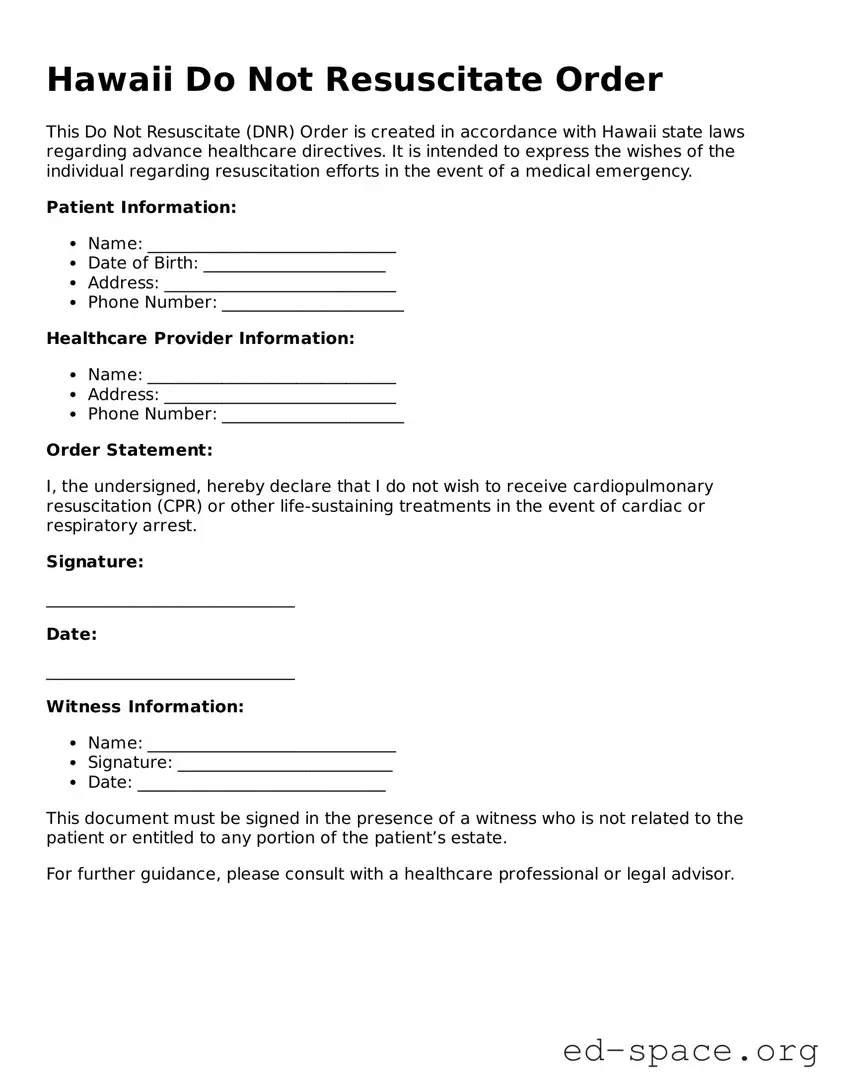
In the beautiful state of Hawaii, where the sun meets the sea, residents have the opportunity to make important decisions about their healthcare, especially in critical situations. One such decision involves the Hawaii Do Not Resuscitate (DNR) Order form, a vital document that allows individuals to express their wishes regarding resuscitation efforts in the event of a medical emergency. This form serves as a clear directive for healthcare providers, ensuring that a person’s preferences are honored when they are unable to communicate them. It is essential for individuals to understand the implications of this form, which not only includes the circumstances under which resuscitation should be avoided but also emphasizes the importance of discussing these wishes with family members and medical professionals. By filling out the DNR Order, individuals can take control of their healthcare decisions, providing peace of mind for themselves and their loved ones. Understanding how to properly complete this form and the nuances involved can empower individuals to make informed choices about their end-of-life care, reflecting their values and beliefs.
Hawaii Do Not Resuscitate Order
This Do Not Resuscitate (DNR) Order is created in accordance with Hawaii state laws regarding advance healthcare directives. It is intended to express the wishes of the individual regarding resuscitation efforts in the event of a medical emergency.
Patient Information:
Healthcare Provider Information:
Order Statement:
I, the undersigned, hereby declare that I do not wish to receive cardiopulmonary resuscitation (CPR) or other life-sustaining treatments in the event of cardiac or respiratory arrest.
Signature:
______________________________
Date:
______________________________
Witness Information:
This document must be signed in the presence of a witness who is not related to the patient or entitled to any portion of the patient’s estate.
For further guidance, please consult with a healthcare professional or legal advisor.
| Fact Name | Description |
|---|---|
| Definition | A Do Not Resuscitate (DNR) Order is a legal document that indicates a person's wish not to receive cardiopulmonary resuscitation (CPR) in the event of cardiac or respiratory arrest. |
| Governing Law | The Hawaii Do Not Resuscitate Order is governed by Hawaii Revised Statutes § 327-1 through § 327-8. |
| Eligibility | Individuals who are at least 18 years old can create a DNR order in Hawaii. |
| Signature Requirement | The DNR order must be signed by the individual or their legal representative. |
| Healthcare Provider's Role | A physician must sign the DNR order to validate it and ensure that it reflects the patient’s wishes. |
| Form Availability | The Hawaii DNR order form can be obtained from healthcare providers or online through state health department resources. |
| Revocation | Individuals can revoke a DNR order at any time, and it must be documented appropriately. |
| Emergency Medical Services | Emergency medical personnel are required to honor a valid DNR order when it is presented. |
| Patient Rights | Patients have the right to discuss their DNR wishes with healthcare providers and family members. |
Filling out the Hawaii Do Not Resuscitate Order form is a straightforward process that requires careful attention to detail. After completing the form, it will need to be signed and dated to ensure it is valid. You will then want to keep a copy for your records and provide copies to your healthcare provider and family members.
What is a Do Not Resuscitate (DNR) Order in Hawaii?
A Do Not Resuscitate Order is a legal document that allows individuals to refuse resuscitation efforts in the event of cardiac arrest or respiratory failure. In Hawaii, this order is specifically designed for patients who have a terminal illness or a condition that significantly limits their quality of life. It ensures that medical personnel respect the individual's wishes regarding end-of-life care, preventing unwanted interventions that may not align with their preferences.
How do I obtain a DNR Order in Hawaii?
To obtain a DNR Order in Hawaii, a patient must first discuss their wishes with their healthcare provider. This conversation is crucial, as it ensures that the medical team understands the patient’s condition and preferences. Once the decision is made, the healthcare provider will complete the official DNR form. The patient or their legal representative must then sign the document. It is important to keep copies of the DNR Order accessible, such as in a medical file or with a family member, to ensure that it is readily available in an emergency.
Can a DNR Order be revoked?
Yes, a DNR Order can be revoked at any time by the patient or their legal representative. If a patient decides to change their mind about resuscitation efforts, they should communicate this clearly to their healthcare provider and ensure that the previous DNR Order is formally canceled. It is essential to destroy any copies of the old order and create a new one if the patient wishes to establish a different directive regarding resuscitation.
Will a DNR Order affect other medical treatments?
No, having a DNR Order does not impact the provision of other medical treatments. Patients with a DNR Order will still receive comprehensive medical care for their conditions, including pain management and other supportive treatments. The order specifically pertains to resuscitation efforts only. Healthcare providers are obligated to continue to provide necessary medical care that aligns with the patient's overall treatment plan and wishes.
Failing to provide accurate personal information. This includes the patient's full name, date of birth, and contact information.
Not having the form signed by a qualified physician. A physician's signature is necessary for the order to be valid.
Overlooking the need for a witness signature. Many states, including Hawaii, require a witness to sign the document.
Using outdated forms. Ensure that the form is the most current version to comply with state regulations.
Neglecting to discuss the order with family members. Open communication can help avoid confusion and conflict later.
Not specifying the scope of the order. Clearly outline what medical interventions should or should not be performed.
Filling out the form under pressure. Take time to consider the implications of the decision before completing the document.
Forgetting to update the order. Life circumstances can change, necessitating a revision of the Do Not Resuscitate Order.
Ignoring state-specific requirements. Each state may have different rules regarding the completion and submission of the form.
Not keeping copies of the form. Retain copies for personal records and share them with healthcare providers and family members.
When considering end-of-life care in Hawaii, the Do Not Resuscitate (DNR) Order form is a crucial document. However, there are other forms and documents that often accompany it to ensure that an individual's healthcare wishes are clearly communicated and respected. Here’s a brief overview of some of these important documents.
Each of these documents plays a vital role in ensuring that healthcare providers and family members understand and respect an individual's wishes regarding medical treatment. Having them in place can provide peace of mind for both the individual and their loved ones during difficult times.
A Do Not Resuscitate (DNR) Order is an important document that outlines a person's wishes regarding medical treatment in the event of a life-threatening situation. Several other documents serve similar purposes, ensuring that individuals' preferences for medical care are respected. Here are seven documents that share similarities with a DNR Order:
Each of these documents plays a vital role in ensuring that a person's healthcare choices are honored, especially in critical moments. Understanding their similarities can help individuals navigate their options for end-of-life care more effectively.
When filling out the Hawaii Do Not Resuscitate Order form, it is essential to be careful and thorough. Here are some important dos and don'ts to consider:
Taking these steps can help ensure that your wishes are clearly communicated and respected.
Understanding the Hawaii Do Not Resuscitate (DNR) Order form is crucial for making informed healthcare decisions. However, several misconceptions can cloud this important topic. Here’s a list of seven common misunderstandings:
Being informed about these misconceptions can help individuals make better choices regarding their healthcare preferences. It’s always a good idea to discuss these topics with healthcare providers or legal professionals.
Filling out and using the Hawaii Do Not Resuscitate Order (DNR) form involves several important considerations. Below are key takeaways to help individuals understand the process and implications of this legal document.