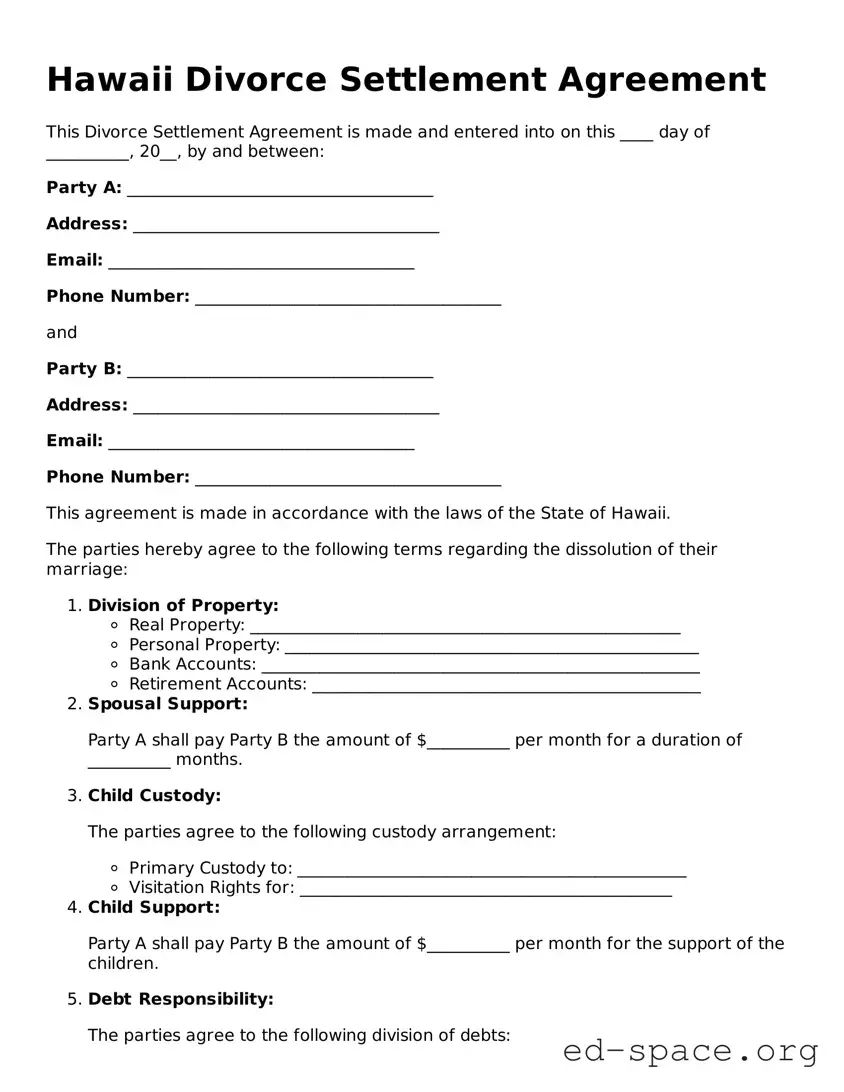
In the context of a divorce, reaching a settlement agreement is a crucial step that helps both parties outline their rights and responsibilities moving forward. The Hawaii Divorce Settlement Agreement form serves as a formal document that details the terms agreed upon by both spouses. This form typically covers essential aspects such as the division of marital property, spousal support, and child custody arrangements. It also addresses child support obligations, ensuring that both parents contribute to their children's well-being. By clearly outlining these terms, the form aims to prevent future disputes and provides a framework for the post-divorce relationship between the parties. Understanding the components of this agreement is vital for anyone navigating the divorce process in Hawaii, as it not only reflects the decisions made during negotiations but also serves as a legally binding contract once signed by both parties.
Hawaii Divorce Settlement Agreement
This Divorce Settlement Agreement is made and entered into on this ____ day of __________, 20__, by and between:
Party A: _____________________________________
Address: _____________________________________
Email: _____________________________________
Phone Number: _____________________________________
and
Party B: _____________________________________
Address: _____________________________________
Email: _____________________________________
Phone Number: _____________________________________
This agreement is made in accordance with the laws of the State of Hawaii.
The parties hereby agree to the following terms regarding the dissolution of their marriage:
Party A shall pay Party B the amount of $__________ per month for a duration of __________ months.
The parties agree to the following custody arrangement:
Party A shall pay Party B the amount of $__________ per month for the support of the children.
The parties agree to the following division of debts:
This agreement constitutes the entire understanding between the parties and supersedes all prior negotiations, representations, or agreements, whether written or oral.
IN WITNESS WHEREOF, the parties have executed this Divorce Settlement Agreement as of the date first above written.
Party A Signature: ____________________________ Date: ___________
Party B Signature: ____________________________ Date: ___________
Witness Signature: ____________________________ Date: ___________
| Fact Name | Description |
|---|---|
| Governing Law | The Hawaii Divorce Settlement Agreement is governed by Hawaii Revised Statutes, Chapter 580. |
| Purpose | This form outlines the terms of the divorce settlement between spouses, including asset division and support obligations. |
| Required Signatures | Both parties must sign the agreement to ensure its validity and enforceability. |
| Filing Requirement | The completed agreement must be filed with the family court as part of the divorce proceedings. |
| Modification Clause | Any changes to the agreement must be made in writing and signed by both parties. |
| Legal Advice | It is strongly advised to seek legal counsel before finalizing the agreement to ensure all rights are protected. |
Filling out the Hawaii Divorce Settlement Agreement form is an important step in finalizing your divorce. Once you complete this form, you will be ready to submit it to the court for approval. Here’s how to fill it out correctly.
After completing the form, review it carefully to ensure all information is accurate. Once everything looks good, you can file it with the court. This is a crucial step in moving forward with your divorce process.
What is a Hawaii Divorce Settlement Agreement?
A Hawaii Divorce Settlement Agreement is a legal document that outlines the terms agreed upon by both spouses during a divorce. This agreement typically covers important aspects such as division of property, child custody, child support, and spousal support. It serves as a comprehensive guide for both parties to follow, ensuring that all matters are settled amicably and clearly defined.
Who needs to sign the Divorce Settlement Agreement?
Both spouses must sign the Divorce Settlement Agreement for it to be valid. Each party should review the document carefully to ensure that it accurately reflects their understanding and agreements. It’s advisable to have the agreement notarized to provide an extra layer of authenticity and to help in future legal proceedings, if necessary.
Can the terms of the Divorce Settlement Agreement be modified later?
Yes, the terms of the Divorce Settlement Agreement can be modified after it has been finalized, but both parties must agree to any changes. If circumstances change significantly, such as a job loss or a change in the needs of the children, one party may petition the court to modify certain terms. However, it’s important to document any changes formally to avoid misunderstandings in the future.
Is a Divorce Settlement Agreement legally binding?
Yes, once signed by both parties and approved by the court, a Divorce Settlement Agreement becomes legally binding. This means that both spouses are required to adhere to the terms outlined in the agreement. If either party fails to comply, the other can seek enforcement through the court.
What happens if we cannot reach an agreement?
If both spouses are unable to reach an agreement on the terms of the divorce, they may need to consider mediation or, in some cases, go to court for a judge to make the decisions. Mediation involves a neutral third party who helps facilitate discussions and negotiations. This can often lead to a more amicable resolution than a court decision.
Do I need a lawyer to draft a Divorce Settlement Agreement?
While it is not legally required to have a lawyer draft a Divorce Settlement Agreement, it is highly recommended. An attorney can ensure that your rights are protected and that the agreement complies with Hawaii laws. They can also help clarify any complex issues and provide guidance throughout the divorce process, making it smoother for both parties.
Incomplete Information: One of the most common mistakes is failing to provide all necessary details. Each section of the form must be filled out completely. Missing information can delay the process or lead to complications later on.
Incorrect Financial Disclosures: It's essential to accurately report income, assets, and debts. Underestimating or overestimating these figures can create mistrust and may affect the final settlement.
Ignoring Legal Guidelines: People often overlook specific legal requirements unique to Hawaii. Familiarizing oneself with state laws regarding divorce can prevent errors that might invalidate the agreement.
Not Considering Future Needs: Focusing solely on the present can lead to inadequate arrangements for future needs, such as child support or alimony. It's crucial to think long-term when negotiating terms.
Failing to Review the Agreement: Many individuals rush through the process and neglect to thoroughly review the completed form. Taking the time to double-check can help catch mistakes before submission.
Not Seeking Professional Help: Some believe they can navigate the process without assistance. However, consulting a legal professional can provide valuable insights and help avoid common pitfalls.
When navigating the divorce process in Hawaii, several documents are commonly utilized alongside the Divorce Settlement Agreement form. Each of these documents serves a specific purpose and is essential for ensuring that the divorce proceedings are handled appropriately.
Understanding these documents can help individuals feel more prepared and informed throughout the divorce process. Each plays a vital role in ensuring that the rights and responsibilities of all parties are clearly defined and respected.
When filling out the Hawaii Divorce Settlement Agreement form, it is essential to approach the process with care. Here are five things you should and shouldn't do:
When navigating the divorce process in Hawaii, many individuals encounter misconceptions about the Divorce Settlement Agreement form. Understanding the truth behind these misconceptions can help ensure a smoother legal experience.
This is incorrect. Even without children, a Divorce Settlement Agreement is crucial for dividing assets and debts. It outlines how property will be divided and can prevent disputes later.
In reality, a simple and clear agreement can be just as effective. The key is that it must be fair and cover all necessary aspects of the divorce, including property division and spousal support.
This is not true. Parties can modify the agreement if both agree to the changes. However, any modifications should be documented and signed to maintain legal integrity.
While it is possible to complete the form without legal counsel, seeking advice is highly recommended. An attorney can help ensure that your rights are protected and that the agreement complies with state laws.
When filling out and using the Hawaii Divorce Settlement Agreement form, it is important to keep several key points in mind. This document plays a crucial role in outlining the terms of your divorce and ensuring both parties are in agreement. Here are some essential takeaways:
Taking these steps can help ensure that the divorce settlement process goes smoothly. It is essential to approach this with care and attention to detail.