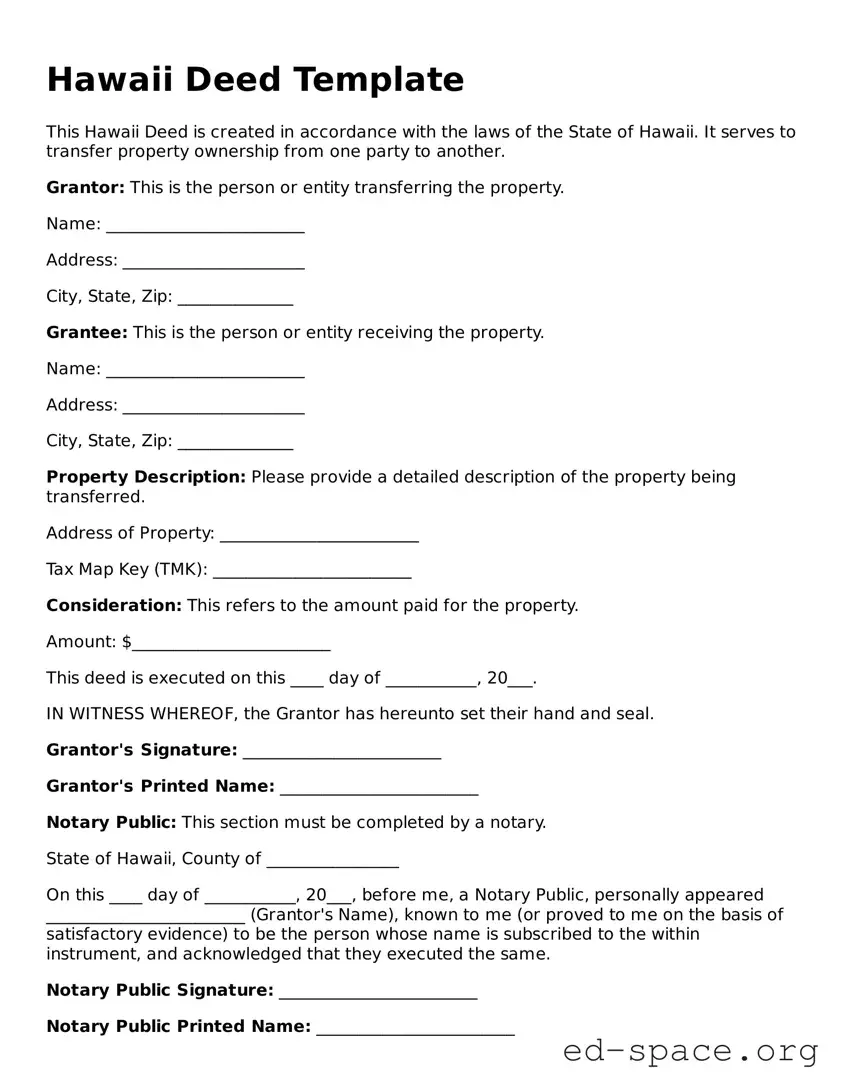
The Hawaii Deed form is a critical document in real estate transactions within the state, serving as a legal instrument to transfer property ownership from one party to another. This form includes essential details such as the names of the grantor (the seller) and grantee (the buyer), a description of the property being transferred, and the signatures of both parties. It also outlines any conditions or restrictions associated with the transfer, ensuring clarity and legal compliance. In Hawaii, specific requirements must be met for the deed to be valid, including notarization and proper recording with the Bureau of Conveyances. Understanding these aspects is vital for anyone involved in property transactions, as a well-prepared deed can prevent disputes and facilitate a smooth transfer process. Additionally, various types of deeds exist, such as warranty deeds and quitclaim deeds, each serving different purposes and offering varying levels of protection to the parties involved.
Hawaii Deed Template
This Hawaii Deed is created in accordance with the laws of the State of Hawaii. It serves to transfer property ownership from one party to another.
Grantor: This is the person or entity transferring the property.
Name: ________________________
Address: ______________________
City, State, Zip: ______________
Grantee: This is the person or entity receiving the property.
Name: ________________________
Address: ______________________
City, State, Zip: ______________
Property Description: Please provide a detailed description of the property being transferred.
Address of Property: ________________________
Tax Map Key (TMK): ________________________
Consideration: This refers to the amount paid for the property.
Amount: $________________________
This deed is executed on this ____ day of ___________, 20___.
IN WITNESS WHEREOF, the Grantor has hereunto set their hand and seal.
Grantor's Signature: ________________________
Grantor's Printed Name: ________________________
Notary Public: This section must be completed by a notary.
State of Hawaii, County of ________________
On this ____ day of ___________, 20___, before me, a Notary Public, personally appeared ________________________ (Grantor's Name), known to me (or proved to me on the basis of satisfactory evidence) to be the person whose name is subscribed to the within instrument, and acknowledged that they executed the same.
Notary Public Signature: ________________________
Notary Public Printed Name: ________________________
My commission expires: ________________
This deed is intended to comply with all applicable laws of the State of Hawaii. Please consult with a legal professional for further guidance.
| Fact Name | Description |
|---|---|
| Governing Law | The Hawaii Deed form is governed by the Hawaii Revised Statutes, specifically Chapter 501. |
| Types of Deeds | Hawaii recognizes various types of deeds, including warranty deeds, quitclaim deeds, and special warranty deeds. |
| Signature Requirements | All parties involved in the deed must sign the document for it to be valid. |
| Notarization | A Hawaii Deed must be notarized to ensure its authenticity and to be accepted for recording. |
| Recording | Deeds must be recorded with the Bureau of Conveyances in Hawaii to provide public notice of ownership. |
| Legal Description | The deed must include a legal description of the property being transferred, ensuring clarity in ownership. |
| Consideration | The deed should state the consideration, or value, exchanged for the property, although this is not always mandatory. |
| Transfer Tax | Hawaii imposes a conveyance tax on property transfers, which must be paid at the time of recording. |
| Revocation | A deed can be revoked or modified, but this typically requires a new deed to be executed and recorded. |
Once you have the Hawaii Deed form in hand, it's essential to complete it accurately to ensure a smooth transfer of property. After filling out the form, you will need to have it notarized and then file it with the appropriate county office. This process is crucial for the legal validity of the deed.
What is a Hawaii Deed form?
A Hawaii Deed form is a legal document used to transfer ownership of real property in the state of Hawaii. This form outlines the details of the property being transferred, the parties involved, and any conditions related to the transfer. It serves as proof of ownership once recorded with the appropriate county office.
What types of deeds are available in Hawaii?
Hawaii recognizes several types of deeds, including warranty deeds, quitclaim deeds, and special warranty deeds. A warranty deed guarantees that the seller holds clear title to the property and has the right to sell it. A quitclaim deed transfers whatever interest the seller has in the property, without guarantees. A special warranty deed provides limited warranties, only covering the time the seller owned the property.
How do I complete a Hawaii Deed form?
To complete a Hawaii Deed form, you will need to provide specific information, including the names of the grantor (seller) and grantee (buyer), a legal description of the property, and the date of the transaction. It is important to ensure that all information is accurate and complete. After filling out the form, both parties must sign it in the presence of a notary public.
Do I need to have the deed notarized?
Yes, in Hawaii, a deed must be notarized to be legally valid. This means that both the grantor and grantee need to sign the deed in front of a notary public. The notary will verify the identities of the signers and then affix their seal to the document, confirming that the signatures are authentic.
Where do I file the Hawaii Deed form?
The completed and notarized Hawaii Deed form must be filed with the Bureau of Conveyances or the Land Court, depending on the type of property. This filing is essential to make the transfer of ownership official and to ensure that the new owner’s rights are protected. Each county in Hawaii may have different filing requirements, so it’s advisable to check with the local office for specific instructions.
Are there any fees associated with filing a Hawaii Deed form?
Yes, there are fees for filing a Hawaii Deed form. The fees can vary based on the county and the type of deed being filed. It's important to check with the Bureau of Conveyances or the Land Court for the most current fee schedule. Additionally, there may be other costs involved, such as notary fees and potential transfer taxes, depending on the property value.
Failing to include the correct names of the grantor and grantee. It is crucial to ensure that the names are spelled correctly and match the legal documents.
Not providing a complete legal description of the property. A vague or incomplete description can lead to confusion and legal issues later.
Neglecting to sign the deed. All parties involved must sign the document for it to be legally binding.
Forgetting to have the deed notarized. A notary public must witness the signatures to validate the document.
Using incorrect or outdated forms. Always use the most current version of the Hawaii Deed form to avoid complications.
Not including the date of the transaction. This information is essential for record-keeping and legal purposes.
Overlooking local recording requirements. Each county may have specific rules regarding how deeds should be filed and recorded.
Failing to check for any outstanding liens or encumbrances on the property. This oversight can lead to unexpected financial burdens.
When dealing with property transactions in Hawaii, several documents often accompany the Hawaii Deed form. Each of these documents plays a crucial role in ensuring that the transfer of property is clear and legally binding. Below is a list of commonly used forms and documents.
Understanding these documents is essential for anyone involved in a property transaction in Hawaii. Each serves a specific purpose and helps ensure that the process runs smoothly and legally.
When filling out the Hawaii Deed form, it is essential to approach the task with care. Here are six important things to consider:
By following these guidelines, individuals can help ensure a smoother process when completing the Hawaii Deed form.
Understanding the Hawaii Deed form is crucial for anyone involved in property transactions in the state. However, several misconceptions can lead to confusion. Below is a list of common misunderstandings regarding the Hawaii Deed form, along with clarifications to help you navigate this important document.
Being aware of these misconceptions can save you time and potential legal issues. It’s important to approach the Hawaii Deed form with the right information and understanding.
When filling out and using the Hawaii Deed form, it is essential to keep several key points in mind to ensure the process goes smoothly.
By following these guidelines, you can effectively complete and utilize the Hawaii Deed form, ensuring a smooth transfer of property ownership.