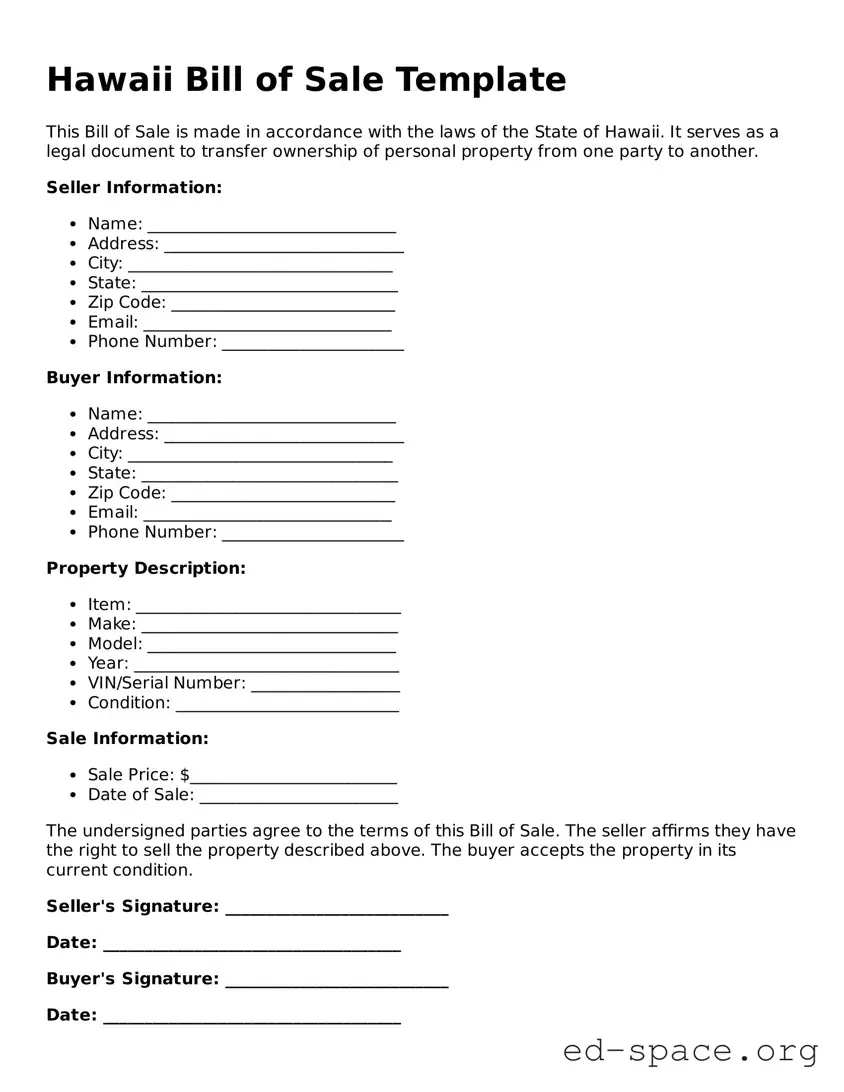
The Hawaii Bill of Sale form serves as a vital document in the process of transferring ownership of personal property, whether it be vehicles, boats, or other tangible items. This form not only provides a clear record of the transaction but also protects both the buyer and seller by outlining the terms of the sale. Key elements typically included in the form are the names and addresses of both parties, a detailed description of the item being sold, and the purchase price. Additionally, the Bill of Sale may include information regarding any warranties or guarantees associated with the item, as well as the date of the transaction. By ensuring that all relevant details are documented, this form helps to mitigate potential disputes and fosters transparency in the sale process. Understanding the importance of this document can empower individuals to navigate the complexities of property transactions in Hawaii with confidence.
Hawaii Bill of Sale Template
This Bill of Sale is made in accordance with the laws of the State of Hawaii. It serves as a legal document to transfer ownership of personal property from one party to another.
Seller Information:
Buyer Information:
Property Description:
Sale Information:
The undersigned parties agree to the terms of this Bill of Sale. The seller affirms they have the right to sell the property described above. The buyer accepts the property in its current condition.
Seller's Signature: ___________________________
Date: ____________________________________
Buyer's Signature: ___________________________
Date: ____________________________________
| Fact Name | Description |
|---|---|
| Purpose | The Hawaii Bill of Sale form serves as a legal document that records the transfer of ownership of personal property from one party to another. |
| Governing Laws | This form is governed by the Hawaii Revised Statutes, specifically under Title 1, Chapter 490, which pertains to the Uniform Commercial Code. |
| Requirements | The form must include the names and addresses of both the seller and buyer, a description of the property, and the purchase price. |
| Signatures | Both parties should sign the Bill of Sale to validate the transaction, although notarization is not required in Hawaii. |
Filling out the Hawaii Bill of Sale form is a straightforward process. Once completed, this document serves as a record of the transaction between the buyer and seller. It's important to ensure all details are accurate to avoid any potential disputes in the future.
What is a Hawaii Bill of Sale form?
A Hawaii Bill of Sale form is a legal document that serves as proof of the transfer of ownership of personal property from one party to another. It details the items being sold, the sale price, and the identities of both the buyer and the seller. This form is essential for transactions involving vehicles, boats, or other significant items to ensure that both parties have a record of the sale.
When do I need a Bill of Sale in Hawaii?
You need a Bill of Sale when you buy or sell personal property, especially vehicles or boats. In Hawaii, a Bill of Sale is often required for registering a vehicle with the Department of Motor Vehicles (DMV). It provides proof of ownership and can help protect both the buyer and seller in case of disputes.
What information should be included in a Bill of Sale?
A comprehensive Bill of Sale should include the names and addresses of both the buyer and seller, a description of the item being sold (including make, model, and VIN for vehicles), the sale price, and the date of the transaction. It’s also helpful to include any warranties or conditions of the sale to clarify the agreement.
Is a Bill of Sale legally binding in Hawaii?
Yes, a Bill of Sale is legally binding in Hawaii as long as it contains the necessary information and is signed by both parties. It acts as a contract that outlines the terms of the sale. While it does not need to be notarized, having a witness or a notary can add an extra layer of protection.
Can I create my own Bill of Sale, or do I need a specific form?
You can create your own Bill of Sale in Hawaii as long as it includes all the required information. However, using a template or specific form can simplify the process and ensure that you don’t miss any important details. Various online resources provide templates that you can customize for your transaction.
Failing to include the date of the transaction. This is crucial for establishing the timeline of ownership.
Not providing accurate buyer and seller information. Both parties should be clearly identified, including full names and addresses.
Omitting the description of the item being sold. This should include details such as make, model, year, and any identifying numbers.
Neglecting to indicate the purchase price. This is essential for both parties and for future reference.
Forgetting to include any conditions of sale. If there are specific terms or warranties, they should be clearly stated.
Not signing the form. Both the buyer and seller must provide their signatures to validate the document.
Using incorrect or outdated form versions. Always ensure that the most current form is being used to avoid issues.
Failing to keep a copy of the bill of sale. Each party should retain a copy for their records.
Not understanding local requirements. Different counties may have specific rules regarding the bill of sale, so it's important to check.
The Hawaii Bill of Sale is an important document used to transfer ownership of personal property from one party to another. However, several other forms and documents are often utilized alongside it to ensure a smooth transaction. Here are five commonly associated documents:
Utilizing these documents in conjunction with the Hawaii Bill of Sale can help facilitate a clear and legal transfer of ownership. It is advisable to ensure all forms are completed accurately to avoid any future complications.
A Bill of Sale form is a crucial document that serves to transfer ownership of personal property from one party to another. However, it shares similarities with several other documents that also facilitate ownership transfers or provide proof of transactions. Here are eight documents that are similar to a Bill of Sale:
Understanding these documents and their similarities can help individuals navigate the complexities of ownership transfers with confidence and clarity.
When filling out the Hawaii Bill of Sale form, it's important to follow certain guidelines to ensure the document is completed correctly. Here are some do's and don'ts to keep in mind:
When dealing with the Hawaii Bill of Sale form, several misconceptions can arise. Understanding the facts can help clarify its purpose and use. Here are eight common misconceptions:
Many people believe that a Bill of Sale is only needed for selling cars. In reality, this document can be used for various transactions, including boats, motorcycles, and personal property.
Some think that notarization is a requirement for a Bill of Sale. While notarization can add an extra layer of authenticity, it is not mandatory in Hawaii for the document to be legally binding.
Another misconception is that the Bill of Sale is only applicable for private transactions. Businesses can also use this document when selling goods or services.
Not every transaction needs a Bill of Sale. For example, gifts or trades may not require this document, although having one can still be beneficial for record-keeping.
Some individuals view the Bill of Sale as a complicated legal form. In truth, it is relatively straightforward and can be completed with basic information about the buyer, seller, and item being sold.
Many believe that the Bill of Sale primarily serves the seller's interests. However, it also protects the buyer by providing proof of purchase and the terms of the sale.
Some assume that a written contract eliminates the need for a Bill of Sale. While a contract can serve a similar purpose, the Bill of Sale specifically documents the transfer of ownership.
People often think that a Bill of Sale is final and cannot be modified. In fact, if both parties agree, they can create an amended version or add additional terms.
Understanding these misconceptions can help ensure that you use the Hawaii Bill of Sale form correctly and effectively for your transactions.
Filling out and using the Hawaii Bill of Sale form is an important process for transferring ownership of personal property. Here are key takeaways to keep in mind: