When applying to graduate school, one critical component of your application is the recommendation letter. This letter serves as a testament to your abilities, character, and potential for success in advanced studies. The Graduate School Recommendation Letter form is designed to streamline this process, ensuring that your recommenders provide the necessary information to support your application. Typically, the form requests details about your academic performance, professional experiences, and personal qualities. It may also ask for specific examples that highlight your strengths. Additionally, it often includes a section for the recommender to rate your skills and attributes, giving admissions committees a clear snapshot of who you are as a candidate. Completing this form accurately and thoughtfully can significantly impact your chances of acceptance, making it essential for both you and your recommenders to understand its importance and requirements.
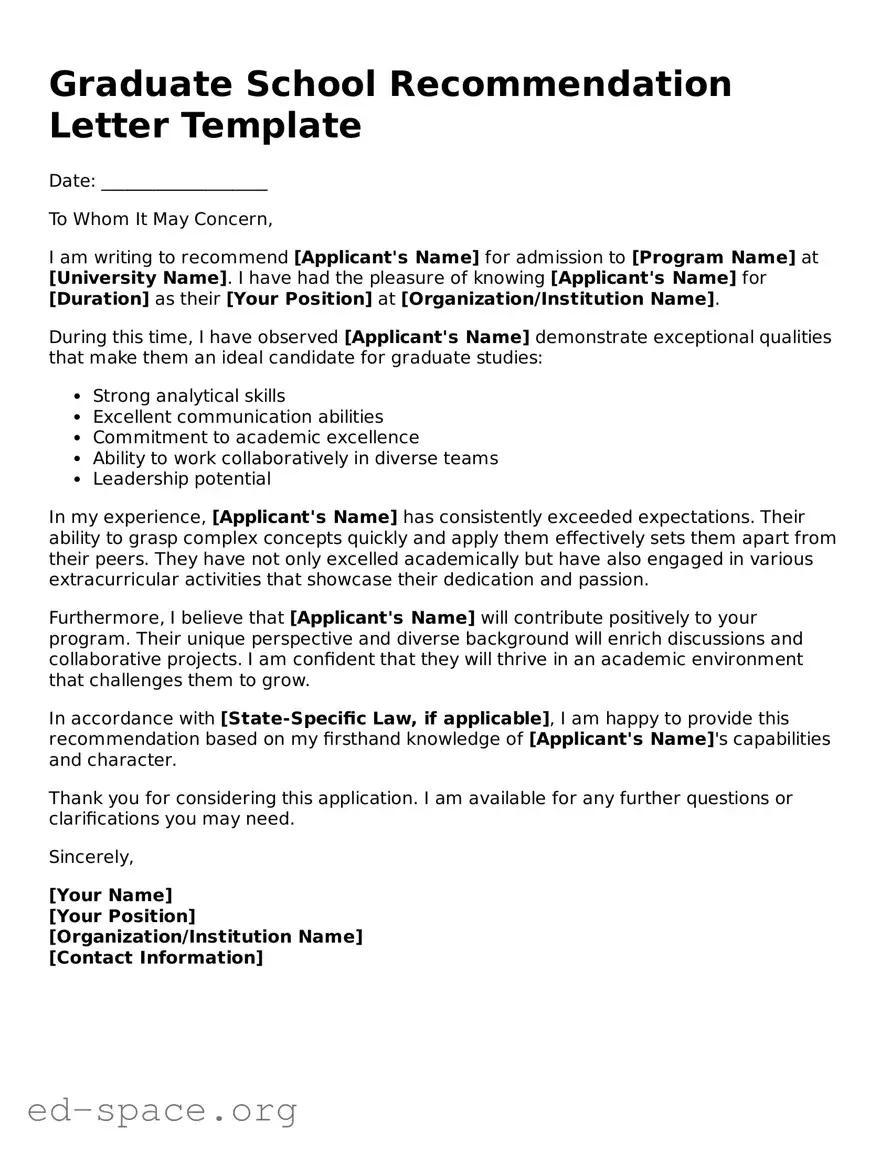
Graduate School Recommendation Letter Template
Date: ___________________
To Whom It May Concern,
I am writing to recommend [Applicant's Name] for admission to [Program Name] at [University Name]. I have had the pleasure of knowing [Applicant's Name] for [Duration] as their [Your Position] at [Organization/Institution Name].
During this time, I have observed [Applicant's Name] demonstrate exceptional qualities that make them an ideal candidate for graduate studies:
In my experience, [Applicant's Name] has consistently exceeded expectations. Their ability to grasp complex concepts quickly and apply them effectively sets them apart from their peers. They have not only excelled academically but have also engaged in various extracurricular activities that showcase their dedication and passion.
Furthermore, I believe that [Applicant's Name] will contribute positively to your program. Their unique perspective and diverse background will enrich discussions and collaborative projects. I am confident that they will thrive in an academic environment that challenges them to grow.
In accordance with [State-Specific Law, if applicable], I am happy to provide this recommendation based on my firsthand knowledge of [Applicant's Name]'s capabilities and character.
Thank you for considering this application. I am available for any further questions or clarifications you may need.
Sincerely,
[Your Name]
[Your Position]
[Organization/Institution Name]
[Contact Information]
| Fact Name | Description |
|---|---|
| Purpose | The Graduate School Recommendation Letter form is designed to gather insights about a candidate's qualifications and character from a recommender. |
| Recommender's Role | A recommender typically provides their perspective on the applicant's skills, experiences, and suitability for graduate studies. |
| Confidentiality | Many programs allow the recommendation to be submitted confidentially, ensuring honest feedback from the recommender. |
| Submission Process | Recommenders usually submit their letters online or via mail, depending on the school's requirements. |
| State-Specific Forms | Some states may have specific forms or requirements for graduate school recommendations, governed by local education regulations. |
| Content Guidelines | Recommenders are often encouraged to include specific examples that demonstrate the applicant's abilities and achievements. |
| Deadline | Each graduate program has its own deadline for submission, which must be adhered to for the application to be considered complete. |
| Impact on Admission | A strong recommendation letter can significantly enhance an applicant's chances of admission to a graduate program. |
| Follow-Up | Applicants may follow up with their recommenders to ensure that letters are submitted on time, maintaining professionalism in the process. |
Once you have received the Graduate School Recommendation Letter form, you are ready to complete it. This form is crucial for your application process. Follow these steps carefully to ensure all necessary information is provided accurately.
After filling out the form, it will be submitted to the appropriate graduate school. Make sure to follow up with your recommender to confirm they have sent their letter on your behalf.
What is the purpose of the Graduate School Recommendation Letter form?
The Graduate School Recommendation Letter form is designed to collect insights and evaluations from individuals who can speak to a candidate's qualifications for graduate school. This form allows recommenders to provide structured feedback on the applicant's academic performance, character, and potential for success in a graduate program.
Who should I ask to write my recommendation letter?
It is advisable to choose individuals who are familiar with your academic or professional work. Ideally, recommenders should be professors, employers, or mentors who can provide specific examples of your skills and accomplishments. Select people who can articulate your strengths and potential for graduate study.
What information do recommenders need to provide?
Recommenders typically need to provide their contact information, their relationship to you, and an assessment of your abilities and experiences relevant to your desired program. They may also be asked to rate your skills in various areas, such as leadership, teamwork, and analytical thinking.
How should I approach my recommenders?
When approaching potential recommenders, it’s important to communicate your goals clearly. Explain why you are applying to graduate school and why you believe they would be a good fit to provide a recommendation. Give them ample time to prepare, and offer to provide any materials that might help, such as your resume or a statement of purpose.
What is the deadline for submitting the recommendation letter?
Deadlines for submitting recommendation letters vary by program. It is essential to check the specific requirements of each graduate program you are applying to. Generally, it is a good idea to remind your recommenders of the deadline a week or two in advance to ensure timely submission.
Can I see my recommendation letter before it is submitted?
Most graduate programs require that recommendation letters remain confidential to ensure candid feedback. You should discuss this with your recommenders beforehand. If you want to see the letter, you may need to ask them directly, but be aware that many prefer to keep their evaluations private.
What if my recommender is unable to complete the letter?
If a recommender is unable to complete the letter, it’s important to address the situation promptly. You can ask them if they would prefer to decline or if they need more time. If they cannot proceed, seek another recommender who can fulfill the requirement, ensuring you provide them with sufficient notice.
Is there a specific format for the recommendation letter?
While there may not be a strict format, most recommendation letters should include a formal greeting, an introduction of the recommender, a detailed assessment of the candidate, and a conclusion. Each program may have its own preferences, so it is wise to check the guidelines provided by the graduate school.
Failing to provide specific examples of the applicant's skills and achievements. Instead of general statements, detailed anecdotes can significantly strengthen a recommendation.
Not adhering to the submission guidelines. Each graduate program may have unique requirements regarding length, format, and content. Ignoring these can lead to a recommendation being disregarded.
Using overly formal or complex language. Clarity is essential. A recommendation should be accessible and convey genuine insights about the applicant.
Neglecting to proofread the letter. Typos and grammatical errors can detract from the credibility of the recommendation. Careful review is necessary to ensure professionalism.
Being overly vague or generic. A letter filled with clichés does not provide the admissions committee with meaningful information. Personalizing the recommendation is crucial.
Forgetting to include the recommender's contact information. This omission can prevent the admissions committee from reaching out for further clarification or questions.
Not considering the relationship with the applicant. It’s important to clearly outline how well the recommender knows the applicant and in what capacity.
Submitting the recommendation late. Timeliness is critical in the application process. Late submissions can negatively impact the applicant’s chances of acceptance.
When applying to graduate school, several documents are typically required alongside the Graduate School Recommendation Letter form. Each of these documents plays a crucial role in presenting a complete picture of the applicant's qualifications and potential. Below is a list of commonly used forms and documents.
Each of these documents complements the Graduate School Recommendation Letter, helping admissions committees make informed decisions. Together, they provide a comprehensive view of the applicant's qualifications and readiness for graduate study.
The Graduate School Recommendation Letter form is an important document used in the application process for graduate programs. Several other documents serve similar purposes in various contexts. Here are five documents that share similarities with the Graduate School Recommendation Letter form:
When completing a Graduate School Recommendation Letter form, it is essential to follow certain guidelines to ensure the process is smooth and effective. Here are six important dos and don’ts to consider:
By following these guidelines, you can contribute positively to the candidate's application and help them present their best self to the admissions committee.
When applying to graduate school, recommendation letters play a crucial role in your application. However, there are several misconceptions surrounding the Graduate School Recommendation Letter form that can lead to confusion. Here are eight common misunderstandings:
This is not true. While academic references are valuable, you can also include supervisors or professionals who know your work ethic and skills well.
While academic achievements are important, letters should also highlight your personal qualities, leadership skills, and other relevant experiences.
It's better for letters to focus on your strengths. Recommenders can mention areas for growth but should primarily emphasize your positive attributes.
Different programs may value different aspects of your background. Tailoring your letters to each program can strengthen your application.
While it’s great to have well-known recommenders, it’s more important that they know you well and can provide a detailed and personalized letter.
In fact, they can be a deciding factor in the admissions process. A strong letter can significantly enhance your application.
Most programs have specific deadlines. Make sure your recommenders are aware of these dates to avoid any last-minute issues.
It’s perfectly acceptable to reach out to former professors or employers. Just provide them with context about your current goals and why you’re seeking their support.
Understanding these misconceptions can help you navigate the recommendation letter process more effectively. Choose your recommenders wisely, and make sure they can provide a compelling endorsement of your abilities and character.
When preparing to fill out and use the Graduate School Recommendation Letter form, consider the following key takeaways: