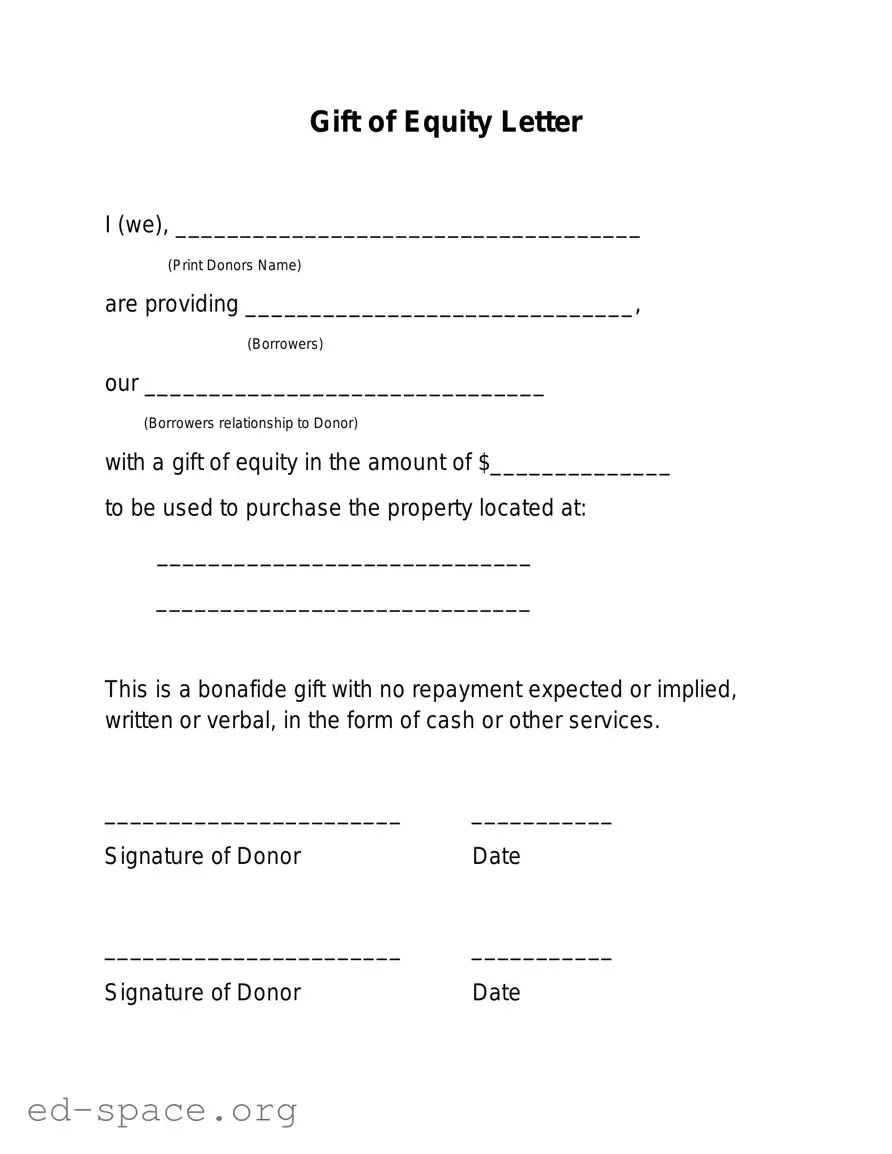
When navigating the complexities of real estate transactions, understanding the nuances of financing options can be crucial. One such option is the Gift of Equity Letter, a valuable document that facilitates the transfer of equity from a property owner to a buyer, often a family member or close friend. This letter serves as a formal declaration of a gift, specifying the amount of equity being transferred and the relationship between the donor and the recipient. The document typically includes essential details such as the names of the parties involved, the relationship of the borrower to the donor, and the specific property address. Importantly, the letter emphasizes that this is a genuine gift, meaning that the donor does not expect any repayment, whether in cash or through services. By clearly outlining these terms, the Gift of Equity Letter not only protects the interests of both parties but also helps streamline the home buying process, making it an essential component in many real estate transactions.
Gift of Equity Letter
I (we), ____________________________________
(Print Donors Name)
are providing ______________________________,
(Borrowers)
our _______________________________
(Borrowers relationship to Donor)
with a gift of equity in the amount of $______________
to be used to purchase the property located at:
_____________________________
_____________________________
This is a bonafide gift with no repayment expected or implied, written or verbal, in the form of cash or other services.
_______________________ |
___________ |
Signature of Donor |
Date |
_______________________ |
___________ |
Signature of Donor |
Date |
| Fact Name | Description |
|---|---|
| Purpose | The Gift of Equity Letter is used to document a gift of equity from a donor to a borrower for property purchase. |
| Donor Information | The form requires the donor's name to be printed clearly for identification. |
| Borrower Details | It includes the borrower's name and their relationship to the donor, establishing the context of the gift. |
| Gift Amount | The form specifies the amount of equity being gifted, which is crucial for financial documentation. |
| Property Location | The address of the property being purchased with the gifted equity must be included. |
| Nature of Gift | The letter confirms that the gift is genuine, with no expectation of repayment, either in cash or services. |
| Signatures Required | Both donors must sign and date the document, providing legal acknowledgment of the gift. |
| State-Specific Forms | Some states may have specific requirements for the Gift of Equity Letter; check local laws for compliance. |
| Governing Law | In California, for example, the California Civil Code governs gift transactions. |
| Use in Financing | Lenders often require a Gift of Equity Letter as part of the mortgage application process to verify the source of funds. |
Completing the Gift of Equity Letter form is a straightforward process that requires accurate information about both the donor and the borrower. After filling out the form, it serves as a formal declaration of the gift, ensuring clarity in the transaction.
What is a Gift of Equity Letter?
A Gift of Equity Letter is a document that formalizes the transfer of equity from one party to another, typically from a family member or friend to a borrower. This letter indicates that the donor is providing a financial gift that can be applied towards the purchase of real estate. Importantly, it clarifies that the gift does not need to be repaid, thus easing the financial burden on the borrower.
Who typically uses a Gift of Equity Letter?
Gift of Equity Letters are commonly used in family transactions, where a parent might assist a child in purchasing a home. However, they can also be utilized among close friends or relatives. The key factor is the relationship between the donor and the borrower, which helps to establish the legitimacy of the gift.
What information is required in a Gift of Equity Letter?
The letter should include the names of both the donor and the borrower, the relationship between them, the amount of the gift, and the specific property being purchased. Additionally, the letter must contain the signatures of the donors and the date to validate the transaction. This clarity helps prevent misunderstandings later on.
Is a Gift of Equity Letter legally binding?
While the Gift of Equity Letter serves as a formal acknowledgment of the gift, it is not a legally binding contract in the traditional sense. It does, however, provide essential documentation that can be used in real estate transactions and may be required by lenders to verify the source of funds.
Do I need to file the Gift of Equity Letter with any government agency?
Generally, there is no need to file the Gift of Equity Letter with a government agency. However, it is advisable to keep a copy for personal records. In some cases, lenders may require a copy as part of the mortgage application process, so having it readily available is beneficial.
Are there tax implications for the donor?
Yes, there can be tax implications for the donor. The IRS allows individuals to gift a certain amount each year without incurring gift tax. If the value of the equity exceeds this annual exclusion limit, the donor may need to file a gift tax return. Consulting a tax professional is wise to understand any potential tax consequences fully.
Can a Gift of Equity be used for down payment assistance?
Absolutely! A Gift of Equity can be applied toward the down payment on a home. Many lenders accept this type of gift as part of the borrower's equity contribution, which can significantly help first-time homebuyers or those with limited financial resources.
What happens if the borrower does not use the Gift of Equity?
If the borrower does not utilize the Gift of Equity as intended, it typically does not create any legal issues for the donor. However, it may lead to misunderstandings or strained relationships if expectations were set regarding the use of the funds. Clear communication between the parties involved is crucial to avoid such situations.
Failing to clearly print the donor's name in the designated space can lead to confusion about who is providing the gift.
Not specifying the borrower's name accurately may result in complications during the transaction process.
Omitting the relationship to the borrower can create misunderstandings regarding the nature of the gift.
Leaving the amount of the gift blank can delay the process, as the lender needs this information for their records.
Not providing the property address can hinder the ability to verify the details of the transaction.
Forgetting to include a signature can invalidate the letter, as it is essential for confirming the donor's intent.
Neglecting to date the letter can create issues, especially if the transaction takes place several months later.
Using ambiguous language regarding the gift's terms can lead to misunderstandings about whether repayment is expected.
The Gift of Equity Letter is often accompanied by several other important documents that help clarify the terms of the transaction and protect the interests of all parties involved. Below is a list of common forms and documents that are frequently used alongside the Gift of Equity Letter.
Having these documents prepared and organized can facilitate a smoother transaction process. Each document serves a specific purpose and contributes to the overall legality and clarity of the equity gift transaction.
The Gift of Equity Letter form is an important document in real estate transactions, particularly when family members are involved. Several other documents serve similar purposes in various contexts. Here are ten documents that share similarities with the Gift of Equity Letter:
When filling out the Gift of Equity Letter form, consider the following guidelines to ensure accuracy and clarity.
Understanding the Gift of Equity Letter form is essential for both donors and borrowers. However, several misconceptions can lead to confusion. Here are five common misunderstandings:
Being aware of these misconceptions can help you navigate the process more effectively and ensure a smoother transaction.
When filling out and using the Gift of Equity Letter form, keep these key takeaways in mind: