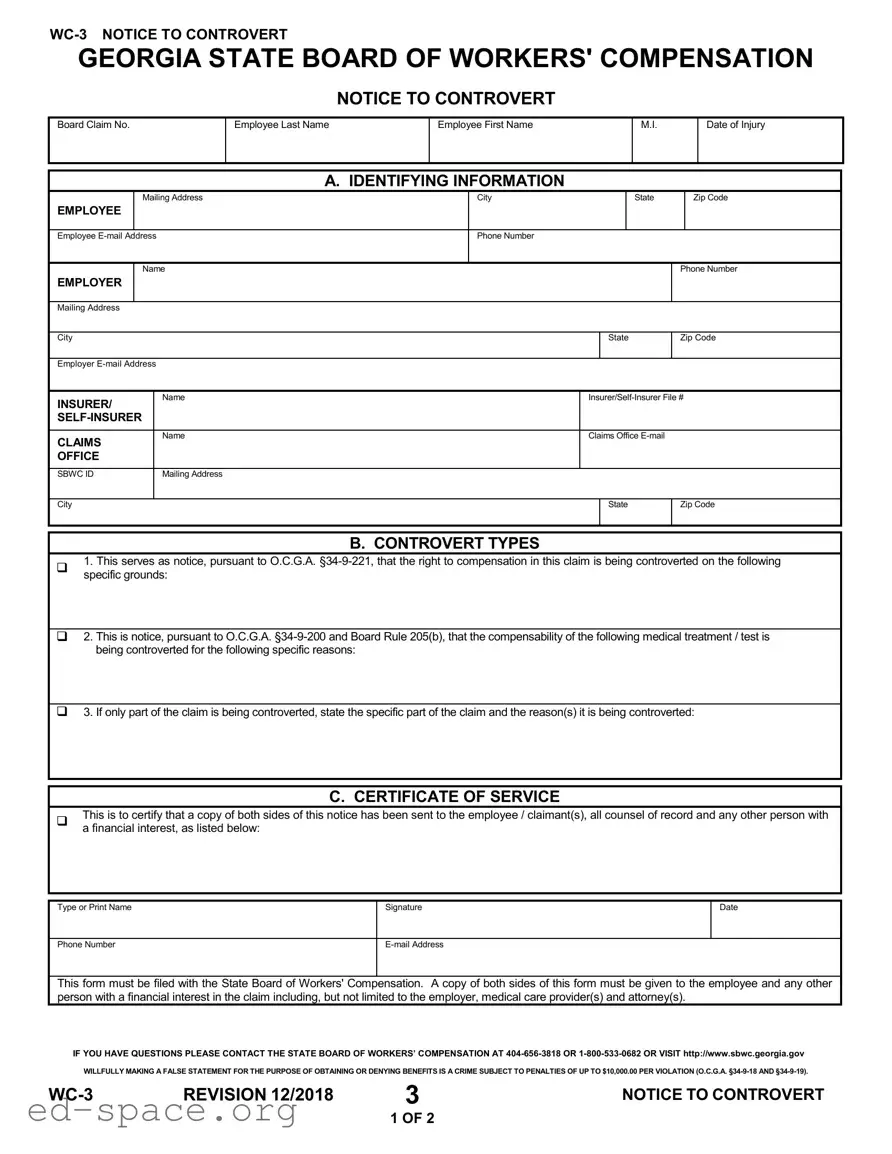
In the realm of workers' compensation in Georgia, the WC-3 form plays a crucial role in managing disputes over claims. This form, known as the "Notice to Controvert," is primarily used by employers or insurers to formally contest an employee's right to compensation following a workplace injury. It requires essential information such as the employee's details, the nature of the injury, and the specific reasons for disputing the claim. There are several grounds for controverting a claim, including questioning the compensability of medical treatments or asserting that the right to compensation is being challenged for particular reasons. Completing the WC-3 form accurately is vital; it must be filed with the Georgia State Board of Workers' Compensation within a specific timeframe to avoid penalties. Additionally, a copy of this notice must be provided to all parties involved, ensuring transparency and communication throughout the process. Understanding the nuances of the WC-3 form is essential for both employees and employers, as it can significantly impact the outcome of a claim.

GEORGIA STATE BOARD OF WORKERS' COMPENSATION
NOTICE TO CONTROVERT
Board Claim No.
Employee Last Name
Employee First Name
M.I.
Date of Injury
|
|
|
|
A. IDENTIFYING INFORMATION |
|
|
|
|
|
|
EMPLOYEE |
|
Mailing Address |
|
City |
|
|
State |
|
Zip Code |
|
|
|
|
|
|
|
|
|
|
|
|
|
|
|
|
|
|
|
|
|
|
|
Employee |
|
Phone Number |
|
|
|
|
|
|||
|
|
|
|
|
|
|
|
|
|
|
EMPLOYER |
|
Name |
|
|
|
|
|
Phone Number |
||
|
|
|
|
|
|
|
|
|
|
|
|
|
|
|
|
|
|
|
|
|
|
Mailing Address |
|
|
|
|
|
|
|
|
|
|
|
|
|
|
|
|
|
|
|||
City |
|
|
|
|
|
State |
Zip Code |
|||
|
|
|
|
|
|
|
|
|
||
Employer |
|
|
|
|
|
|
|
|||
|
|
|
|
|
|
|
||||
INSURER/ |
|
Name |
|
|
||||||
|
|
|
|
|
|
|
|
|
||
|
|
|
|
|
|
|
|
|
||
|
|
|
|
|
|
|
|
|
||
CLAIMS |
|
Name |
|
|
Claims Office |
|
|
|||
|
|
|
|
|
|
|
|
|
||
OFFICE |
|
|
|
|
|
|
|
|
|
|
|
|
|
|
|
|
|
|
|
|
|
SBWC ID |
|
Mailing Address |
|
|
|
|
|
|
|
|
|
|
|
|
|
|
|
|
|||
City |
|
|
|
|
|
State |
Zip Code |
|||
|
|
|
|
|
|
|
|
|
|
|
|
|
B. CONTROVERT TYPES |
|
1. This serves as notice, pursuant to O.C.G.A. |
|
|
specific grounds: |
|
|
|
|
|
2. |
This is notice, pursuant to O.C.G.A. |
|
|
being controverted for the following specific reasons: |
|
|
|
|
3. |
If only part of the claim is being controverted, state the specific part of the claim and the reason(s) it is being controverted: |
|
|
|
|
|
C. CERTIFICATE OF SERVICE |
|
|
|
|
This is to certify that a copy of both sides of this notice has been sent to the employee / claimant(s), all counsel of record and any other person with |
||||
|
a financial interest, as listed below: |
|
|
|
|
|
|
|
|
|
|
|
|
|
|
|
|
Type or Print Name |
|
Signature |
|
Date |
|
|
|
|
|
|
|
Phone Number |
|
|
|
||
|
|
||||
This form must be filed with the State Board of Workers' Compensation. A copy of both sides of this form must be given to the employee and any other |
|||||
person with a financial interest in the claim including, but not limited to the employer, medical care provider(s) and attorney(s). |
|||||
|
IF YOU HAVE QUESTIONS PLEASE CONTACT THE STATE BOARD OF WORKERS’ COMPENSATION AT |
||||
|
WILLFULLY MAKING A FALSE STATEMENT FOR THE PURPOSE OF OBTAINING OR DENYING BENEFITS IS A CRIME SUBJECT TO PENALTIES OF UP TO $10,000.00 PER VIOLATION (O.C.G.A. |
||||
REVISION 12/2018 |
3 |
NOTICE TO CONTROVERT |
|||
|
|
|
1 OF 2 |
|
|
NOTICE TO CONTROVERT |
GEORGIA STATE BOARD OF WORKERS' COMPENSATION
INFORMATION FOR THE
Board Rule 61(b)(1): An insurer who receives a Form
Board Rule 61(b)(4): previously been filed.
Form
O.C.G.A.
Board Rule 221(d): To controvert in whole or in part the right to income benefits or other compensation use Form
O.C.G.A.
Board Rule 221(h)(1): A Form
O.C.G.A.
Board Rule 221(h)(2): If income benefits have been continued for more than 60 days after the due date of first payment of compensation, benefits may be suspended only on the grounds of a change in condition or newly discovered evidence. File Forms
O.C.G.A.
INFORMATION FOR THE EMPLOYEE:
This claim is being controverted for the reason(s) indicated on the front of this form. If you disagree, you should request a hearing by sending Form
STATE BOARD OF WORKERS' COMPENSATION
270 Peachtree Street, N.W. Atlanta, Georgia
or:
http://www.sbwc.georgia.gov
IF YOU HAVE QUESTIONS PLEASE CONTACT THE STATE BOARD OF WORKERS’ COMPENSATION AT
WILLFULLY MAKING A FALSE STATEMENT FOR THE PURPOSE OF OBTAINING OR DENYING BENEFITS IS A CRIME SUBJECT TO PENALTIES OF UP TO $10,000.00 PER VIOLATION (O.C.G.A.
REVISION 12/2018 |
3 |
NOTICE TO CONTROVERT |
|
|
|
2 OF 2 |
|
| Fact Name | Details |
|---|---|
| Purpose of Form | The WC-3 form serves as a Notice to Controvert, informing the State Board of Workers' Compensation that an employer or insurer is disputing a worker's compensation claim. |
| Governing Laws | This form is governed by O.C.G.A. §34-9-221 and Board Rule 221, which outline the requirements for disputing compensation claims in Georgia. |
| Filing Deadline | The form must be filed within 21 days of the employer's knowledge of the injury or death to avoid penalties, as specified in O.C.G.A. §34-9-221(d). |
| Certificate of Service | Section C of the form includes a Certificate of Service, confirming that copies of the notice have been sent to all relevant parties. |
| Consequences of False Statements | Providing false information on the form can lead to penalties of up to $10,000, as per O.C.G.A. §34-9-18 and §34-9-19. |
| Employee Rights | If a claim is controverted, the employee has the right to request a hearing by submitting Form WC-14 to the State Board. |
Completing the Georgia WC-3 form is a crucial step in the process of formally disputing a workers' compensation claim. Follow these instructions carefully to ensure all necessary information is provided accurately.
Once completed, submit the form to the State Board of Workers' Compensation. Ensure that copies are provided to the employee and any other parties with a financial interest in the claim. If you have questions, reach out to the State Board for assistance.
What is the purpose of the Georgia WC-3 form?
The Georgia WC-3 form, also known as the Notice to Controvert, serves as an official document to notify the State Board of Workers' Compensation that an employer or insurer is disputing a worker's compensation claim. This form outlines the specific grounds for the controversion, which may include disputes over the right to compensation or the compensability of medical treatment.
Who is required to file the WC-3 form?
The employer or insurer must file the WC-3 form. This requirement arises when they wish to contest a claim for workers' compensation benefits. The form must be submitted to the State Board of Workers' Compensation within 21 days after the employer becomes aware of the injury or disability.
What information is needed to complete the WC-3 form?
To complete the WC-3 form, the filer must provide identifying information about the employee, such as their name, address, and date of injury. Additionally, details about the employer and insurer must be included. The specific grounds for the controversion should also be clearly stated in the form.
What are the consequences of failing to file the WC-3 form on time?
If the WC-3 form is not filed within the required 21-day period, the employer or insurer may face penalties, including the potential assessment of attorney's fees. This can occur if a claimant engages legal representation to enforce their rights under the workers' compensation laws and prevails in their case.
Can the WC-3 form be used to suspend benefits?
The WC-3 form cannot be used to suspend benefits if the only issue in question is the length of disability. Instead, in such cases, a different form, the WC-2, should be filed. However, if the employer or insurer wishes to controvert a claim based on newly discovered evidence or a change in condition, the WC-3 form may be applicable.
What should an employee do if they disagree with the controversion?
If an employee disagrees with the reasons stated in the WC-3 form for the controversion of their claim, they have the right to request a hearing. This can be done by submitting a Form WC-14 to the State Board of Workers' Compensation. The employee may contact the Board for assistance in obtaining this form or for further guidance.
What are the penalties for making false statements on the WC-3 form?
Willfully making false statements on the WC-3 form in order to obtain or deny benefits is considered a crime. Penalties can include fines of up to $10,000 for each violation, as stipulated by Georgia law. It is crucial for all parties involved to provide accurate and truthful information when filing this form.
Filling out the Georgia WC-3 form can be complex. Here are nine common mistakes to avoid:
Ensure all sections, including employee and employer details, are fully filled out. Missing information can delay processing.
Double-check the claim number for accuracy. An incorrect number can lead to confusion and misdirection of your form.
Clearly state the specific grounds for controversion. Vague reasons may lead to rejection of the form.
All necessary parties must sign the form. Missing signatures can invalidate the submission.
It’s crucial to certify that copies were sent to all relevant parties. Failure to do so may result in penalties.
Submit the form within the required timeframe. Late submissions can lead to penalties or loss of rights.
Always use the most current version of the WC-3 form. Outdated forms may not be accepted.
Follow the instructions provided on the form carefully. Ignoring them can result in incomplete submissions.
Ensure that all contact information is accurate and up-to-date. Incorrect details can hinder communication.
By avoiding these mistakes, you can help ensure that your Georgia WC-3 form is processed smoothly and efficiently.
The Georgia WC-3 form is an essential document used in workers' compensation cases to formally dispute a claim. Along with the WC-3, there are several other forms that are commonly utilized in the process. Here’s a brief overview of five important documents that may accompany the WC-3 form.
Understanding these forms and their purposes can help ensure that all parties involved in a workers' compensation claim are properly informed and that the process runs smoothly. Each document plays a critical role in the overall claims process.
The Georgia WC-3 form, known as the Notice to Controvert, serves a specific purpose in the workers' compensation process. It allows employers or insurers to formally dispute a claim for benefits. Several other documents share similarities with the WC-3 form in terms of their function and the context in which they are used. Here are five such documents:
When filling out the Georgia WC-3 form, there are several important considerations to keep in mind. Here is a list of things you should and shouldn't do to ensure the process goes smoothly.
By following these guidelines, you can navigate the process more effectively and reduce the likelihood of issues arising. If you have any questions or need assistance, don't hesitate to reach out to the State Board of Workers' Compensation.
Misconceptions about the Georgia WC-3 form can lead to confusion for both employees and employers. Understanding the facts is essential for navigating the workers' compensation process. Below are seven common misconceptions:
Addressing these misconceptions can help both employees and employers better navigate the complexities of workers' compensation in Georgia.
When dealing with the Georgia WC-3 form, it is essential to understand its purpose and requirements. Here are some key takeaways that can help you navigate the process effectively:
By keeping these points in mind, you can ensure that you fill out and use the WC-3 form correctly, thus protecting your rights and responsibilities within the workers' compensation system.