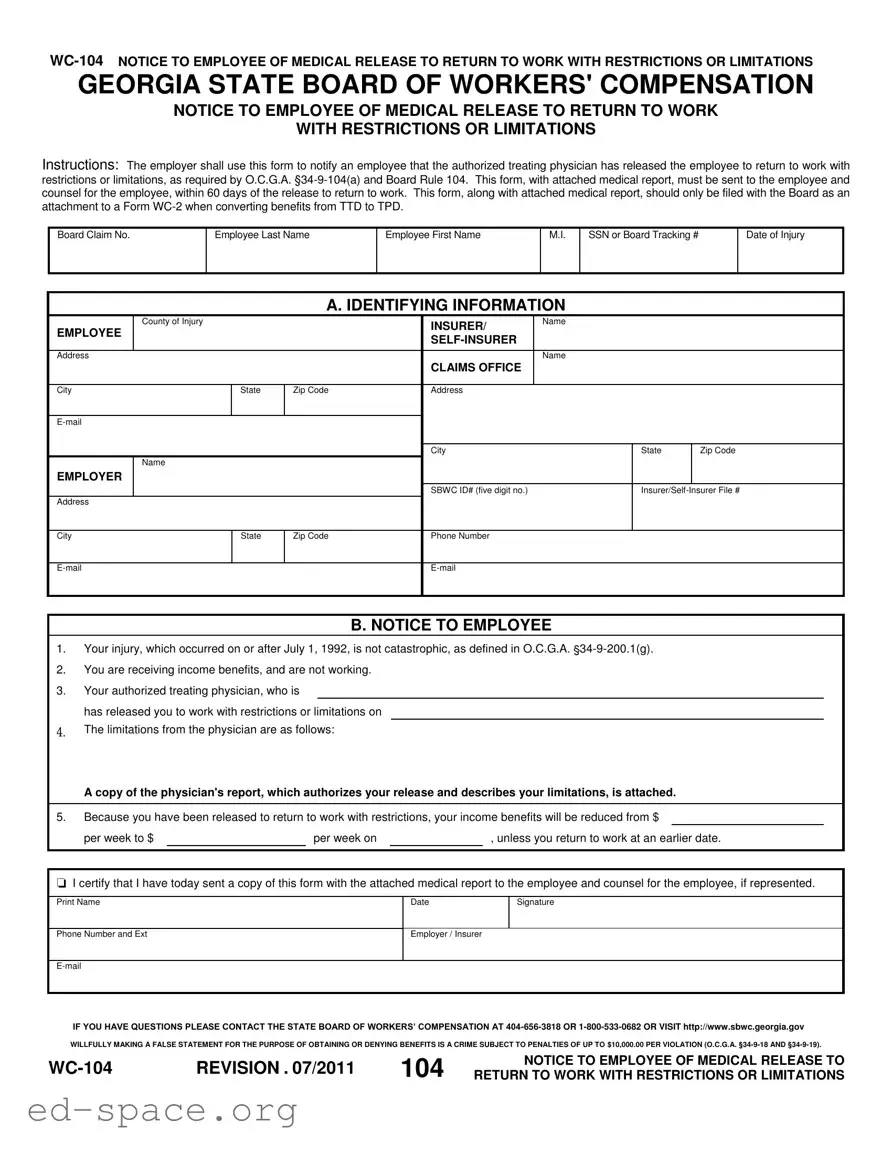
When navigating the complexities of workplace injuries in Georgia, understanding the WC-104 form is essential for both employees and employers. This form serves as a crucial communication tool, notifying employees that their authorized treating physician has cleared them to return to work, albeit with specific restrictions or limitations. It’s not just a formality; it is a legally required document under Georgia law, specifically O.C.G.A. §34-9-104(a) and Board Rule 104. Employers must send this notice, along with the attached medical report, to the employee and their counsel within 60 days of the release. The WC-104 form includes vital information such as the employee's injury details, the physician's limitations, and the implications for income benefits. For instance, if an employee is released to work with restrictions, their income benefits may be adjusted accordingly. This form ensures that everyone involved is on the same page, fostering a smoother transition back to work while prioritizing the employee's health and safety. Understanding how to properly complete and utilize the WC-104 is key to maintaining compliance and supporting injured workers in their recovery process.
GEORGIA STATE BOARD OF WORKERS' COMPENSATION
NOTICE TO EMPLOYEE OF MEDICAL RELEASE TO RETURN TO WORK
WITH RESTRICTIONS OR LIMITATIONS
Instructions: The employer shall use this form to notify an employee that the authorized treating physician has released the employee to return to work with restrictions or limitations, as required by O.C.G.A.
Board Claim No.
Employee Last Name
Employee First Name
M.I.
SSN or Board Tracking #
Date of Injury
|
|
|
A. IDENTIFYING INFORMATION |
|
|
||
|
County of Injury |
|
|
INSURER/ |
Name |
|
|
EMPLOYEE |
|
|
|
|
|
|
|
|
|
|
|
|
|
||
|
|
|
|
|
|
|
|
|
|
|
|
|
|
|
|
Address |
|
|
|
Name |
|
|
|
|
|
|
|
CLAIMS OFFICE |
|
|
|
|
|
|
|
|
|
|
|
City |
State |
Zip Code |
Address |
|
|
|
|
|
|
|
|
|
|
|
|
|
|
|
|
|
|
||
|
|
|
|
|
|
|
|
|
|
|
|
City |
|
State |
Zip Code |
|
Name |
|
|
|
|
|
|
EMPLOYER |
|
|
|
|
|
|
|
|
|
|
|
SBWC ID# (five digit no.) |
|
||
Address |
|
|
|
|
|
|
|
|
|
|
|
|
|
|
|
City |
State |
Zip Code |
Phone Number |
|
|
|
|
|
|
|
|
|
|
|
|
|
|
|
|
|
|||
|
|
|
|
|
|
|
|
|
|
|
|
|
|
|
|
B. NOTICE TO EMPLOYEE
1.Your injury, which occurred on or after July 1, 1992, is not catastrophic, as defined in O.C.G.A.
2.You are receiving income benefits, and are not working.
3.Your authorized treating physician, who is
has released you to work with restrictions or limitations on
4.The limitations from the physician are as follows:
A copy of the physician's report, which authorizes your release and describes your limitations, is attached.
5.Because you have been released to return to work with restrictions, your income benefits will be reduced from $
|
per week to $ |
|
per week on |
|
, unless you return to work at an earlier date. |
|
I certify that I have today sent a copy of this form with the attached medical report to the employee and counsel for the employee, if represented.
Print Name
Date
Signature
Phone Number and Ext
Employer / Insurer
IF YOU HAVE QUESTIONS PLEASE CONTACT THE STATE BOARD OF WORKERS’ COMPENSATION AT
WILLFULLY MAKING A FALSE STATEMENT FOR THE PURPOSE OF OBTAINING OR DENYING BENEFITS IS A CRIME SUBJECT TO PENALTIES OF UP TO $10,000.00 PER VIOLATION (O.C.G.A.
REVISION . 07/2011 |
104 |
NOTICE TO EMPLOYEE OF MEDICAL RELEASE TO |
|
RETURN TO WORK WITH RESTRICTIONS OR LIMITATIONS |
| Fact Name | Fact Description |
|---|---|
| Purpose | The WC-104 form is used to notify employees of their medical release to return to work with restrictions or limitations. |
| Governing Law | This form is governed by O.C.G.A. §34-9-104(a) and Board Rule 104. |
| Submission Timeline | Employers must send this form to the employee and their counsel within 60 days of the medical release. |
| Attachment Requirement | The WC-104 must be submitted with an attached medical report when converting benefits from TTD to TPD. |
| Income Benefits Impact | Employees' income benefits will be reduced if they are released to work with restrictions. |
| Catastrophic Injury Definition | The form states that the injury is not considered catastrophic as defined in O.C.G.A. §34-9-200.1(g). |
| Contact Information | For questions, employees can contact the State Board of Workers’ Compensation at 404-656-3818 or 1-800-533-0682. |
| False Statements Penalty | Willfully making false statements for obtaining or denying benefits is a crime, with penalties up to $10,000 per violation (O.C.G.A. §34-9-18 and §34-9-19). |
Completing the Georgia WC-104 form is essential for notifying an employee of their medical release to return to work with restrictions or limitations. After filling out this form, it must be sent to the employee and their legal counsel within 60 days of the physician's release. This ensures compliance with state regulations and helps facilitate the employee's transition back to work.
After completing these steps, review the form for accuracy. Ensure that all required attachments are included before sending it to the employee and their legal counsel. This will help ensure compliance with the Georgia State Board of Workers' Compensation requirements.
What is the Georgia WC-104 form?
The Georgia WC-104 form is a notice that employers use to inform employees about their medical release to return to work, but with certain restrictions or limitations. This form is a crucial part of the workers' compensation process in Georgia and ensures that employees are aware of their rights and responsibilities after an injury.
Who is required to send the WC-104 form?
The employer is responsible for sending the WC-104 form to the employee. This notification must include the medical report from the authorized treating physician who has determined that the employee can return to work, albeit with specific restrictions or limitations.
When must the WC-104 form be sent?
The WC-104 form, along with the attached medical report, must be sent to the employee and their legal counsel within 60 days of the physician’s release to return to work. Timely notification is essential to ensure compliance with Georgia's workers' compensation laws.
What information is included in the WC-104 form?
The WC-104 form includes identifying information such as the employee's name, Social Security number, and details about the injury. It also outlines the restrictions or limitations set by the physician and informs the employee about any changes to their income benefits as a result of their return to work.
What happens if an employee does not return to work?
If an employee does not return to work, their income benefits may be reduced based on the restrictions provided by the physician. The form specifies the new benefit amount and the effective date of this change. Employees should be aware of these implications to make informed decisions about their return to work.
What should an employee do if they have questions about the WC-104 form?
If an employee has questions regarding the WC-104 form or their workers' compensation case, they should contact the State Board of Workers' Compensation. They can reach out at 404-656-3818 or 1-800-533-0682 for assistance. Additionally, more information is available on their website.
What are the consequences of providing false information on the WC-104 form?
Providing false information on the WC-104 form is a serious matter. It is considered a crime and can result in penalties of up to $10,000 per violation. This emphasizes the importance of honesty and accuracy when filling out the form and during the entire workers' compensation process.
Incomplete Information: Failing to provide all required identifying details can lead to delays. Ensure that the employee's name, Social Security Number, and claim number are fully and accurately filled out.
Missing Attachments: Not including the physician's report is a common oversight. This report is crucial as it details the restrictions or limitations placed on the employee's ability to work.
Incorrect Dates: Entering the wrong date of injury or the date of the medical release can cause confusion. Double-check these dates to ensure they align with the official records.
Failure to Notify: Neglecting to send the form to both the employee and their legal counsel can lead to complications. It is essential to follow the notification requirements outlined in the instructions.
Not Updating Income Benefits: Forgetting to update the income benefits amount can result in incorrect payments. Clearly state the new weekly benefit amount and the effective date of the change.
When navigating the workers' compensation process in Georgia, several forms and documents complement the Georgia WC-104 form. Understanding these documents can help streamline communication between employers, employees, and medical professionals.
Familiarity with these forms can enhance the experience of managing workers' compensation claims in Georgia. Each document plays a vital role in ensuring that both employees and employers adhere to the necessary legal requirements and facilitate a smoother claims process.
The Georgia WC-104 form serves a specific purpose in the workers' compensation process, particularly regarding an employee's return to work with certain restrictions. Several other documents share similar functions or processes within the realm of workers' compensation and employee health management. Below are five documents that are comparable to the WC-104 form, each serving a unique yet related role.
When filling out the Georgia WC-104 form, it is essential to follow specific guidelines to ensure accuracy and compliance. Here are nine things to do and avoid:
Understanding the Georgia WC 104 form is crucial for both employees and employers involved in workers' compensation cases. However, several misconceptions often arise regarding this document. Here are five common misunderstandings:
By clarifying these misconceptions, both employees and employers can navigate the workers' compensation process more effectively and ensure that rights and responsibilities are understood.
When dealing with the Georgia WC-104 form, there are several important points to keep in mind:
Understanding these key aspects will help ensure compliance and facilitate a smoother transition back to work for employees with restrictions.