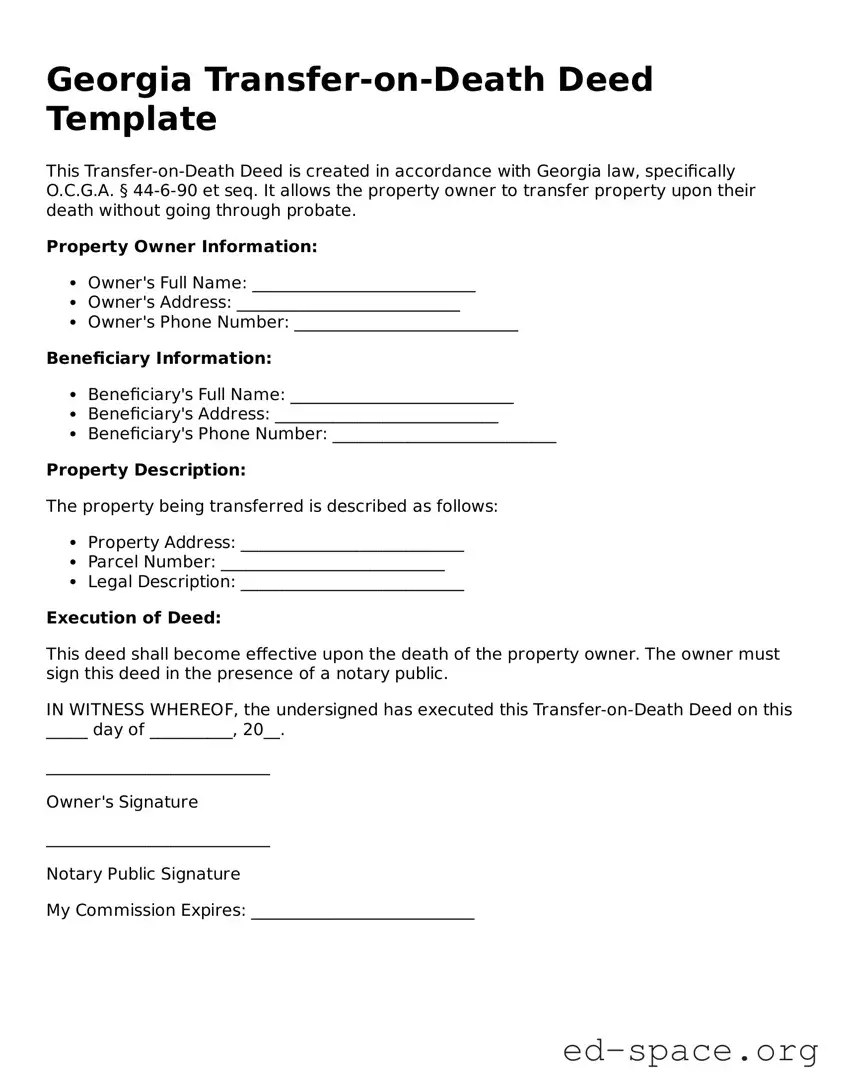
The Georgia Transfer-on-Death Deed form serves as a valuable estate planning tool, allowing property owners to designate beneficiaries who will receive their real estate upon their passing. This form simplifies the transfer process, bypassing the often lengthy and costly probate procedures. By completing the deed, property owners can ensure that their chosen beneficiaries inherit the property directly, providing clarity and reducing potential disputes among heirs. The form requires specific information, including the names of the property owner and the designated beneficiaries, as well as a legal description of the property involved. Importantly, the deed must be executed in accordance with state laws, including notarization and recording with the county clerk, to be effective. Understanding the nuances of this form can empower individuals to make informed decisions about their estate and help secure their legacy for future generations.
Georgia Transfer-on-Death Deed Template
This Transfer-on-Death Deed is created in accordance with Georgia law, specifically O.C.G.A. § 44-6-90 et seq. It allows the property owner to transfer property upon their death without going through probate.
Property Owner Information:
Beneficiary Information:
Property Description:
The property being transferred is described as follows:
Execution of Deed:
This deed shall become effective upon the death of the property owner. The owner must sign this deed in the presence of a notary public.
IN WITNESS WHEREOF, the undersigned has executed this Transfer-on-Death Deed on this _____ day of __________, 20__.
___________________________
Owner's Signature
___________________________
Notary Public Signature
My Commission Expires: ___________________________
| Fact Name | Details |
|---|---|
| Definition | The Georgia Transfer-on-Death Deed allows property owners to transfer real estate to a designated beneficiary upon their death, avoiding probate. |
| Governing Law | This deed is governed by the Official Code of Georgia Annotated, specifically O.C.G.A. § 44-6-15. |
| Eligibility | Any individual who holds title to real property in Georgia may create a Transfer-on-Death Deed. |
| Revocation | The property owner can revoke the deed at any time before their death by executing a new deed or a written revocation. |
| Beneficiary Rights | Beneficiaries do not have any rights to the property until the owner's death, ensuring that the owner retains full control during their lifetime. |
| Filing Requirements | The deed must be recorded in the county where the property is located to be effective, and it should be done within five years of execution. |
Completing the Georgia Transfer-on-Death Deed form is a straightforward process that allows individuals to designate beneficiaries for real property. After filling out the form, it must be properly executed and recorded to ensure its validity and effectiveness.
What is a Transfer-on-Death Deed in Georgia?
A Transfer-on-Death Deed (TOD) in Georgia is a legal document that allows an individual to transfer real estate property to a designated beneficiary upon their death. This deed enables property owners to avoid probate, as the property will pass directly to the beneficiary without the need for court intervention. The TOD deed must be properly executed and recorded with the county to be effective.
Who can be a beneficiary on a Transfer-on-Death Deed?
In Georgia, any individual, corporation, or trust can be named as a beneficiary on a Transfer-on-Death Deed. However, it is important to ensure that the beneficiary is clearly identified in the deed. Multiple beneficiaries can be designated, and the property can be divided among them as specified by the property owner.
How do I create a Transfer-on-Death Deed?
To create a Transfer-on-Death Deed in Georgia, the property owner must complete the deed form, which includes essential information such as the property description and the beneficiary's details. The form must be signed by the property owner in the presence of a notary public. Once completed, the deed must be filed with the appropriate county clerk's office to be valid.
Can I revoke or change a Transfer-on-Death Deed?
Yes, a Transfer-on-Death Deed can be revoked or changed at any time before the property owner’s death. To revoke the deed, the property owner must execute a new deed that explicitly states the revocation or create a new TOD deed that names different beneficiaries. It is recommended to record any changes with the county to maintain clear public records.
What happens to the property if there are multiple beneficiaries?
If a Transfer-on-Death Deed names multiple beneficiaries, the property will be divided among them according to the terms specified in the deed. If no specific terms are mentioned, the property will typically be shared equally. Beneficiaries should be aware of their rights and responsibilities regarding the property to avoid any disputes after the property owner's death.
Not including the correct legal description of the property. This is crucial for ensuring that the deed is valid and accurately reflects the property being transferred.
Failing to sign the deed in front of a notary public. A signature without notarization may render the deed ineffective.
Omitting the names of the beneficiaries. Without clearly identifying who will receive the property, the deed may not serve its intended purpose.
Using outdated forms. Always ensure that the form you are using is the most current version to avoid any legal issues.
Not checking for any existing liens or encumbrances on the property. These can affect the transfer and should be addressed prior to completing the deed.
Failing to record the deed with the appropriate county office. Recording is necessary for the deed to be legally recognized.
Inaccurate or incomplete information about the grantor. This includes not providing full legal names or using nicknames, which can lead to confusion.
Not understanding the implications of the Transfer-on-Death Deed. It is important to recognize how this deed affects estate planning and potential tax implications.
Neglecting to inform beneficiaries about the deed. Beneficiaries should be aware that they are named in the deed to avoid surprises later.
Failing to review the deed for errors before submission. Simple mistakes can lead to complications that may delay the transfer process.
When dealing with property transfers in Georgia, particularly through a Transfer-on-Death Deed, several other forms and documents may be necessary to ensure a smooth process. These documents help clarify intentions, establish legal standing, and provide necessary information for all parties involved. Below are five important forms that are often used in conjunction with the Georgia Transfer-on-Death Deed.
Understanding these forms can significantly ease the process of transferring property upon death. Each document plays a unique role, helping to clarify intentions and streamline the legal procedures involved in estate management. It is always advisable to consult with a legal expert to ensure compliance with all applicable laws and to address any specific circumstances that may arise.
The Transfer-on-Death Deed (TODD) allows property owners to transfer their real estate to beneficiaries upon their death without going through probate. Several other documents serve similar purposes in estate planning and property transfer. Below is a list of eight documents that share similarities with the Transfer-on-Death Deed:
When filling out the Georgia Transfer-on-Death Deed form, it is essential to be thorough and accurate. Here are some important dos and don'ts to keep in mind:
By following these guidelines, you can help ensure that the process goes smoothly and that your intentions are clearly expressed in the deed.
Understanding the Georgia Transfer-on-Death Deed can be tricky, and several misconceptions often arise. Here’s a look at seven common misunderstandings about this important legal document:
Many people believe that once a Transfer-on-Death Deed is signed, the property automatically transfers to the beneficiary upon the owner's death. In reality, the deed only takes effect after the owner's passing, and the property remains in the owner's name until then.
This is not true. The Transfer-on-Death Deed can only be used for real estate, not for personal property or financial accounts. It’s essential to know what can and cannot be included.
Some people think that having a Transfer-on-Death Deed means they don’t need a will. While it can simplify the transfer of specific properties, a will is still necessary to address other assets and personal wishes.
This is a common misconception. Once the owner passes away, the designated beneficiaries cannot change the terms of the Transfer-on-Death Deed. It is set in stone at the time of the owner's death.
One of the primary advantages of a Transfer-on-Death Deed is that it allows for the transfer of property without going through the probate process. This means that beneficiaries can avoid the time and expense typically associated with probate.
While a Transfer-on-Death Deed can be revoked, it must be done in a specific manner according to Georgia law. Simply deciding to change your mind isn't enough; proper procedures must be followed.
Another misconception is that only individuals can be named as beneficiaries. In fact, entities such as trusts or organizations can also be designated as beneficiaries under a Transfer-on-Death Deed.
By understanding these misconceptions, individuals can make more informed decisions about their estate planning and the use of a Transfer-on-Death Deed in Georgia.
Filling out and utilizing the Georgia Transfer-on-Death Deed form can be a straightforward process, but it is essential to understand its nuances. Here are some key takeaways to consider:
Understanding these aspects can greatly enhance the effectiveness of using the Transfer-on-Death Deed form in Georgia, ensuring a smoother transition of property to your chosen beneficiaries.