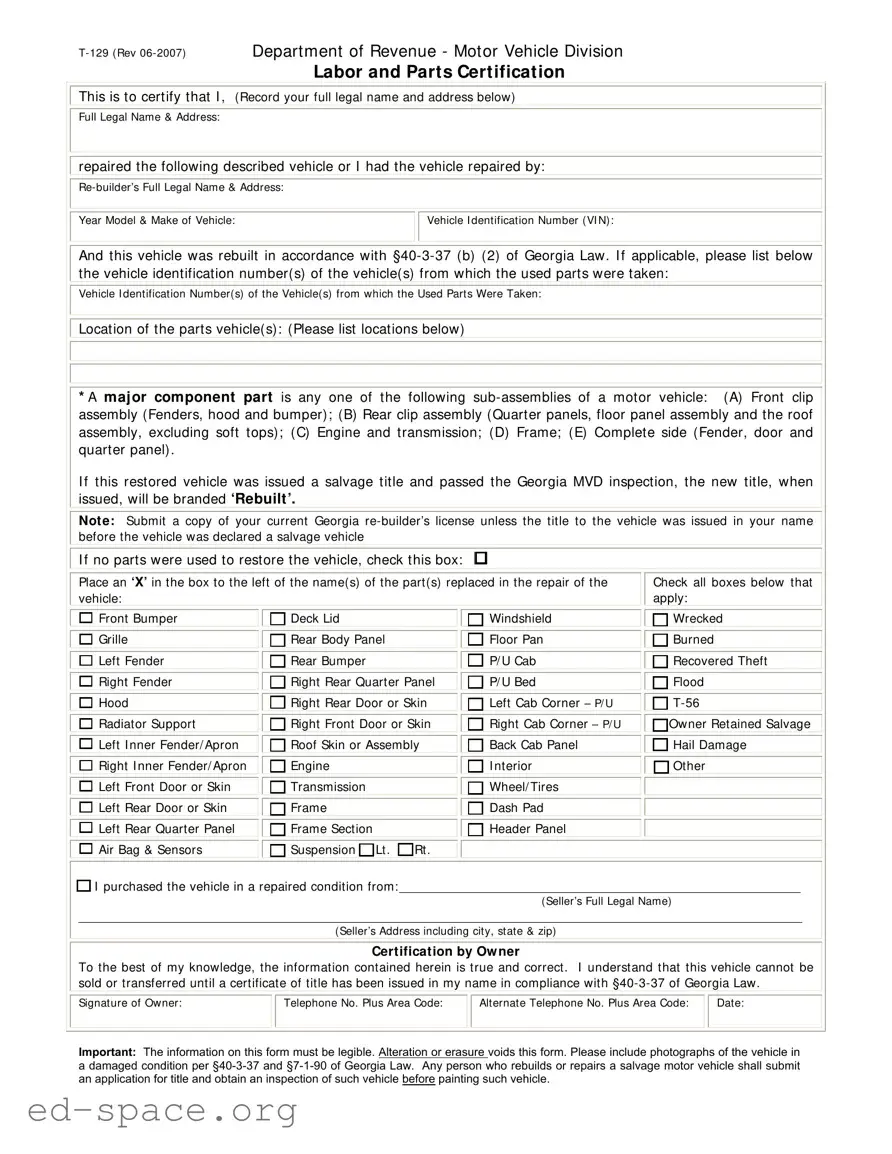
The Georgia T 129 form plays a crucial role in the process of certifying the repair and rebuilding of salvaged vehicles. When a vehicle has been damaged to the extent that it is deemed a total loss, it may be rebuilt using either new or used parts. This form serves as an official declaration that the vehicle has been restored in compliance with Georgia law, specifically §40-3-37 (b) (2). It requires the owner or rebuilder to provide essential details, including their full legal name and address, the vehicle's make, model, and identification number, as well as information about any used parts sourced from other vehicles. If the vehicle was previously issued a salvage title and has passed inspection, it will receive a new title branded as 'Rebuilt.' This process ensures transparency and accountability, as it prevents the sale of vehicles that have not been properly restored. Additionally, the form includes sections for the owner to certify the truthfulness of the information provided and to acknowledge the legal implications of the vehicle’s status. Photographs of the vehicle in its damaged condition must also be submitted, emphasizing the importance of thorough documentation throughout this process.
|
Department of Revenue - Motor Vehicle Division |
||
|
|
Labor and Part s Cert ificat ion |
|
|
|
|
|
|
This is to certify that I , |
(Record your full legal name and address below) |
|
|
|
|
|
|
Full Legal Name & Address: |
|
|
|
|
|
|
|
|
|
|
repaired the following described vehicle or I had the vehicle repaired by:
Year Model & Make of Vehicle:
Vehicle I dentification Number (VI N):
And this vehicle was rebuilt in accordance with
Vehicle I dentification Number(s) of the Vehicle(s) from which the Used Parts Were Taken:
Location of the parts vehicle(s): (Please list locations below)
*A maj or component assembly (Fenders, hood assembly, excluding soft quarter panel).
part is any one of the following
I f this restored vehicle was issued a salvage title and passed the Georgia MVD inspection, the new title, when issued, will be branded ‘Rebuilt ’.
Not e: Submit a copy of your current Georgia
I f no parts were used to restore the vehicle, check this box:
Place an ‘X’ in the box to the left of the name(s) of the part(s) replaced in the repair of the vehicle:
Front Bumper |
|
|
|
Deck Lid |
|
|
|
|
Windshield |
|
|
|
|
|
|
|
|
|
|
Grille |
|
|
|
Rear Body Panel |
|
|
|
|
Floor Pan |
|
|
|
|
|
|
|
|
|
|
Left Fender |
|
|
|
Rear Bumper |
|
|
|
|
P/ U Cab |
|
|
|
|
|
|
|
|
|
|
Right Fender |
|
|
|
Right Rear Quarter Panel |
|
|
|
P/ U Bed |
|
|
|
|
|
|
|
|
|
|
|
Hood |
|
|
|
Right Rear Door or Skin |
|
|
|
Left Cab Corner – P/ U |
|
|
|
|
|
|
|
|
|
|
|
Radiator Support |
|
|
|
Right Front Door or Skin |
|
|
|
Right Cab Corner – P/ U |
|
|
|
|
|
|
|
|
|
|
|
Left I nner Fender/ Apron |
|
|
|
Roof Skin or Assembly |
|
|
|
Back Cab Panel |
|
|
|
|
|
|
|
|
|
|
|
Right I nner Fender/ Apron |
|
|
|
Engine |
|
|
|
|
I nterior |
|
|
|
|
|
|
|
|
|
|
Left Front Door or Skin |
|
|
|
Transmission |
|
|
|
|
Wheel/ Tires |
|
|
|
|
|
|
|
|
|
|
Left Rear Door or Skin |
|
|
|
Frame |
|
|
|
|
Dash Pad |
|
|
|
|
|
|
|
|
|
|
Left Rear Quarter Panel |
|
|
|
Frame Section |
|
|
|
|
Header Panel |
|
|
|
|
|
|
|
|
|
|
Air Bag & Sensors |
|
|
|
Suspension Lt . |
Rt . |
|
|
|
|
Check all boxes below that apply:
Wrecked
Burned
Recovered Theft
Flood
Owner Retained Salvage
Hail Damage
Other
I purchased the vehicle in a repaired condition from: ________________________________________________________
(Seller’s Full Legal Name)
_____________________________________________________________________________________________________
(Seller’s Address including city, state & zip)
Cert ificat ion by Ow ner
To the best of my knowledge, the information contained herein is true and correct . I understand that this vehicle cannot be sold or transferred until a certificate of title has been issued in my name in compliance with
Signature of Owner:
Telephone No. Plus Area Code:
Alternate Telephone No. Plus Area Code:
Date:
Important: The information on this form must be legible. Alteration or erasure voids this form. Please include photographs of the vehicle in a damaged condition per
| Fact Name | Details |
|---|---|
| Purpose of Form | The Georgia T 129 form certifies that a vehicle has been repaired or rebuilt, ensuring compliance with state regulations. |
| Governing Law | This form is governed by Georgia Code §40-3-37, which outlines the requirements for rebuilding and titling salvage vehicles. |
| Salvage Title Branding | If the vehicle was issued a salvage title and passes inspection, the new title will be branded as 'Rebuilt'. |
| Submission Requirements | A copy of the Georgia re-builder’s license must be submitted unless the vehicle title was issued in the owner's name prior to it being declared salvage. |
Filling out the Georgia T 129 form is an important step in certifying the repair of a vehicle. Once completed, this form will help you move forward with the necessary documentation for your vehicle's title. Make sure to provide accurate information as it will be used for official purposes.
What is the Georgia T 129 form?
The Georgia T 129 form is a certification document used in the state of Georgia for vehicles that have been rebuilt or repaired. It is issued by the Department of Revenue’s Motor Vehicle Division. This form certifies that the vehicle has been restored according to state law and provides details about the vehicle and any used parts that were utilized in the repair process.
Who needs to fill out the T 129 form?
The T 129 form must be completed by anyone who has rebuilt or repaired a salvage vehicle. This includes individuals who repaired the vehicle themselves or those who had it repaired by a professional. It is essential for ensuring compliance with Georgia law regarding salvage and rebuilt titles.
What information is required on the T 129 form?
The form requires several key pieces of information. This includes the full legal name and address of the person completing the form, details about the vehicle such as the year, model, make, and Vehicle Identification Number (VIN). Additionally, it asks for information about any used parts that were taken from other vehicles and the locations of those vehicles.
What happens if no parts were used to restore the vehicle?
If no parts were used in the restoration of the vehicle, the individual must check a specific box on the form. This indicates that the vehicle was repaired without the use of any salvaged parts, which can affect the title branding process.
How does the title branding process work?
If the rebuilt vehicle was issued a salvage title and passes the Georgia MVD inspection, the new title will be branded as ‘Rebuilt.’ This branding is important for future buyers, as it indicates the vehicle has been restored and is legally roadworthy.
Is a re-builder’s license required?
Yes, a current Georgia re-builder’s license must be submitted with the T 129 form unless the title to the vehicle was issued in the owner's name before it was declared salvage. This license serves as proof that the individual is authorized to perform such repairs.
What types of damage must be reported on the form?
When filling out the T 129 form, the owner must check all applicable boxes that describe the vehicle’s condition prior to repair. This includes options like wrecked, burned, recovered theft, flood, hail damage, and other types of damage. Accurate reporting is crucial for compliance with state regulations.
What supporting documents are needed with the T 129 form?
In addition to the completed T 129 form, it is important to include photographs of the vehicle in its damaged condition. This visual evidence helps support the claims made on the form and is required by Georgia law.
Can the vehicle be sold before the title is issued?
No, the vehicle cannot be sold or transferred until a certificate of title has been issued in the owner's name. This is in compliance with Georgia law and ensures that the vehicle's history is clear and properly documented.
What should I do if I make a mistake on the form?
If there are any alterations or erasures on the T 129 form, it will be considered void. Therefore, it is important to ensure that all information is legible and accurate before submitting the form. If a mistake is made, it is best to fill out a new form rather than trying to correct the existing one.
Incomplete Information: Failing to provide all required details, such as the full legal name and address of both the owner and the re-builder, can lead to delays. Make sure every section is filled out accurately.
Illegible Handwriting: If the information is difficult to read, it may be rejected. Take your time and write clearly, or consider typing the information if possible.
Missing Signatures: Forgetting to sign the form is a common oversight. Ensure that the owner’s signature is included at the bottom of the document.
Incorrect Vehicle Identification Number (VIN): Entering an incorrect VIN can cause significant issues. Double-check the number against the vehicle’s title or registration to confirm accuracy.
Not Providing Supporting Documents: Failing to include necessary documents, such as a copy of the Georgia re-builder’s license or photographs of the vehicle in damaged condition, can result in rejection.
Neglecting to Check Applicable Boxes: If the vehicle was wrecked, burned, or had any other condition, ensure you check the appropriate boxes. This information is crucial for proper classification.
Ignoring the Title Requirement: Remember, the vehicle cannot be sold or transferred until a certificate of title has been issued. Make sure to comply with all legal requirements before proceeding.
The Georgia T-129 form serves a crucial role in the process of certifying the repair and rebuilding of salvaged vehicles. When navigating the complexities of vehicle restoration and titling in Georgia, several other documents often accompany the T-129 form. Each of these documents plays a significant role in ensuring compliance with state regulations and facilitating the transfer of ownership. Below is a list of these important forms and documents.
In summary, the Georgia T-129 form is part of a larger framework of documentation necessary for the rebuilding and retitling of salvaged vehicles. Understanding the role of each of these forms can greatly assist individuals in navigating the legal landscape surrounding vehicle repairs and ownership in Georgia.
The Georgia T 129 form is a critical document for vehicle owners who have rebuilt or repaired a salvage vehicle. Several other documents serve similar purposes in various contexts. Below is a list of nine documents that share similarities with the Georgia T 129 form:
Each of these documents plays a role in the ownership, repair, or sale of vehicles, much like the Georgia T 129 form does in the context of rebuilt or salvaged vehicles.
When filling out the Georgia T 129 form, it is crucial to follow specific guidelines to ensure accuracy and compliance. Here are some dos and don'ts to keep in mind:
Understanding the Georgia T 129 form is essential for anyone involved in the rebuilding or repair of salvage vehicles. However, several misconceptions can lead to confusion. Below is a list of common misunderstandings about this form.
Clarifying these misconceptions can help ensure compliance with Georgia law and facilitate a smoother process for vehicle repairs and title applications.
Here are some key takeaways about filling out and using the Georgia T 129 form:
Filling out the Georgia T 129 form accurately is crucial for compliance and successful title issuance. Pay attention to each section and provide all necessary details to avoid delays.