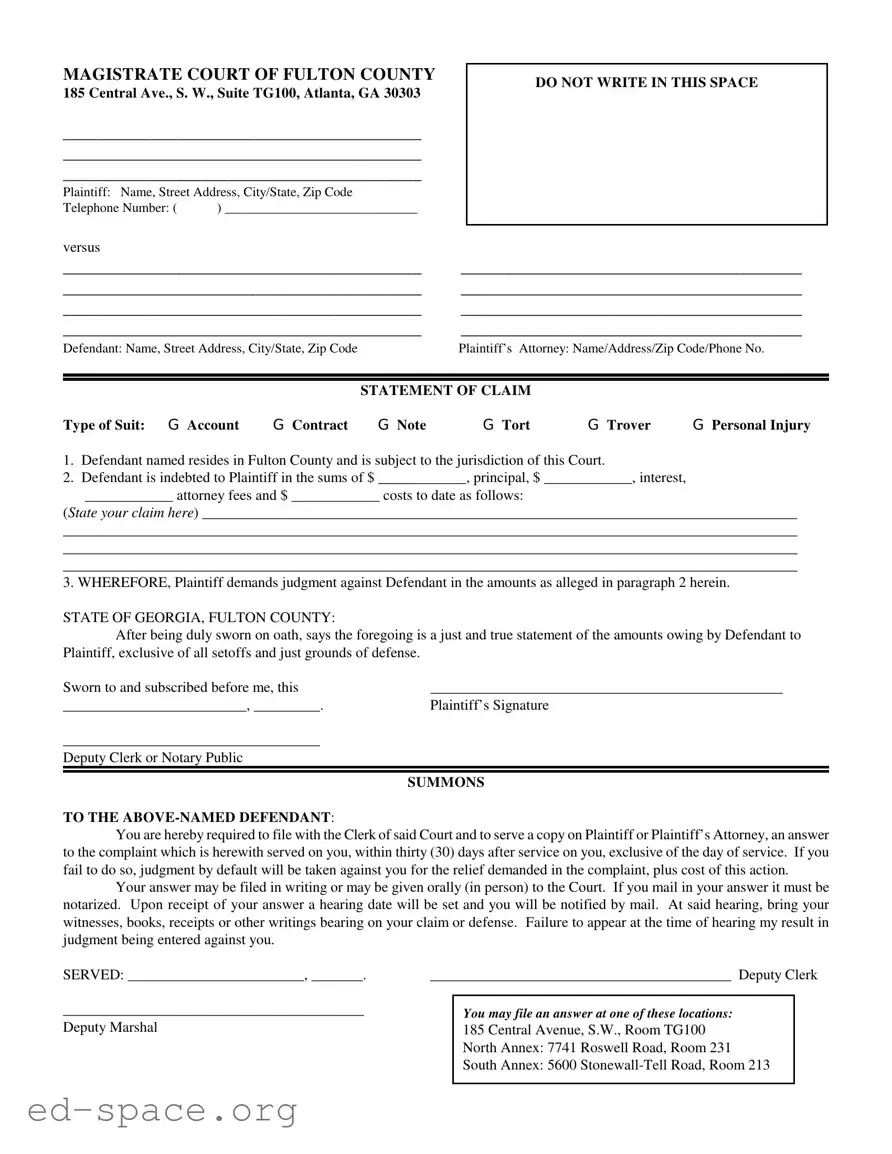
The Georgia Statement Claim Fulton form is a critical document used in the Magistrate Court of Fulton County, facilitating the process of initiating a civil lawsuit. This form requires the plaintiff to provide essential information, including their name, address, and contact details, as well as similar information for the defendant. The plaintiff must specify the type of suit, which can include categories such as account, contract, note, tort, trover, or personal injury. Additionally, the form prompts the plaintiff to detail the amount owed by the defendant, breaking it down into principal, interest, attorney fees, and costs. A sworn statement by the plaintiff affirms the accuracy of the claim, ensuring that the information presented is truthful and complete. The form also includes a summons, which instructs the defendant to respond to the complaint within thirty days. Failure to respond can lead to a default judgment against the defendant. Overall, this form serves as a foundational tool for legal proceedings in Fulton County, streamlining the claims process while ensuring that both parties are informed of their rights and responsibilities.

MAGISTRATE COURT OF FULTON COUNTY
185 Central Ave., S. W., Suite TG100, Atlanta, GA 30303
_________________________________________
_________________________________________
_________________________________________
Plaintiff: Name, Street Address, City/State, Zip Code
Telephone Number: ( |
) _____________________________ |
versus |
|
DO NOT WRITE IN THIS SPACE
_________________________________________ |
_______________________________________ |
||||
_________________________________________ |
_______________________________________ |
||||
_________________________________________ |
_______________________________________ |
||||
_________________________________________ |
_______________________________________ |
||||
Defendant: Name, Street Address, City/State, Zip Code |
|
Plaintiff’s Attorney: Name/Address/Zip Code/Phone No. |
|||
|
|
|
|
|
|
|
|
|
|
|
|
|
|
STATEMENT OF CLAIM |
|
|
|
Type of Suit: G Account |
G Contract |
G Note |
G Tort |
G Trover |
G Personal Injury |
1.Defendant named resides in Fulton County and is subject to the jurisdiction of this Court.
2.Defendant is indebted to Plaintiff in the sums of $ ____________, principal, $ ____________, interest,
____________ attorney fees and $ ____________ costs to date as follows:
(State your claim here) _________________________________________________________________________________
____________________________________________________________________________________________________
____________________________________________________________________________________________________
____________________________________________________________________________________________________
3. WHEREFORE, Plaintiff demands judgment against Defendant in the amounts as alleged in paragraph 2 herein.
STATE OF GEORGIA, FULTON COUNTY:
After being duly sworn on oath, says the foregoing is a just and true statement of the amounts owing by Defendant to Plaintiff, exclusive of all setoffs and just grounds of defense.
Sworn to and subscribed before me, this |
________________________________________________ |
_________________________, _________. |
Plaintiff’s Signature |
___________________________________ |
|
Deputy Clerk or Notary Public |
|
|
|
|
SUMMONS |
TO THE
You are hereby required to file with the Clerk of said Court and to serve a copy on Plaintiff or Plaintiff’s Attorney, an answer to the complaint which is herewith served on you, within thirty (30) days after service on you, exclusive of the day of service. If you fail to do so, judgment by default will be taken against you for the relief demanded in the complaint, plus cost of this action.
Your answer may be filed in writing or may be given orally (in person) to the Court. If you mail in your answer it must be notarized. Upon receipt of your answer a hearing date will be set and you will be notified by mail. At said hearing, bring your witnesses, books, receipts or other writings bearing on your claim or defense. Failure to appear at the time of hearing my result in judgment being entered against you.
SERVED: ________________________, _______. |
_________________________________________ Deputy Clerk |
||
_________________________________________ |
|
|
|
|
You may file an answer at one of these locations: |
|
|
|
|
|
|
Deputy Marshal |
|
185 Central Avenue, S.W., Room TG100 |
|
|
|
North Annex: 7741 Roswell Road, Room 231 |
|
|
|
South Annex: 5600 |
|
|
|
|
|
| Fact Name | Details |
|---|---|
| Jurisdiction | The Fulton County Magistrate Court has jurisdiction over claims involving defendants residing in Fulton County. |
| Types of Claims | The form allows for various types of suits, including account, contract, note, tort, trover, and personal injury. |
| Debt Specification | Plaintiffs must specify the amounts owed by the defendant, including principal, interest, attorney fees, and costs. |
| Filing Requirements | Defendants are required to file an answer within thirty (30) days of being served, or they risk a default judgment. |
| Sworn Statement | The plaintiff must provide a sworn statement affirming the accuracy of the claim amounts, which is then notarized. |
| Service of Summons | The summons must be served to the defendant along with the complaint, detailing the requirements for their response. |
| Hearing Notification | Upon receiving the defendant's answer, the court will set a hearing date and notify the parties by mail. |
| Location for Filing | Answers can be filed at multiple locations, including the main courthouse and annexes, ensuring accessibility for defendants. |
Filling out the Georgia Statement Claim Fulton form is an important step in initiating a legal claim. This form allows you to present your case clearly and concisely. Once completed, the form will need to be filed with the appropriate court and served to the defendant. Here’s how to fill it out step by step:
After filing the form, you will need to ensure that the defendant receives a copy of your claim. This starts the process of the legal proceedings. Keep a copy of everything for your records, and be prepared to follow up as necessary.
What is the Georgia Statement Claim Fulton form used for?
The Georgia Statement Claim Fulton form is a legal document used to initiate a claim in the Magistrate Court of Fulton County. It allows a plaintiff to formally present their case against a defendant, detailing the nature of the claim, the amount owed, and any relevant supporting information.
Who can file a claim using this form?
Any individual or entity that believes they are owed money or compensation can file a claim using this form, provided the defendant resides in Fulton County and is subject to the court's jurisdiction. This includes claims related to accounts, contracts, notes, torts, trover actions, or personal injuries.
What information is required to complete the form?
The form requires specific details, including the names and addresses of both the plaintiff and the defendant, the type of suit, the amount of principal, interest, attorney fees, and costs. Additionally, the plaintiff must provide a clear statement of the claim, outlining the basis for the demand.
How does the defendant respond to a claim filed against them?
The defendant must file an answer with the Clerk of the Court and serve a copy to the plaintiff or their attorney within 30 days of being served. The answer can be submitted in writing or given orally in person. If mailed, it must be notarized.
What happens if the defendant does not respond?
If the defendant fails to respond within the specified timeframe, the court may enter a judgment by default against them. This means the plaintiff could receive the relief they requested without the defendant having the opportunity to present their case.
What should the plaintiff do after filing the form?
After filing the Georgia Statement Claim Fulton form, the plaintiff should prepare for a potential hearing. They should gather any relevant evidence, such as witnesses, documents, or receipts, that support their claim. The court will notify them of the hearing date once the defendant's answer is received.
Where can the form be filed?
The completed form can be filed at the Magistrate Court of Fulton County, located at 185 Central Avenue, S.W., Room TG100. Additional filing locations include the North Annex at 7741 Roswell Road, Room 231, and the South Annex at 5600 Stonewall-Tell Road, Room 213.
Is there a fee associated with filing this form?
Yes, there is typically a filing fee associated with submitting the Georgia Statement Claim Fulton form. The exact amount may vary, so it is advisable to check with the court for the current fee schedule before filing.
Failing to provide complete contact information for both the plaintiff and defendant. This includes missing names, addresses, or phone numbers, which can delay the process.
Not specifying the type of suit correctly. Choosing the wrong category can lead to confusion and may result in the case being dismissed.
Omitting the amounts owed. It is crucial to fill in the principal, interest, attorney fees, and costs. Leaving these blank can invalidate the claim.
Providing incomplete statements of the claim. A detailed explanation of the claim is necessary. Simply stating "I want my money" is not sufficient.
Neglecting to sign the form. Without a signature, the document is not legally binding, and the claim cannot proceed.
Forgetting to have the form notarized when required. If mailing an answer, notarization is essential to validate the submission.
Missing the filing deadline. The answer must be filed within thirty days. Ignoring this timeline can lead to a default judgment.
Not serving the defendant properly. The rules for serving documents must be followed to ensure the defendant is notified.
Failing to prepare for the hearing. Bringing necessary documents, witnesses, and evidence is vital for supporting the claim.
When filing a claim in the Fulton County Magistrate Court, several forms and documents are commonly required alongside the Georgia Statement Claim Fulton form. Understanding these documents can streamline the process and ensure that all necessary information is provided. Below is a list of essential forms that may be needed.
Each of these documents plays a vital role in the legal process, ensuring that both parties have a fair opportunity to present their cases. Properly completing and filing these forms can significantly impact the outcome of the case, so attention to detail is essential. If you have questions about any of these documents, seeking legal advice may be beneficial.
The Georgia Statement Claim Fulton form is similar to several other legal documents used in civil litigation. Each document serves a unique purpose but shares common elements, such as outlining claims and notifying parties involved. Here are six documents that are similar:
Filling out the Georgia Statement Claim Fulton form can seem daunting, but with the right approach, you can navigate it smoothly. Here’s a handy list of things to do and avoid to ensure your submission is successful.
By following these guidelines, you’ll be better prepared to fill out the Georgia Statement Claim Fulton form effectively. Remember, clarity and accuracy are your best friends in this process!
Understanding the Georgia Statement Claim Fulton form is essential for anyone involved in a legal dispute in Fulton County. However, several misconceptions can lead to confusion. Below are some common misunderstandings about this form:
In reality, the Georgia Statement Claim Fulton form is versatile. It can be used for various types of claims, including accounts, contracts, notes, torts, and more.
While having legal representation can be beneficial, it is not a requirement. Individuals can file the form on their own, known as pro se representation.
The defendant has a specific timeframe—30 days from the date of service—to file a response. This allows them time to prepare their case.
Attorney fees can be included in the claim if they are part of the agreement between the parties or if allowed by law. This should be clearly stated in the form.
After the defendant files an answer, the court will notify them of the hearing date. It is the responsibility of the plaintiff to ensure that they are aware of any updates.
There are designated locations for filing the form, such as the Deputy Marshal's office and specific annexes. Submitting the form at the wrong location may cause delays.
Failure to appear at the hearing can result in a default judgment against you. Rescheduling is not guaranteed and may require a valid reason.
By addressing these misconceptions, individuals can better navigate the legal process and ensure their claims are properly filed and heard.
When filling out and using the Georgia Statement Claim Fulton form, it is essential to understand several key aspects to ensure the process goes smoothly. Here are four important takeaways: