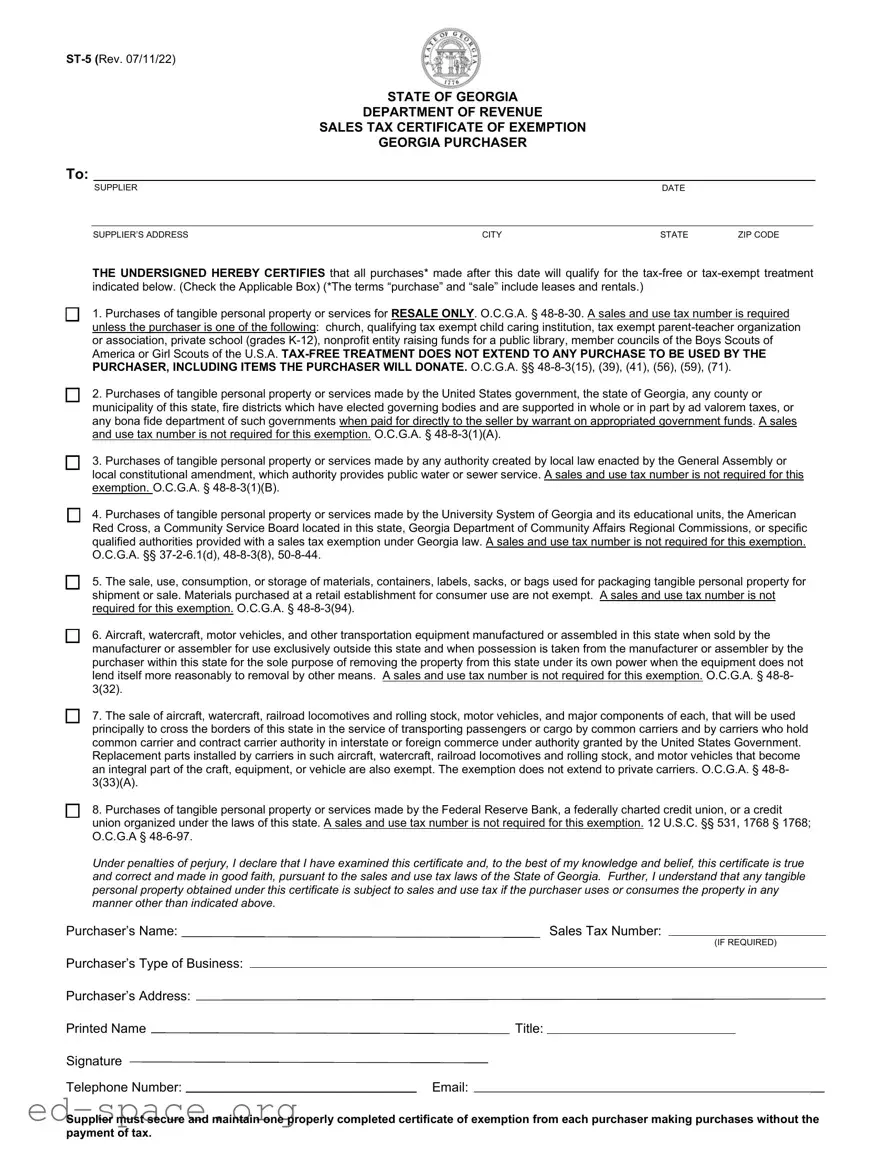
The Georgia ST-5 form, officially known as the Sales Tax Certificate of Exemption, serves as a vital document for purchasers seeking tax-exempt treatment on specific transactions within the state. Designed for various entities, this form allows eligible buyers to certify that their purchases qualify for exemption from sales and use tax. The form outlines several categories under which exemptions may apply, including purchases made for resale, government transactions, and certain educational or nonprofit organizations. It also details the requirements for each exemption type, such as the need for a sales tax number in some cases, while explicitly stating that certain purchases, like those intended for personal use, do not qualify. Additionally, the form emphasizes the importance of accurate completion and the legal responsibilities of the purchaser, including the declaration of truthfulness under penalties of perjury. By understanding the nuances of the Georgia ST-5 form, businesses and organizations can navigate tax exemptions effectively, ensuring compliance with state regulations while optimizing their financial operations.

STATE OF GEORGIA
DEPARTMENT OF REVENUE
SALES TAX CERTIFICATE OF EXEMPTION
GEORGIA PURCHASER
To:
|
SUPPLIER |
|
DATE |
|
|
|
|
|
|
|
|
SUPPLIER’S ADDRESS |
CITY |
STATE |
ZIP CODE |
||
THE UNDERSIGNED HEREBY CERTIFIES that all purchases* made after this date will qualify for the
1. Purchases of tangible personal property or services for RESALE ONLY. O.C.G.A. §
2. Purchases of tangible personal property or services made by the United States government, the state of Georgia, any county or municipality of this state, fire districts which have elected governing bodies and are supported in whole or in part by ad valorem taxes, or any bona fide department of such governments when paid for directly to the seller by warrant on appropriated government funds. A sales and use tax number is not required for this exemption. O.C.G.A. §
3. Purchases of tangible personal property or services made by any authority created by local law enacted by the General Assembly or local constitutional amendment, which authority provides public water or sewer service. A sales and use tax number is not required for this exemption. O.C.G.A. §
4. Purchases of tangible personal property or services made by the University System of Georgia and its educational units, the American Red Cross, a Community Service Board located in this state, Georgia Department of Community Affairs Regional Commissions, or specifi c qualified authorities provided with a sales tax exemption under Georgia law. A sales and use tax number is not required for this exemption. O.C.G.A. §§
5. The sale, use, consumption, or storage of materials, containers, labels, sacks, or bags used for packaging tangible personal property for shipment or sale. Materials purchased at a retail establishment for consumer use are not exempt. A sales and use tax number is not required for this exemption. O.C.G.A. §
6. Aircraft, watercraft, motor vehicles, and other transportation equipment manufactured or assembled in this state when sold by the manufacturer or assembler for use exclusively outside this state and when possession is taken from the manufacturer or assembler by the purchaser within this state for the sole purpose of removing the property from this state under its own power when the equipment does not lend itself more reasonably to removal by other means. A sales and use tax number is not required for this exemption. O.C.G.A. §
7. The sale of aircraft, watercraft, railroad locomotives and rolling stock, motor vehicles, and major components of each, that will be used principally to cross the borders of this state in the service of transporting passengers or cargo by common carriers and by carriers who hold common carrier and contract carrier authority in interstate or foreign commerce under authority granted by the United States Government. Replacement parts installed by carriers in such aircraft, watercraft, railroad locomotives and rolling stock, and motor vehicles that become an integral part of the craft, equipment, or vehicle are also exempt. The exemption does not extend to private carriers. O.C.G.A. §
8. Purchases of tangible personal property or services made by the Federal Reserve Bank, a federally charted credit union, or a credit union organized under the laws of this state. A sales and use tax number is not required for this exemption. 12 U.S.C. §§ 531, 1768 § 1768; O.C.G.A §
Under penalties of perjury, I declare that I have examined this certificate and, to the best of my knowledge and belief, this certificate is true and correct and made in good faith, pursuant to the sales and use tax laws of the State of Georgia. Further, I understand that any tangible personal property obtained under this certificate is subject to sales and use tax if the purchaser uses or consumes the property in any manner other than indicated above.
Purchaser’s Name: |
|
|
Sales Tax Number: |
|
|
|
|
|
|
|
|
(IF REQUIRED) |
|
Purchaser’s Type of Business: |
|
|
|
|
|
|
|
|
|
|
|
||
Purchaser’s Address: |
|
|
|
|
|
|
Printed Name |
|
Title: |
||||
Signature |
|
|
|
|
|
|
Telephone Number: |
|
|
Email: |
|||
Supplier must secure and maintain one properly completed certificate of exemption from each purchaser making purchases without the payment of tax.
| Fact Name | Fact Description |
|---|---|
| Form Title | The form is titled "Sales Tax Certificate of Exemption" and is issued by the State of Georgia Department of Revenue. |
| Governing Law | The form is governed by various sections of the Official Code of Georgia Annotated (O.C.G.A.), primarily § 48-8-30 and § 48-8-3. |
| Purpose | This form certifies that certain purchases will be exempt from sales tax, provided they meet specific criteria. |
| Eligible Purchasers | Eligible purchasers include government entities, certain nonprofit organizations, and educational institutions. |
| Sales Tax Number Requirement | A sales and use tax number is required for some exemptions but not for others, such as government purchases. |
| Exemption Limitations | Exemptions do not apply to items used by the purchaser, including donations. |
| Record Keeping | Suppliers must keep a properly completed certificate of exemption from each purchaser to validate tax-free transactions. |
Completing the Georgia ST-5 form is a straightforward process that allows purchasers to certify their eligibility for tax-exempt purchases. Following these steps will ensure that you fill out the form correctly and avoid any potential issues.
After completing these steps, you can confidently proceed with your tax-exempt purchases. Remember that maintaining accurate records and documentation is essential for compliance with Georgia's sales and use tax laws.
What is the Georgia ST-5 form?
The Georgia ST-5 form is a Sales Tax Certificate of Exemption. It allows certain purchasers to buy tangible personal property or services without paying sales tax, provided they meet specific criteria. This form must be completed by the purchaser and presented to the supplier to certify that the purchases qualify for tax exemption under Georgia law.
Who can use the ST-5 form for tax exemption?
The ST-5 form can be used by various entities, including churches, nonprofit organizations, government agencies, and educational institutions. It is essential to check the applicable box on the form that corresponds to the reason for the exemption. For example, if a church is making a purchase for resale, it would check the box indicating that. However, personal use or donations do not qualify for tax exemption.
Do I need a sales tax number to use the ST-5 form?
In most cases, a sales tax number is required for tax-exempt purchases. However, there are exceptions. For instance, government entities and certain nonprofit organizations do not need a sales tax number to qualify for the exemption. It’s important to read the instructions on the ST-5 form carefully to determine whether a sales tax number is necessary for your specific situation.
What types of purchases are exempt under the ST-5 form?
The ST-5 form covers various types of purchases, including items for resale, purchases made by government entities, and materials used for packaging. Additionally, certain transportation equipment and components used for interstate commerce may also be exempt. Each category has specific criteria that must be met, so it is crucial to ensure that your purchase fits within one of these exemptions.
What happens if I misuse the ST-5 form?
Misusing the ST-5 form can lead to penalties, including the requirement to pay sales tax on the items purchased. If a purchaser uses or consumes the property in a manner not indicated on the form, they could be held liable for the tax owed. Furthermore, providing false information on the form can result in legal consequences. It is vital to use the form in good faith and ensure that all information is accurate.
Not Checking the Applicable Box: Many individuals fail to select the correct exemption category. This can lead to issues if the purchases do not meet the requirements for the selected exemption.
Incorrectly Filling Out the Supplier Information: Providing inaccurate or incomplete information about the supplier can cause delays or complications. Ensure that the supplier's name, address, and contact details are correct.
Missing Sales Tax Number: If required for the selected exemption, the sales tax number must be included. Omitting this number can invalidate the exemption.
Using the Form for Ineligible Purchases: Some individuals mistakenly use the form for items that do not qualify for tax exemption. Always verify that the purchase aligns with the exemption criteria.
Not Signing the Form: Failing to sign the form can lead to it being considered incomplete. A signature is necessary to validate the declaration of truthfulness.
Providing Inaccurate Business Information: Incorrect details about the purchaser's business type or address can create complications in processing the exemption.
Ignoring the Penalties of Perjury Statement: Some overlook the seriousness of the declaration. Misrepresentation can have legal consequences, so it’s crucial to provide accurate information.
Not Keeping a Copy: Failing to retain a copy of the completed form can lead to difficulties in the future. Always keep a record for your files.
The Georgia ST-5 form is a Sales Tax Certificate of Exemption that allows certain purchasers to make tax-exempt purchases. Along with this form, there are several other documents that may be necessary to support tax-exempt transactions. Here’s a list of commonly used forms and documents.
Understanding these forms can help ensure compliance with Georgia's sales tax laws while maximizing tax savings. It’s essential to use the correct documentation to avoid potential issues during audits or transactions.
The Georgia ST-5 form is a certificate of exemption from sales tax for certain purchases. Several other documents serve similar purposes in various contexts. Below are five documents that share similarities with the Georgia ST-5 form:
When filling out the Georgia ST-5 form, it's important to follow certain guidelines to ensure accuracy and compliance. Here is a list of things you should and shouldn't do:
Understanding the Georgia ST-5 form is essential for both buyers and sellers in Georgia. However, there are several misconceptions that can lead to confusion. Here’s a breakdown of eight common misunderstandings about the Georgia ST-5 form:
This is not true. The ST-5 form only certifies specific purchases that qualify for tax exemption. Not all items purchased are exempt, and it's crucial to check the eligibility criteria.
In fact, certain entities like government agencies and nonprofit organizations may not need a sales tax number to claim exemptions. Understanding these exceptions is vital.
This is incorrect. The form is strictly for business-related purchases or items intended for resale. Using it for personal purchases can lead to penalties.
Not every organization qualifies. Only specific entities, such as certain nonprofits or government bodies, are eligible for tax exemptions under this form.
It only applies to tangible personal property or services that meet specific criteria. Items for personal use or donation do not qualify for the exemption.
Actually, the form may need to be updated if there are changes in business operations or ownership. Keeping it current is essential for compliance.
This is misleading. Each purchase must still meet the exemption criteria at the time of sale. Just having the form does not ensure automatic exemption for all purchases.
This is false. Misuse of the form can lead to significant penalties, including fines and back taxes owed. It's important to use the form correctly and responsibly.
Being informed about these misconceptions can help businesses navigate the complexities of sales tax exemptions in Georgia. Always ensure that you understand the requirements and limitations of the ST-5 form to avoid potential pitfalls.
Filling out the Georgia ST-5 form can be a straightforward process, but it's essential to understand its key components. Here are some important takeaways to keep in mind:
Understanding these key points will help ensure that the ST-5 form is used correctly and effectively, making tax-exempt purchases smoother for eligible entities.