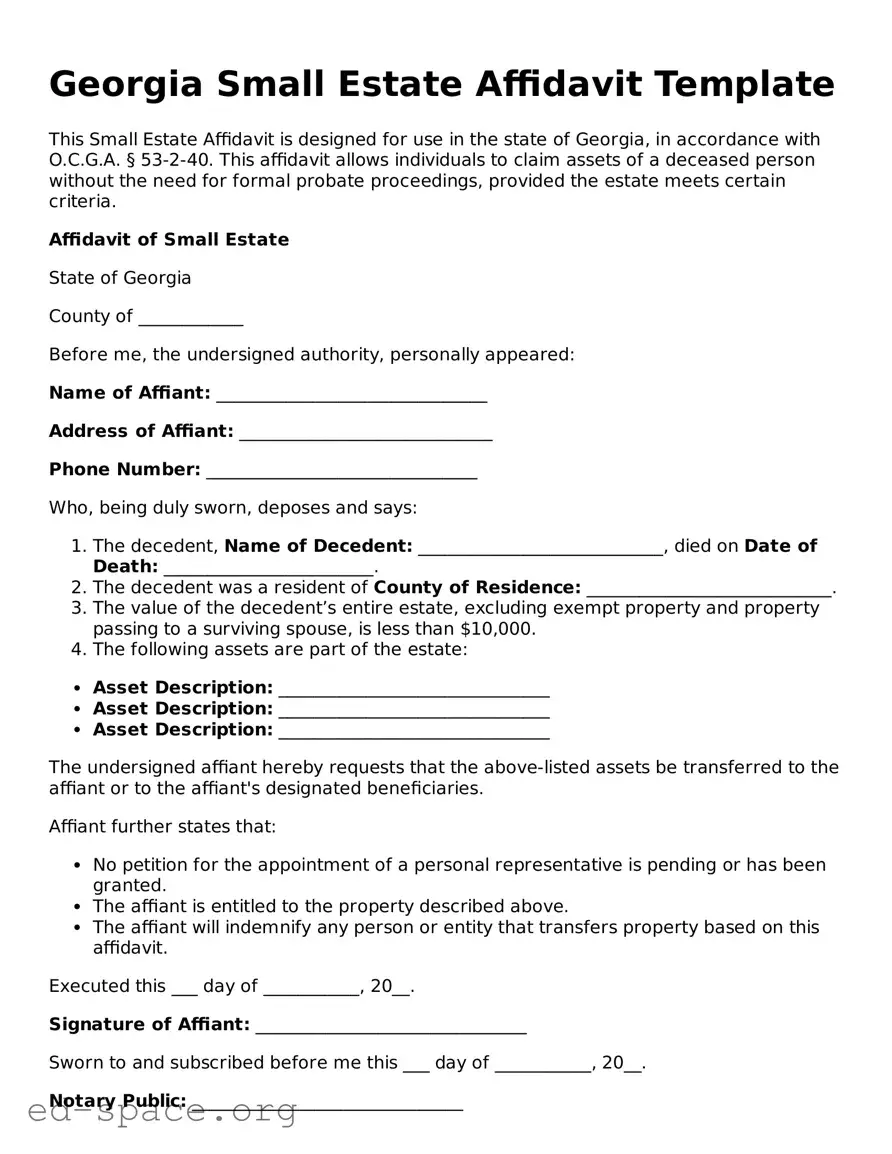
The Georgia Small Estate Affidavit form serves as a practical tool for individuals navigating the process of settling the estates of deceased loved ones when the total value of the estate is below a specified threshold. This form allows eligible heirs to claim assets without the need for formal probate proceedings, streamlining the transfer of property and simplifying what can often be a complex and emotionally taxing process. To utilize this form, the estate must meet certain criteria, including the total value of the estate being less than $10,000, excluding certain types of property such as real estate. The affidavit must be completed by the appropriate heirs, who affirm their relationship to the deceased and their entitlement to the estate's assets. Additionally, the form requires the inclusion of pertinent information about the decedent, including their date of death and any outstanding debts. By providing a straightforward method for asset distribution, the Small Estate Affidavit form alleviates some of the burdens faced by families during a difficult time, promoting efficiency and clarity in the estate settlement process.
Georgia Small Estate Affidavit Template
This Small Estate Affidavit is designed for use in the state of Georgia, in accordance with O.C.G.A. § 53-2-40. This affidavit allows individuals to claim assets of a deceased person without the need for formal probate proceedings, provided the estate meets certain criteria.
Affidavit of Small Estate
State of Georgia
County of ____________
Before me, the undersigned authority, personally appeared:
Name of Affiant: _______________________________
Address of Affiant: _____________________________
Phone Number: _______________________________
Who, being duly sworn, deposes and says:
The undersigned affiant hereby requests that the above-listed assets be transferred to the affiant or to the affiant's designated beneficiaries.
Affiant further states that:
Executed this ___ day of ___________, 20__.
Signature of Affiant: _______________________________
Sworn to and subscribed before me this ___ day of ___________, 20__.
Notary Public: _______________________________
My Commission Expires: _______________________________
| Fact Name | Description |
|---|---|
| Purpose | The Georgia Small Estate Affidavit allows heirs to claim property without going through formal probate, simplifying the process for small estates. |
| Eligibility | To use this affidavit, the total value of the estate must not exceed $10,000, excluding certain assets like real estate. |
| Governing Law | This form is governed by Georgia Code § 53-2-40, which outlines the requirements for small estate proceedings. |
| Required Information | The affidavit must include details such as the deceased's name, date of death, and a list of assets and their values. |
| Signature Requirements | All heirs must sign the affidavit, affirming their relationship to the deceased and their agreement to the distribution of assets. |
| Filing Process | The completed affidavit is typically filed with the county probate court where the deceased lived at the time of death. |
| Limitations | This affidavit cannot be used for estates that include real property or for those that exceed the value limit set by law. |
After gathering the necessary information and documents, you are ready to fill out the Georgia Small Estate Affidavit form. This form allows you to claim assets of a deceased person without going through the lengthy probate process. Below are the steps to help you complete the form accurately.
Once the form is completed and notarized, you can submit it to the appropriate institutions to claim the assets. Be sure to keep copies of the affidavit and any supporting documents for your records.
What is a Georgia Small Estate Affidavit?
The Georgia Small Estate Affidavit is a legal document that allows heirs to claim property and assets of a deceased person without going through the full probate process. This form is typically used when the total value of the estate is under a certain threshold, making it a simpler and quicker option for settling small estates.
Who can use the Small Estate Affidavit?
Generally, the Small Estate Affidavit can be used by individuals who are heirs or beneficiaries of the deceased person’s estate. To qualify, the total value of the estate must fall below the limit set by Georgia law, which is currently $10,000 for personal property. This includes cash, bank accounts, and other assets, excluding real estate.
How do I complete the Small Estate Affidavit?
To complete the Small Estate Affidavit, you will need to provide information about the deceased, including their name, date of death, and the details of their estate. You must also list the heirs and their relationship to the deceased. After filling out the form, you will need to sign it in front of a notary public. Make sure to keep copies for your records.
Where do I file the Small Estate Affidavit?
The completed Small Estate Affidavit should be filed with the probate court in the county where the deceased person lived at the time of their death. You may also need to present it to financial institutions or other entities holding the deceased's assets to claim them.
Is there a fee to file the Small Estate Affidavit?
Yes, there may be a filing fee associated with submitting the Small Estate Affidavit to the probate court. The fee varies by county, so it’s a good idea to check with your local court for the exact amount. Additionally, there might be fees for notarization or other related services.
What happens after I file the Small Estate Affidavit?
After filing the Small Estate Affidavit, the court will review the document. If everything is in order, the court may issue an order allowing you to collect the assets. Once you have the order, you can present it to banks, insurance companies, and other institutions to access the deceased’s property and funds.
Failing to include all necessary information about the deceased. Ensure that the full name, date of death, and other identifying details are accurately provided.
Omitting the names and addresses of all heirs. Every heir must be listed to avoid complications later.
Not providing a complete inventory of the estate's assets. Include all relevant property and its estimated value to ensure compliance with state requirements.
Forgetting to sign the affidavit. A signature is required to validate the document; without it, the affidavit is not legally binding.
Using outdated forms. Always ensure you are using the most current version of the Small Estate Affidavit form to avoid rejection.
Neglecting to have the affidavit notarized. A notary's signature is essential for the affidavit to be accepted by financial institutions and courts.
Incorrectly estimating the total value of the estate. This can lead to legal issues or delays in the distribution process.
Not checking for additional requirements specific to the county. Some counties may have their own rules or forms that need to be followed.
The Georgia Small Estate Affidavit is a useful tool for settling the estate of a deceased individual with minimal assets. When preparing to use this form, several other documents may be required to ensure a smooth process. Below is a list of forms and documents that are often used alongside the Small Estate Affidavit in Georgia.
Gathering these documents can streamline the process of using the Georgia Small Estate Affidavit. Each item plays a crucial role in ensuring that the estate is settled in accordance with the law and the wishes of the deceased.
The Small Estate Affidavit is a useful legal document that allows individuals to settle the estate of a deceased person without going through the lengthy probate process. Several other documents share similarities with the Small Estate Affidavit, often serving similar purposes in estate management. Below is a list of nine such documents, each with a brief explanation of how they relate to the Small Estate Affidavit.
Each of these documents plays a role in estate management, and while they may differ in function and application, they share the common goal of facilitating the transfer of assets and honoring the wishes of the deceased.
When filling out the Georgia Small Estate Affidavit form, it is important to approach the process with care and attention to detail. Here are some guidelines to help ensure that the form is completed correctly.
Things You Should Do:
Things You Shouldn't Do:
The Georgia Small Estate Affidavit form is a useful tool for settling small estates without going through the lengthy probate process. However, several misconceptions can lead to confusion and potential issues. Here are seven common misconceptions about this form:
Many believe that only heirs can file this affidavit. In reality, any person who is entitled to inherit under Georgia law can use the form, including creditors in some cases.
This is not true. The affidavit is specifically for estates valued at $10,000 or less, excluding certain property types. Understanding the value limit is crucial.
While the Small Estate Affidavit simplifies the process, it does not exempt the estate from tax obligations. Taxes may still need to be addressed separately.
It is a common belief that all debts must be settled before filing. However, the affidavit allows for the distribution of assets even if some debts remain, provided they are disclosed.
This misconception can lead to unnecessary delays. The Small Estate Affidavit is typically presented to banks or other institutions holding the deceased’s assets, not filed with a court.
While the process may seem daunting, it is relatively straightforward. Clear instructions accompany the form, making it accessible for most individuals.
This is incorrect. If errors are found or circumstances change, the affidavit can be revoked or amended as necessary, following proper procedures.
Understanding these misconceptions can help individuals navigate the Small Estate Affidavit process more effectively and ensure compliance with Georgia law.
Filling out and using the Georgia Small Estate Affidavit form can be a straightforward process if you understand the key aspects involved. Here are some important takeaways to consider:
Understanding these points will help ensure that the process of using the Small Estate Affidavit in Georgia is efficient and compliant with state requirements.