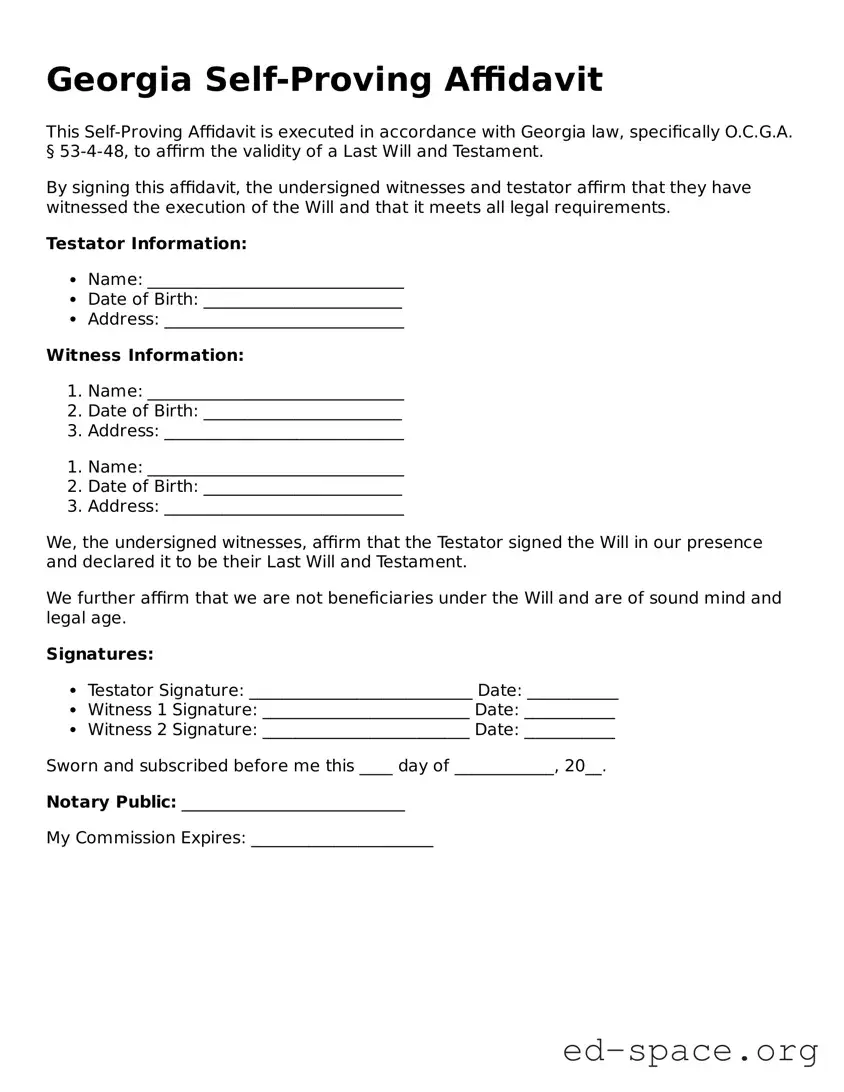
The Georgia Self-Proving Affidavit is an essential legal document that plays a crucial role in the probate process for wills. This form allows a testator, or the individual who created the will, to affirm that their will was signed in the presence of witnesses, thereby simplifying the validation process after their passing. By including a Self-Proving Affidavit, the need for witnesses to testify about the will's execution is eliminated, making it easier for the executor to carry out their duties. This form must be signed by the testator and two witnesses in the presence of a notary public, ensuring that all parties involved are legally acknowledged. When properly executed, the Self-Proving Affidavit provides a level of assurance and clarity, reducing the likelihood of disputes among heirs or challenges to the will's validity. Understanding the nuances of this form is vital for anyone involved in estate planning or the administration of a deceased person's estate in Georgia.
Georgia Self-Proving Affidavit
This Self-Proving Affidavit is executed in accordance with Georgia law, specifically O.C.G.A. § 53-4-48, to affirm the validity of a Last Will and Testament.
By signing this affidavit, the undersigned witnesses and testator affirm that they have witnessed the execution of the Will and that it meets all legal requirements.
Testator Information:
Witness Information:
We, the undersigned witnesses, affirm that the Testator signed the Will in our presence and declared it to be their Last Will and Testament.
We further affirm that we are not beneficiaries under the Will and are of sound mind and legal age.
Signatures:
Sworn and subscribed before me this ____ day of ____________, 20__.
Notary Public: ___________________________
My Commission Expires: ______________________
| Fact Name | Description |
|---|---|
| Purpose | The Georgia Self-Proving Affidavit allows a will to be validated without the need for witnesses to testify in court. |
| Governing Law | This form is governed by Georgia Code § 53-4-48. |
| Requirements | The testator and two witnesses must sign the affidavit in the presence of a notary public. |
| Benefits | Using this affidavit can expedite the probate process and reduce the potential for disputes over the will. |
After gathering the necessary information and materials, you are ready to fill out the Georgia Self-Proving Affidavit form. This form is an important step in the estate planning process, ensuring that the will can be validated without requiring witnesses to testify in court.
What is a Georgia Self-Proving Affidavit?
A Georgia Self-Proving Affidavit is a legal document that allows a testator (the person who created the will) to affirm the validity of their will. This affidavit is typically signed in the presence of a notary public and witnesses. By using this form, the need for witnesses to testify about the will's validity in probate court may be eliminated, streamlining the process for the heirs and beneficiaries.
Why should I use a Self-Proving Affidavit?
Using a Self-Proving Affidavit can simplify the probate process. When a will is self-proved, the court can accept it without requiring the witnesses to appear and testify. This can save time and reduce the potential for disputes regarding the will's authenticity, providing peace of mind to the testator and their loved ones.
Who can sign a Self-Proving Affidavit?
The testator must sign the Self-Proving Affidavit, along with at least two witnesses. These witnesses must also sign the affidavit, affirming that they witnessed the testator sign the will. Additionally, a notary public must acknowledge the signatures to complete the process.
What information is included in the Self-Proving Affidavit?
The affidavit typically includes the names and addresses of the testator and witnesses, a statement affirming the testator's capacity to make a will, and the date of execution. It may also contain a declaration that the witnesses signed the will in the presence of the testator and each other.
Is a Self-Proving Affidavit required in Georgia?
No, a Self-Proving Affidavit is not required for a will to be valid in Georgia. However, it is highly recommended. Including this affidavit can make the probate process smoother and more efficient, reducing potential challenges to the will.
Can I create a Self-Proving Affidavit after my will is signed?
Yes, it is possible to create a Self-Proving Affidavit after the will has been signed. However, both the testator and witnesses must still sign the affidavit in the presence of a notary public. It is best practice to execute the affidavit at the same time as the will to avoid complications.
How does a Self-Proving Affidavit affect the probate process?
A Self-Proving Affidavit can significantly expedite the probate process. Because the affidavit serves as evidence of the will's validity, the court may accept it without requiring the witnesses to testify. This can lead to a quicker resolution of the estate and distribution of assets to beneficiaries.
What happens if I do not have a Self-Proving Affidavit?
If a will does not include a Self-Proving Affidavit, the probate court may require witnesses to appear and testify about the will's authenticity. This can prolong the probate process and may introduce uncertainty, especially if witnesses are unavailable or if their recollections differ.
Can I revoke a Self-Proving Affidavit?
A Self-Proving Affidavit can be revoked if the testator revokes the will itself. Once the will is revoked, any associated affidavits become void. It is important to follow proper legal procedures when revoking a will to ensure that all parties understand the changes.
Where can I find a Self-Proving Affidavit form in Georgia?
Self-Proving Affidavit forms can be obtained from various sources, including legal stationery stores, online legal resources, or through an attorney. It is advisable to consult with a legal professional to ensure that the form meets all legal requirements and is properly executed.
Failing to sign the affidavit in the presence of a notary. It's essential that the document is notarized to ensure its validity.
Not including all required witnesses. Georgia law mandates that the affidavit must be signed by at least two witnesses. Missing a signature can lead to complications.
Using incorrect or incomplete information. Providing accurate details about the testator and witnesses is crucial. Any discrepancies can undermine the document’s effectiveness.
Neglecting to date the affidavit. The date is a critical element that establishes when the document was executed. Without it, questions about the timing may arise.
Overlooking the need for clarity in language. The affidavit should be clear and understandable. Ambiguities can lead to misinterpretations and potential legal disputes.
The Georgia Self-Proving Affidavit is an important document that helps streamline the probate process by verifying the authenticity of a will. When preparing a will or dealing with estate matters, several other forms and documents may also be necessary. Here’s a list of some commonly used documents that often accompany the Self-Proving Affidavit in Georgia.
Understanding these documents can simplify the estate management process and ensure that everything proceeds smoothly. Each form plays a vital role in honoring the wishes of the deceased and protecting the rights of the beneficiaries.
The Self-Proving Affidavit is an important legal document, particularly in the context of wills and estates. It serves to verify the authenticity of a will by allowing witnesses to affirm their signatures without needing to appear in court. There are several other documents that share similarities with the Self-Proving Affidavit in terms of purpose or function. Here are ten such documents:
When filling out the Georgia Self-Proving Affidavit form, it's important to follow certain guidelines to ensure accuracy and compliance. Here are five things you should and shouldn't do:
The Georgia Self-Proving Affidavit form is an important document in the estate planning process. However, several misconceptions exist about its purpose and use. Here are seven common misconceptions:
Many people believe that a Self-Proving Affidavit is only required for estates with significant assets. In reality, this form can be beneficial for any estate, regardless of size, as it simplifies the probate process.
Some think that the Self-Proving Affidavit serves as a substitute for a will. However, it does not replace the will; instead, it supports the validity of the will during probate.
There is a common belief that the affidavit can be signed after the testator has passed away. This is incorrect, as the affidavit must be executed while the testator is still alive.
Some individuals think that only one witness is needed to validate the Self-Proving Affidavit. In Georgia, two witnesses are required to properly execute the document.
This misconception suggests that the Self-Proving Affidavit lacks legal weight. On the contrary, when properly executed, it is a legally binding document that can facilitate the probate process.
Many assume that the Self-Proving Affidavit is valid across all states. However, each state has its own laws regarding wills and affidavits, so it is essential to ensure compliance with Georgia's specific requirements.
Some believe that only those who have hired a lawyer can use the Self-Proving Affidavit. While legal assistance can be beneficial, individuals can complete the form on their own, provided they understand the requirements.
Understanding these misconceptions can help individuals navigate the estate planning process more effectively. It is crucial to be informed and seek guidance if needed.
Understanding the Georgia Self-Proving Affidavit form is crucial for ensuring that a will is valid and can be executed smoothly. Here are some key takeaways: