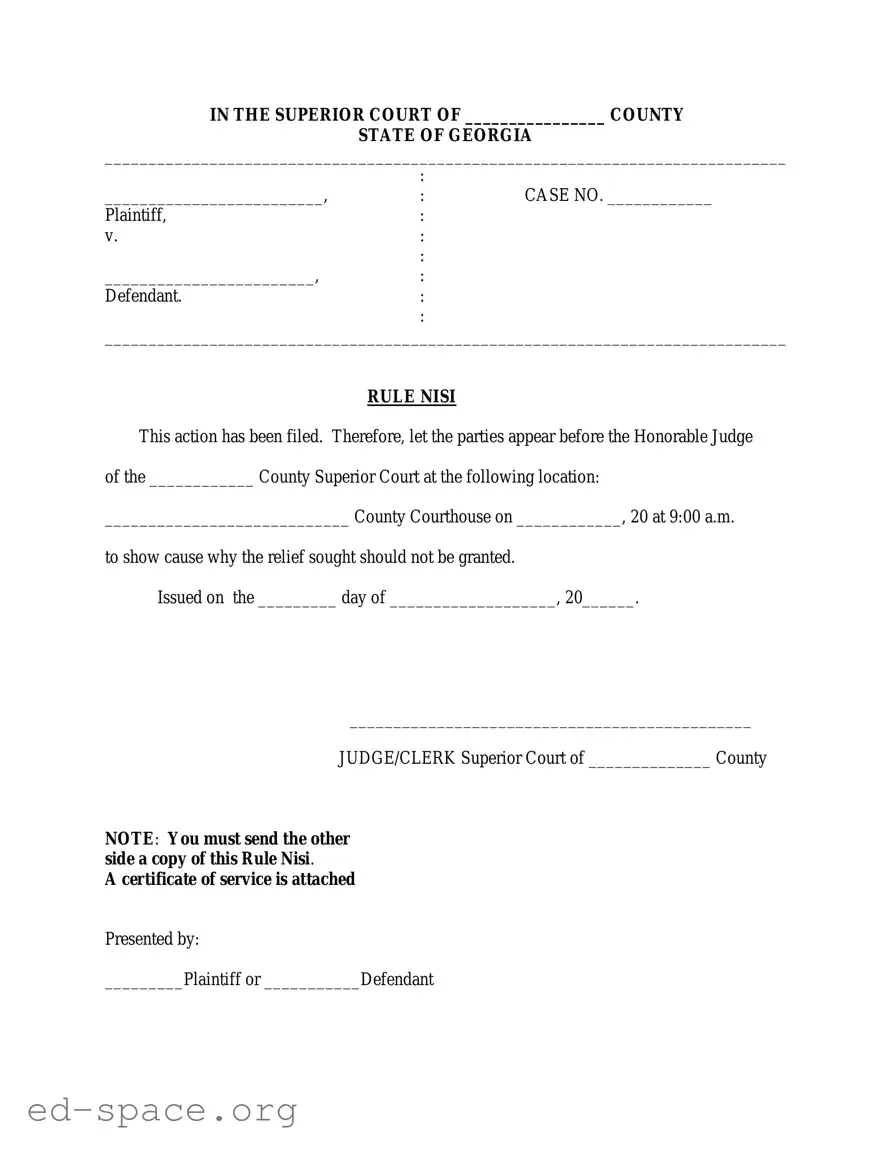
The Georgia Rule Nisi form serves as a crucial document in family law proceedings, particularly in cases involving legitimation. This form is filed in the Superior Court of Fulton County and is designed to initiate a legal process where one party, either the Petitioner or Respondent, is required to appear before a judge. The purpose of this appearance is to provide reasons why the requests made in the petition should or should not be granted. A date and time are specified for this court appearance, ensuring that both parties are aware of when they must present their case. Additionally, the form includes spaces for the names of the parties involved, the civil action file number, and the judge presiding over the case. By outlining these key components, the Rule Nisi form plays a vital role in facilitating communication and ensuring that all parties have a clear understanding of the proceedings ahead.
IN THE SUPERIOR COURT OF ________________ COUNTY
STATE OF GEORGIA
______________________________________________________________________________
|
: |
|
_________________________, |
: |
CASE NO. ____________ |
Plaintiff, |
: |
|
v. |
: |
|
|
: |
|
________________________, |
: |
|
Defendant. |
: |
|
|
: |
|
______________________________________________________________________________
RULE NISI
This action has been filed. Therefore, let the parties appear before the Honorable Judge of the ____________ County Superior Court at the following location:
____________________________ County Courthouse on ____________, 20 at 9:00 a.m.
to show cause why the relief sought should not be granted.
Issued on the _________ day of ___________________, 20______.
______________________________________________
JUDGE/CLERK Superior Court of ______________ County
NOTE: You must send the other side a copy of this Rule Nisi.
A certificate of service is attached
Presented by:
_________Plaintiff or ___________Defendant
IN THE SUPERIOR COURT OF ________________ COUNTY
STATE OF GEORGIA
______________________________________________________________________________
|
: |
|
_________________________, |
: |
CASE NO. ____________ |
Plaintiff, |
: |
|
v. |
: |
|
|
: |
|
________________________, |
: |
|
Defendant. |
: |
|
|
: |
|
______________________________________________________________________________
CERTIFICATE OF SERVICE
I hereby certify that I mailed a copy of the document entitled ________________ to the
following person:
Name of person to whom I mailed document: _______________________________
Address where I mailed document: |
_________________________________ |
|
_________________________________ |
Date I mailed document: |
_________________________________ |
_________________________________
Signature
________________________________
Printed Name
| Fact Name | Description |
|---|---|
| Purpose | The Georgia Rule Nisi form is used to notify a party to appear in court and explain why a request should not be granted. |
| Governing Law | This form is governed by the Georgia Code, specifically Title 19, which covers domestic relations. |
| Parties Involved | The form involves a Petitioner and a Respondent, both of whom have specific roles in the proceedings. |
| Court Specification | The form is specifically for use in the Superior Court of Fulton County, Georgia, under the Family Division. |
| Filing Date | The form must be dated when it is filed, indicating the official record of the court proceedings. |
| Hearing Details | The form requires specific details about the hearing, including the date, time, and courtroom number. |
Completing the Georgia Rule Nisi form is an important step in your legal process. Once you have filled out the form, it will be submitted to the court to schedule a hearing. This will allow you to present your case and seek the necessary orders. Follow these steps carefully to ensure that your form is completed accurately.
What is a Georgia Rule Nisi form?
The Georgia Rule Nisi form is a legal document used in family law cases. It is typically issued by the court to schedule a hearing where a party must show cause for why a request made in a petition should or should not be granted. This form is often used in cases involving legitimation, custody, or other family-related matters.
Who can file a Rule Nisi?
Either party involved in a family law case can file a Rule Nisi. This includes the petitioner, who initiates the case, and the respondent, who is responding to the petition. The form serves as a formal notice to the other party that a hearing will take place regarding the issues raised in the petition.
What information is required on the Rule Nisi form?
The form requires specific details, including the names of the petitioner and respondent, the civil action file number, the date and time of the hearing, and the courtroom number. Additionally, it must indicate which party is ordered to show cause and who is making the request.
How is the Rule Nisi served?
The Rule Nisi must be served to the other party in accordance with Georgia's service of process laws. This typically involves delivering a copy of the form to the respondent, ensuring they are aware of the hearing and the issues to be addressed.
What happens at the hearing?
During the hearing, both parties will have the opportunity to present their arguments and evidence. The judge will listen to both sides and make a determination based on the information provided. This decision will address the requests made in the petition.
Can I represent myself at the hearing?
Yes, you can represent yourself at the hearing, which is known as appearing pro se. However, it is advisable to seek legal counsel to ensure that you understand the process and can effectively present your case.
What if I miss the hearing?
If you miss the hearing, the judge may proceed without you. This could result in a default judgment against you, meaning the court may grant the other party's request without hearing your side. It is crucial to attend all scheduled hearings.
How do I obtain a Rule Nisi form?
You can obtain a Rule Nisi form from the Fulton County Superior Court Family Division or through their official website. It is important to use the most current version of the form to ensure compliance with court requirements.
Incomplete Information: Failing to fill out all required fields can lead to delays. Ensure that both the Petitioner and Respondent sections are fully completed.
Incorrect Dates: Providing an incorrect date for the hearing can cause confusion. Double-check the date and time before submitting the form.
Missing Signatures: Forgetting to sign the form is a common mistake. Both parties must sign where indicated to validate the submission.
Improper Courtroom Designation: Listing the wrong courtroom can result in missed hearings. Verify the courtroom number before finalizing the form.
When navigating family law matters in Georgia, several forms and documents often accompany the Georgia Rule Nisi form. These documents serve various purposes in legal proceedings and can help clarify the issues at hand.
Understanding these documents can aid individuals in preparing for their legal proceedings effectively. Each form plays a crucial role in ensuring that all parties are informed and that the process runs smoothly.
The Georgia Rule Nisi form serves a specific purpose in family law, particularly in cases involving legitimation. However, it shares similarities with several other legal documents. Below is a list of seven documents that are comparable to the Rule Nisi form, along with explanations of their similarities.
When filling out the Georgia Rule Nisi form, it’s essential to be thorough and accurate. Here are some important dos and don’ts to keep in mind:
Following these guidelines can help ensure that your form is processed smoothly and efficiently. Good luck!
Here are seven common misconceptions about the Georgia Rule Nisi form, along with explanations to clarify each point:
This form is often associated with child custody, but it can also be used in various family law matters, such as legitimation and modification of existing orders.
While having legal representation can be beneficial, individuals can file a Rule Nisi on their own. It's important to understand the process and requirements.
Filing the form does not automatically mean a hearing will occur. The court will review the petition and decide if a hearing is necessary.
Once the date and time are set by the court, changes may require additional steps and approval. It's crucial to follow the court's procedures.
Each county may have its own version of the Rule Nisi form. It's important to use the correct form for your specific county.
While the Rule Nisi form itself is essential, supporting documents may be required to provide context and strengthen your case.
The court makes decisions based on the evidence and arguments presented during the hearing. Each case is unique, and outcomes can vary.
Filling out and using the Georgia Rule Nisi form is an important step in legal proceedings regarding legitimation. Here are some key takeaways to keep in mind:
Following these guidelines will help ensure that your Rule Nisi form is filled out correctly and is ready for submission to the court.