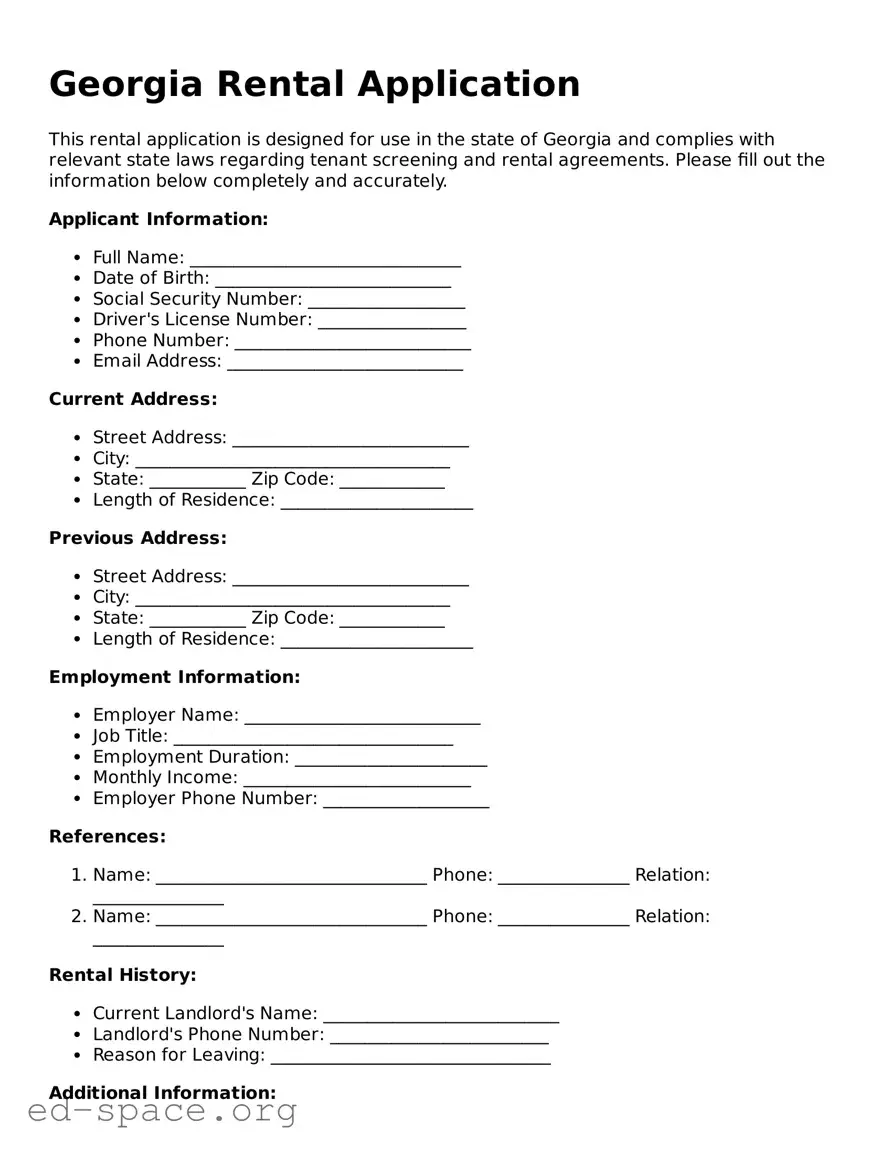
When searching for a rental property in Georgia, the rental application form plays a crucial role in the process. This form typically gathers essential information from potential tenants, including personal details, employment history, and references. Landlords use this information to assess the suitability of applicants. The form often requires applicants to provide consent for background checks, which may include credit history and criminal records. Additionally, applicants might need to disclose their income and rental history, allowing landlords to gauge their ability to pay rent on time. Understanding the components of the Georgia rental application form can empower prospective tenants, helping them present their best selves to landlords and secure their desired housing.
Georgia Rental Application
This rental application is designed for use in the state of Georgia and complies with relevant state laws regarding tenant screening and rental agreements. Please fill out the information below completely and accurately.
Applicant Information:
Current Address:
Previous Address:
Employment Information:
References:
Rental History:
Additional Information:
By signing below, you affirm that the information provided is true and complete to the best of your knowledge. You understand that any false information may result in the denial of your application.
Signature: _______________________________ Date: ___________
| Fact Name | Description |
|---|---|
| Purpose | The Georgia Rental Application form is used by landlords to collect information from prospective tenants. |
| Governing Laws | This form is governed by the Georgia Landlord-Tenant Act (O.C.G.A. § 44-7-1 et seq.). |
| Information Required | Applicants typically provide personal details, rental history, employment information, and references. |
| Application Fee | Landlords may charge an application fee to cover the cost of background and credit checks. |
| Fair Housing Compliance | The application process must comply with federal and state fair housing laws, prohibiting discrimination. |
| Background Checks | Landlords often conduct background checks, including credit history and criminal records, with the applicant's consent. |
| Processing Time | Processing the application may take anywhere from a few hours to several days, depending on the landlord's procedures. |
| Approval Notification | Once a decision is made, landlords are encouraged to notify applicants promptly regarding their application status. |
Filling out the Georgia Rental Application form is an essential step in securing a rental property. Once you complete the application, it will be reviewed by the landlord or property manager. They will assess your information to determine your eligibility as a tenant.
After completing these steps, review the form for any errors or missing information. Then, submit the application to the landlord or property management company as instructed.
What is a Georgia Rental Application form?
The Georgia Rental Application form is a document that potential tenants fill out when applying to rent a property. This form collects essential information about the applicant, including personal details, employment history, rental history, and references. Landlords use this information to assess the suitability of applicants for their rental properties.
What information is typically required on the application?
Applicants usually need to provide personal information such as their full name, contact details, Social Security number, and date of birth. Additionally, the application may require details about current and previous employment, income, rental history, and personal references. Some landlords may also ask for consent to conduct background and credit checks.
Is there a fee associated with the rental application?
Yes, many landlords or property management companies charge a non-refundable application fee. This fee typically covers the costs of processing the application, including background and credit checks. The amount can vary, so it is important to inquire about the fee before submitting the application.
How long does it take to process a rental application?
The processing time for a rental application can vary depending on the landlord or property management company. Generally, it may take anywhere from a few hours to several days. Factors that can influence the timeline include the completeness of the application, the speed of background checks, and the landlord's decision-making process.
Can a landlord deny my application?
Yes, a landlord has the right to deny a rental application. Common reasons for denial include insufficient income, poor credit history, negative rental history, or failure to provide accurate information. Landlords must comply with fair housing laws and cannot discriminate based on race, color, religion, sex, national origin, familial status, or disability.
What should I do if my application is denied?
If your application is denied, the landlord is required to provide you with a notice that includes the reason for the denial. You can request a copy of your credit report or other relevant information that may have influenced the decision. If you believe the denial was unjust, you may consider discussing the matter with the landlord or seeking legal advice.
Is there a way to improve my chances of approval?
To enhance your chances of approval, ensure that your application is complete and accurate. Providing proof of income, positive rental history, and references can also be beneficial. Additionally, being prepared to pay a higher security deposit or offering to sign a longer lease may make your application more appealing to landlords.
Inaccurate Personal Information: Many applicants fail to provide correct details such as their full name, current address, or social security number. This can lead to delays in processing the application.
Incomplete Employment History: Applicants often overlook the need to include their complete employment history. Missing information about previous jobs or gaps in employment can raise red flags for landlords.
Neglecting References: Some individuals forget to list personal or professional references. Providing references is essential as it helps landlords gauge the applicant's reliability and character.
Not Disclosing Criminal History: Failing to mention any past criminal convictions can result in immediate disqualification. Transparency is crucial, as landlords conduct background checks.
Omitting Financial Information: Applicants sometimes do not include necessary financial details, such as income or bank statements. This information helps landlords assess the applicant's ability to pay rent.
Ignoring the Application Fee: Some individuals neglect to submit the required application fee. This fee is often necessary to process the application and conduct background checks.
Failure to Sign the Application: A common oversight is not signing the application form. Without a signature, the application is considered incomplete and cannot be processed.
When renting a property in Georgia, several forms and documents complement the Georgia Rental Application. These documents help landlords assess potential tenants and ensure a smooth rental process. Understanding these forms is crucial for both landlords and tenants.
Having these documents prepared and understood can facilitate a more efficient rental process. Both landlords and tenants should ensure they are familiar with each form to protect their rights and responsibilities throughout the rental agreement.
The Rental Application form shares similarities with several other documents commonly used in real estate and leasing. Here’s a list of six documents that are comparable to the Rental Application form, along with an explanation of how they are alike:
When filling out the Georgia Rental Application form, it is essential to approach the process with care and attention to detail. Here are some dos and don'ts to keep in mind:
Misconceptions about the Georgia Rental Application form can lead to confusion for both landlords and tenants. Below are five common misunderstandings.
Many people believe that once they pay the application fee, it cannot be refunded under any circumstances. However, this is not always the case. Some landlords may choose to refund the fee if the application is denied or if the property is no longer available.
It is a common misconception that all rental applications in Georgia follow a standard format. In reality, different landlords may use different forms and require varying information. Always review the specific application provided by the landlord.
Some individuals think that exaggerating or providing false information on a rental application is inconsequential. This is incorrect; it can lead to immediate denial of the application or eviction if the false information is discovered after the lease is signed.
Many applicants assume that landlords only look at credit history when evaluating applications. In fact, landlords often consider various factors, including rental history, income verification, and background checks.
Some people believe that once they submit a rental application, they cannot make any changes. However, applicants can often update their information or provide additional documentation if necessary, but they should communicate with the landlord promptly.
Filling out a rental application in Georgia is an essential step for prospective tenants. Understanding the key components can help streamline the process and improve your chances of securing a lease. Here are some important takeaways:
By keeping these key points in mind, you can approach the Georgia rental application process with greater confidence and clarity.