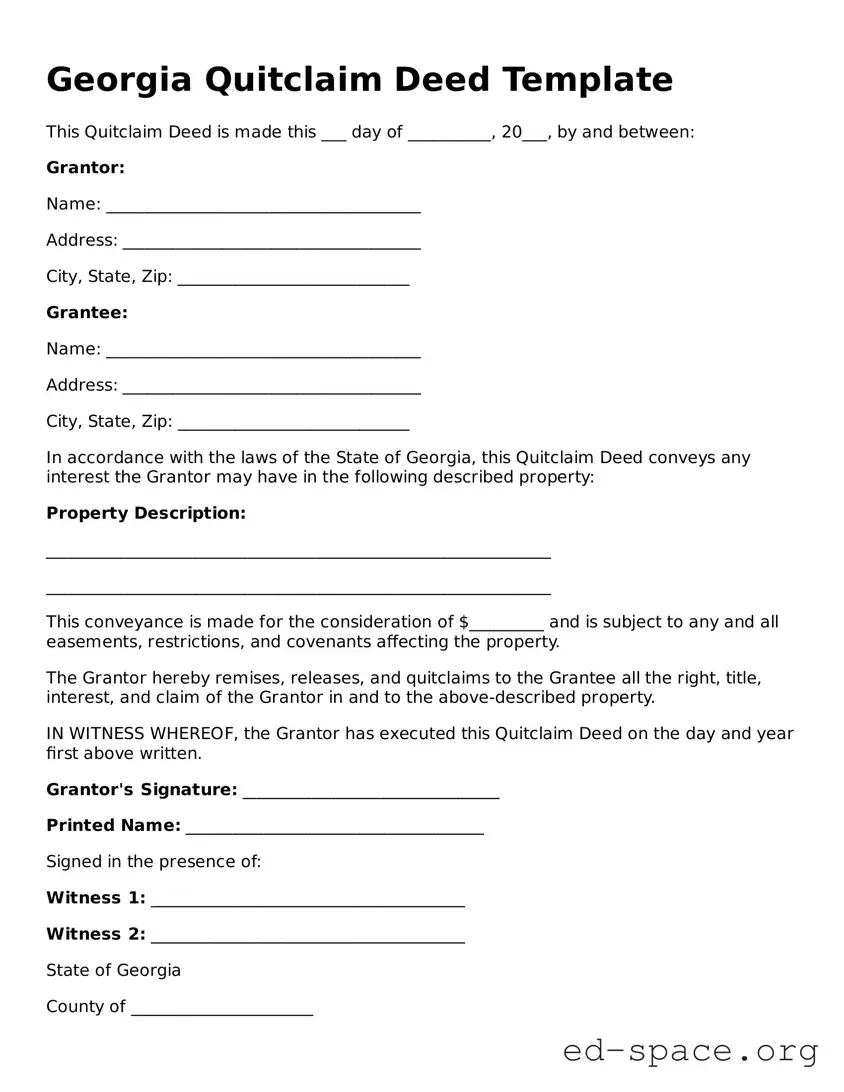
The Georgia Quitclaim Deed form serves as a vital tool in the realm of property transfers, allowing individuals to convey their interest in real estate without guaranteeing the title's validity. This form is particularly useful in situations such as transferring property between family members, settling estates, or clearing up title issues. Unlike a warranty deed, which provides assurances about the property’s title, a quitclaim deed offers no such guarantees, making it essential for parties involved to understand the implications of this type of transfer. In Georgia, the form must include specific information, such as the names of the grantor and grantee, a legal description of the property, and the signatures of the parties involved. Additionally, the deed must be notarized and recorded in the appropriate county office to ensure its legal effectiveness. Understanding these key aspects can help individuals navigate the process of property transfer smoothly and confidently.
Georgia Quitclaim Deed Template
This Quitclaim Deed is made this ___ day of __________, 20___, by and between:
Grantor:
Name: ______________________________________
Address: ____________________________________
City, State, Zip: ____________________________
Grantee:
Name: ______________________________________
Address: ____________________________________
City, State, Zip: ____________________________
In accordance with the laws of the State of Georgia, this Quitclaim Deed conveys any interest the Grantor may have in the following described property:
Property Description:
_____________________________________________________________
_____________________________________________________________
This conveyance is made for the consideration of $_________ and is subject to any and all easements, restrictions, and covenants affecting the property.
The Grantor hereby remises, releases, and quitclaims to the Grantee all the right, title, interest, and claim of the Grantor in and to the above-described property.
IN WITNESS WHEREOF, the Grantor has executed this Quitclaim Deed on the day and year first above written.
Grantor's Signature: _______________________________
Printed Name: ____________________________________
Signed in the presence of:
Witness 1: ______________________________________
Witness 2: ______________________________________
State of Georgia
County of ______________________
Personally appeared before me, the undersigned authority, the Grantor, who acknowledged that he/she executed the foregoing Quitclaim Deed for the purposes therein contained.
Notary Public: _______________________________
My Commission Expires: ______________________
| Fact Name | Details |
|---|---|
| Definition | A Quitclaim Deed in Georgia is a legal document that transfers ownership of real estate from one party to another without any warranties or guarantees regarding the title. |
| Governing Law | The Quitclaim Deed in Georgia is governed by Title 44, Chapter 5 of the Official Code of Georgia Annotated (O.C.G.A.). |
| Usage | This type of deed is commonly used among family members, in divorce settlements, or when clearing up title issues. |
| Execution Requirements | The deed must be signed by the grantor (the person transferring the property) and should be notarized to be valid. |
| Recording | To protect the interests of the grantee (the person receiving the property), the Quitclaim Deed should be recorded in the county where the property is located. |
Once you have the Georgia Quitclaim Deed form ready, it’s time to fill it out carefully. This document is essential for transferring property ownership from one party to another without any warranties. Make sure to have all the necessary information at hand as you proceed.
After completing these steps, your Quitclaim Deed will be ready for submission. Make sure to keep a copy for your records. This will serve as proof of the transaction and can be helpful in the future.
What is a Quitclaim Deed in Georgia?
A Quitclaim Deed is a legal document used to transfer ownership of real estate from one party to another. Unlike a warranty deed, a quitclaim deed does not guarantee that the grantor has clear title to the property. It simply conveys whatever interest the grantor may have in the property at the time of the transfer. This type of deed is often used among family members or in situations where the parties know each other well.
When should I use a Quitclaim Deed?
You might consider using a Quitclaim Deed when transferring property between family members, such as adding a spouse to the title or transferring property to a child. It can also be useful in divorce settlements when one party relinquishes their claim to the property. However, it’s important to understand the implications of not having a guarantee of title.
How do I complete a Quitclaim Deed in Georgia?
Completing a Quitclaim Deed involves filling out the form with the necessary information, including the names of the grantor (the person transferring the property) and the grantee (the person receiving the property), a description of the property, and the date of the transfer. It must then be signed by the grantor in the presence of a notary public. After signing, the deed should be recorded with the county clerk’s office where the property is located to make the transfer official.
Do I need a lawyer to create a Quitclaim Deed?
While it is not legally required to have a lawyer draft a Quitclaim Deed, consulting with one is advisable, especially if the property is part of a complex situation, such as a divorce or estate. A legal professional can help ensure that the deed is correctly prepared and that your interests are protected.
Is there a fee to record a Quitclaim Deed in Georgia?
Yes, there is typically a fee associated with recording a Quitclaim Deed in Georgia. The fee can vary by county, so it’s a good idea to check with your local county clerk’s office for the exact amount. This fee is generally paid at the time of recording the deed.
Will a Quitclaim Deed affect my property taxes?
In most cases, transferring property via a Quitclaim Deed will not directly affect your property taxes. However, if the transfer results in a change in ownership, it could trigger a reassessment of the property value, which may impact your taxes. It’s wise to consult your local tax assessor’s office for specific information regarding your situation.
Can a Quitclaim Deed be revoked?
Once a Quitclaim Deed is executed and recorded, it cannot be revoked unilaterally. If you wish to reverse the transfer, both parties must agree to execute a new deed to transfer the property back. This process can be complex, so seeking legal advice is recommended to navigate any issues that may arise.
What happens if there are issues with the title after using a Quitclaim Deed?
Since a Quitclaim Deed does not provide any warranties regarding the title, if issues arise, such as liens or claims from other parties, the grantee may not have legal recourse against the grantor. This highlights the importance of conducting a title search before using a Quitclaim Deed, ensuring that the property is free of encumbrances.
Can I use a Quitclaim Deed for commercial property?
Yes, a Quitclaim Deed can be used for commercial property in Georgia, just as it can for residential property. However, the parties involved should be aware of the potential risks, especially regarding the title. It’s recommended to consult with a legal professional to understand the implications of using a Quitclaim Deed in a commercial context.
Incorrect Grantee Information: One common mistake is providing incorrect or incomplete information about the grantee. This can lead to confusion and potential legal issues down the line. Ensure that the name is spelled correctly and that the address is complete.
Failure to Include a Legal Description: A quitclaim deed must include a legal description of the property. Omitting this information can make the deed invalid. Always refer to the property’s title or previous deed for accuracy.
Not Signing the Deed: The grantor must sign the deed for it to be valid. Some individuals forget this crucial step, rendering the document useless. Ensure that the signature is clear and matches the name printed on the form.
Improper Witness or Notary Requirements: In Georgia, a quitclaim deed must be signed in the presence of a notary public. Failing to have the deed notarized can lead to complications. Always check that the notary’s signature and seal are present.
Neglecting to Record the Deed: After filling out the quitclaim deed, it’s essential to record it with the county clerk's office. Many people overlook this step, which can cause issues with property rights. Recording provides public notice of the transfer.
Not Considering Tax Implications: Some individuals forget to consider the tax consequences of transferring property. This can lead to unexpected tax liabilities. Consulting a tax professional before completing the deed can be beneficial.
Using an Outdated Form: Laws and forms can change. Using an outdated version of the quitclaim deed can lead to errors. Always ensure you are using the most current form available from a reliable source.
When transferring property in Georgia, a Quitclaim Deed is often accompanied by various other forms and documents to ensure a smooth and legally sound transaction. Below is a list of commonly used documents that may be relevant in conjunction with a Quitclaim Deed.
Understanding these documents can help facilitate a property transfer and ensure that all parties are adequately protected. Each document serves a specific purpose and contributes to the overall legality and clarity of the transaction.
A Quitclaim Deed is a specific type of legal document used to transfer property rights. Several other documents serve similar purposes in property transactions. Here’s a list of nine documents that are similar to a Quitclaim Deed, along with how they relate:
When filling out the Georgia Quitclaim Deed form, it is important to follow certain guidelines to ensure accuracy and compliance. Below is a list of things you should and shouldn't do.
By adhering to these guidelines, you can help ensure that your Quitclaim Deed is filled out correctly and processed without issues.
Understanding the Georgia Quitclaim Deed form can be challenging, especially with the various misconceptions surrounding it. Here are five common misunderstandings, along with clarifications for each:
This is true, but it often leads to confusion. A quitclaim deed does transfer ownership, but it does so without any warranties or guarantees about the title. The grantor simply conveys whatever interest they may have in the property, if any.
While quitclaim deeds are commonly utilized in divorce proceedings to transfer property between spouses, they are not limited to this situation. They can also be used in various scenarios, such as transferring property between family members or in estate settlements.
This is a significant misconception. A warranty deed provides a guarantee that the grantor holds clear title to the property and has the right to transfer it. In contrast, a quitclaim deed offers no such assurances, which can be risky for the grantee.
While a quitclaim deed is a legal document that transfers ownership, it can be revoked under certain circumstances. If both parties agree, they can execute a new deed to reverse the transfer. However, this process can be complex and may require legal assistance.
Filing a quitclaim deed with the appropriate county office is essential for the transfer to be legally recognized. Without proper filing, the transfer may not be enforceable against third parties, which could lead to disputes over property ownership.
Being aware of these misconceptions can help individuals make informed decisions regarding property transfers in Georgia.
When filling out and using the Georgia Quitclaim Deed form, there are several important points to keep in mind:
By following these key takeaways, you can navigate the Quitclaim Deed process more effectively and ensure a smoother transfer of property ownership in Georgia.