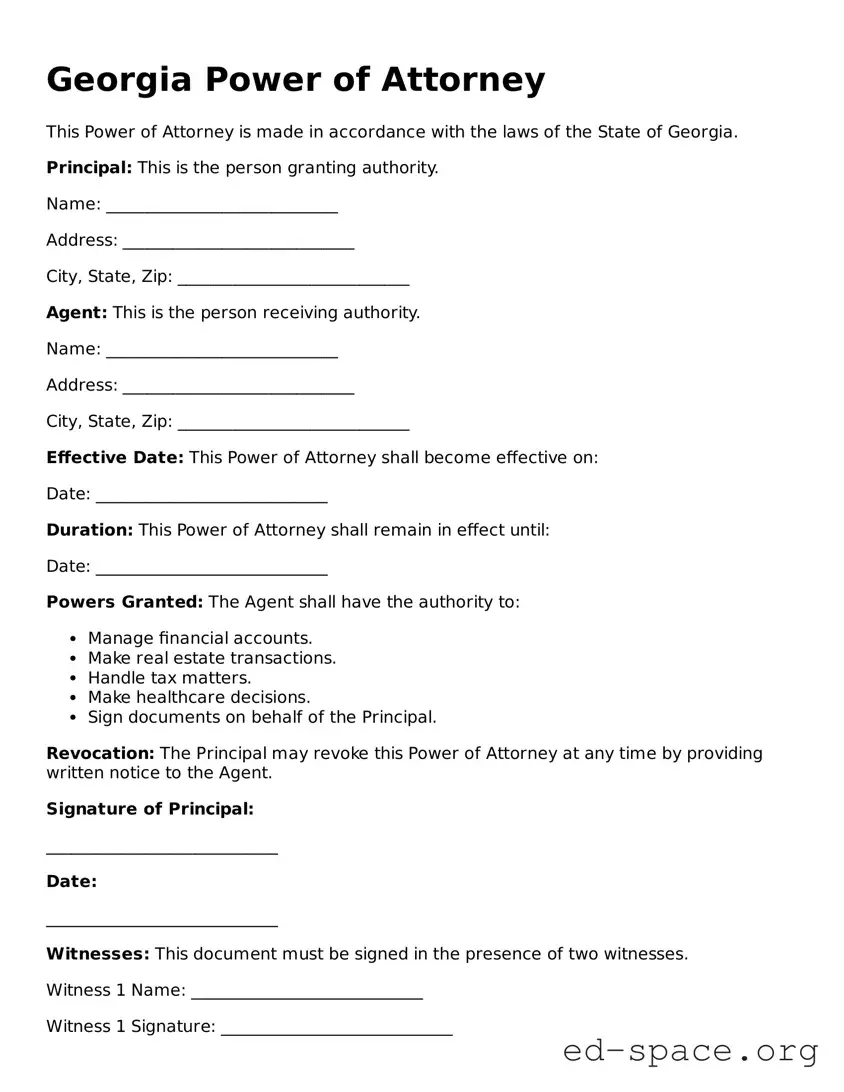
The Georgia Power of Attorney form serves as a crucial legal document that empowers an individual, known as the principal, to designate another person, referred to as the agent or attorney-in-fact, to make decisions on their behalf. This form can cover a wide range of powers, from handling financial matters to making healthcare decisions, depending on the specific needs of the principal. The flexibility of this document allows individuals to customize the scope of authority granted to their agent, whether it be limited to specific tasks or comprehensive in nature. Importantly, the form must be executed in accordance with Georgia law, which includes signing in the presence of a notary public and, in some cases, witnesses. This ensures that the principal's intentions are clear and legally binding. Understanding the nuances of the Georgia Power of Attorney form is essential for anyone looking to safeguard their interests and ensure that their wishes are honored, particularly in situations where they may become incapacitated or unable to communicate their preferences. As such, it is vital to approach this matter with care and diligence, given its potential impact on personal and financial affairs.
Georgia Power of Attorney
This Power of Attorney is made in accordance with the laws of the State of Georgia.
Principal: This is the person granting authority.
Name: ____________________________
Address: ____________________________
City, State, Zip: ____________________________
Agent: This is the person receiving authority.
Name: ____________________________
Address: ____________________________
City, State, Zip: ____________________________
Effective Date: This Power of Attorney shall become effective on:
Date: ____________________________
Duration: This Power of Attorney shall remain in effect until:
Date: ____________________________
Powers Granted: The Agent shall have the authority to:
Revocation: The Principal may revoke this Power of Attorney at any time by providing written notice to the Agent.
Signature of Principal:
____________________________
Date:
____________________________
Witnesses: This document must be signed in the presence of two witnesses.
Witness 1 Name: ____________________________
Witness 1 Signature: ____________________________
Date: ____________________________
Witness 2 Name: ____________________________
Witness 2 Signature: ____________________________
Date: ____________________________
Notary Public: This document must be notarized to be valid.
State of Georgia
County of ____________________________
Subscribed and sworn before me this ____ day of __________, 20__.
Notary Signature: ____________________________
My Commission Expires: ____________________________
| Fact Name | Details |
|---|---|
| Definition | A Georgia Power of Attorney form allows one person to grant another person the authority to act on their behalf in legal and financial matters. |
| Governing Law | The Georgia Power of Attorney is governed by the Georgia Uniform Power of Attorney Act, O.C.G.A. § 10-6B-1 et seq. |
| Types | There are several types of Power of Attorney in Georgia, including durable, limited, and springing powers of attorney. |
| Durability | A durable Power of Attorney remains effective even if the principal becomes incapacitated, making it a popular choice for long-term planning. |
| Execution Requirements | The form must be signed by the principal in the presence of a notary public and two witnesses to be valid. |
| Revocation | A Power of Attorney can be revoked at any time by the principal, provided they are mentally competent. |
| Agent's Responsibilities | The agent must act in the best interest of the principal and keep accurate records of all transactions made on their behalf. |
| Limitations | Some actions, such as creating or revoking a will, cannot be delegated through a Power of Attorney in Georgia. |
Filling out a Georgia Power of Attorney form is an important step in ensuring that your financial and legal matters are managed according to your wishes. After completing the form, you will need to sign it in front of a notary public to make it legally binding. Below are the steps to help you navigate through the process of filling out the form.
What is a Power of Attorney in Georgia?
A Power of Attorney (POA) in Georgia is a legal document that allows one person, known as the principal, to grant another person, called the agent or attorney-in-fact, the authority to act on their behalf. This authority can cover a wide range of decisions, including financial matters, healthcare decisions, and real estate transactions, depending on the type of POA established.
What types of Power of Attorney are available in Georgia?
In Georgia, there are several types of Power of Attorney. The most common are: 1. General Power of Attorney, which grants broad powers to the agent. 2. Limited Power of Attorney, which restricts the agent's authority to specific tasks or situations. 3. Durable Power of Attorney, which remains effective even if the principal becomes incapacitated. 4. Healthcare Power of Attorney, which specifically allows the agent to make medical decisions on behalf of the principal.
How do I create a Power of Attorney in Georgia?
To create a Power of Attorney in Georgia, the principal must complete a written document that clearly states their intentions. It is essential to include the names of both the principal and the agent, outline the powers granted, and specify any limitations. The document must be signed by the principal and, in some cases, witnessed or notarized to ensure its validity.
Do I need to notarize the Power of Attorney in Georgia?
Yes, in Georgia, a Power of Attorney must be notarized to be legally valid. This means that the principal must sign the document in the presence of a notary public. Additionally, if the POA is intended for real estate transactions, it must also be recorded in the county where the property is located.
Can I revoke a Power of Attorney in Georgia?
Yes, a principal can revoke a Power of Attorney at any time as long as they are mentally competent. To do so, the principal should create a written revocation document and notify the agent and any relevant third parties, such as banks or healthcare providers, that the POA has been revoked. It is advisable to keep a copy of the revocation for personal records.
What happens if the principal becomes incapacitated?
If the principal becomes incapacitated, a Durable Power of Attorney remains in effect, allowing the agent to continue making decisions on their behalf. However, if a general Power of Attorney is not designated as durable, it will become invalid upon the principal's incapacity. This highlights the importance of selecting the appropriate type of POA based on individual needs.
Can an agent be held liable for their actions under a Power of Attorney?
Generally, an agent acting under a Power of Attorney is not personally liable for decisions made on behalf of the principal, as long as they act in good faith and within the authority granted. However, if the agent acts outside their authority or engages in fraudulent behavior, they may be held liable for any resulting damages.
Is it necessary to have a lawyer to create a Power of Attorney in Georgia?
No, it is not strictly necessary to have a lawyer to create a Power of Attorney in Georgia. However, consulting with a legal professional can provide valuable guidance, ensure that the document meets all legal requirements, and help clarify any complex issues. This can be particularly important if the principal has specific or unique needs.
Failing to specify the powers granted. Individuals often overlook the importance of clearly defining the powers the agent will have. This can lead to confusion and disputes later.
Not naming an alternate agent. In cases where the primary agent is unable or unwilling to serve, not having a backup can create complications. An alternate ensures continuity in decision-making.
Using outdated forms. Legal requirements can change. Utilizing an outdated version of the Power of Attorney form may result in invalidation of the document.
Inadequate signatures. All required parties must sign the document. Failing to obtain the necessary signatures can render the Power of Attorney ineffective.
Not having the document notarized. Many states, including Georgia, require notarization for the Power of Attorney to be valid. Neglecting this step can invalidate the document.
Overlooking witness requirements. Some jurisdictions require witnesses to the signing of the Power of Attorney. Missing this step can lead to challenges regarding the document's legitimacy.
Failing to update the document. Life circumstances change. Not revising the Power of Attorney when significant life events occur can lead to unintended consequences.
Not discussing the decision with the agent. Individuals often neglect to communicate their wishes with the appointed agent. This can result in decisions that do not align with the principal's intentions.
Leaving out specific instructions. Providing vague directions can create ambiguity. Clear, detailed instructions help ensure the agent acts in accordance with the principal's wishes.
Ignoring state-specific requirements. Each state has its own rules regarding Power of Attorney forms. Failing to adhere to Georgia's specific requirements can lead to legal issues.
When establishing a Power of Attorney in Georgia, several other forms and documents may be necessary to ensure comprehensive legal coverage. These documents can help clarify the authority granted, address specific needs, and provide additional protections. Below is a list of common forms often used in conjunction with the Georgia Power of Attorney form.
These documents can be crucial for ensuring that an individual's wishes are respected and that their affairs are managed according to their preferences. It is advisable to consult with a legal professional to determine which documents are appropriate for specific circumstances.
The Power of Attorney (POA) form is a crucial legal document that grants someone the authority to act on another person's behalf. However, there are several other documents that share similarities with the Power of Attorney. Here’s a list of nine such documents, along with a brief explanation of how they relate to the POA.
Understanding these documents can help individuals make informed decisions about who they trust to manage their affairs, whether in healthcare, finances, or other important areas. Always consider consulting with a legal professional when creating or executing any of these documents to ensure they meet your specific needs.
When filling out the Georgia Power of Attorney form, it is essential to approach the process with care and attention. Here are some important do's and don'ts to consider:
Understanding the Georgia Power of Attorney form is essential for making informed decisions. However, several misconceptions can lead to confusion. Here are eight common misunderstandings:
This is not true. A Power of Attorney can be effective immediately or only when you become incapacitated, depending on how it is set up.
While you can choose anyone you trust, it's wise to select someone responsible and capable of managing your affairs.
A Power of Attorney can be revoked at any time, as long as you are mentally competent. You can change your agent or cancel the document altogether.
Your agent must act in your best interest and follow the guidelines you set in the Power of Attorney. They cannot use your funds for personal gain.
A Power of Attorney can cover various areas, including healthcare decisions, property management, and legal matters, depending on how it is drafted.
While you can create a Power of Attorney without legal help, consulting a lawyer can ensure that it meets your needs and complies with state laws.
A Power of Attorney and a living will serve different purposes. A living will outlines your healthcare wishes, while a Power of Attorney allows someone to make decisions on your behalf.
You retain control over your decisions. If you become incapacitated, your agent steps in, but you can still revoke the Power of Attorney if you regain capacity.
By understanding these misconceptions, you can better navigate the complexities of the Power of Attorney in Georgia.
When filling out and using the Georgia Power of Attorney form, there are several important points to keep in mind. Here are some key takeaways to ensure you navigate the process smoothly:
By keeping these points in mind, you can effectively utilize the Georgia Power of Attorney form to protect your interests and ensure your wishes are honored.