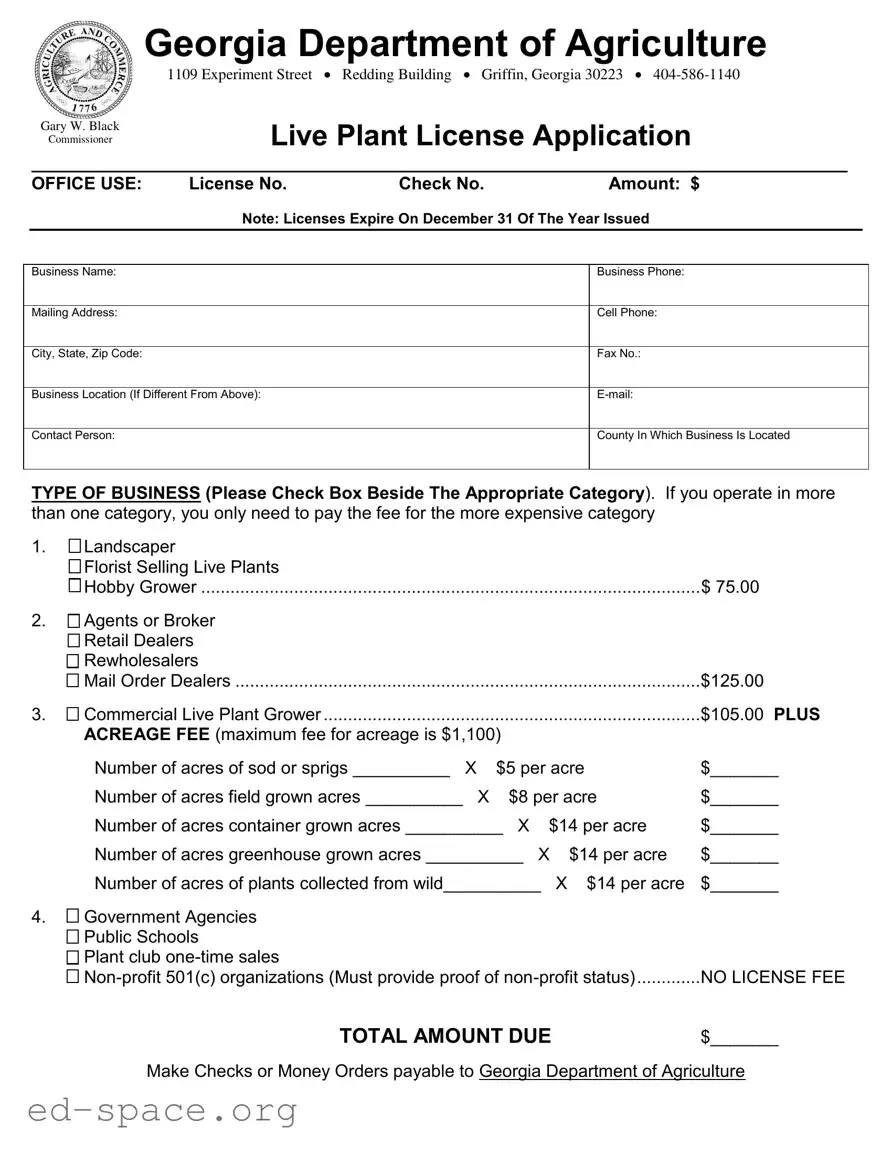
For those looking to engage in the live plant business in Georgia, the Plant License Application form is an essential document. This form, issued by the Georgia Department of Agriculture, serves as a gateway for various types of businesses, including landscapers, florists, hobby growers, and commercial live plant growers. Applicants must provide their business name, address, contact details, and the specific category under which they operate. Fees vary depending on the type of business, with commercial growers facing additional acreage fees based on their operational size. The form also includes critical information about inspections, emphasizing the importance of maintaining a clean and healthy environment for plants. It’s worth noting that licenses expire annually on December 31, and late renewals incur a penalty. Therefore, understanding the requirements and ensuring compliance is vital for anyone wishing to thrive in Georgia's plant industry.
Georgia Department of Agriculture
1109 Experiment Street Redding Building Griffin, Georgia 30223
Gary W. Black
Commissioner
Live Plant License Application
____________________________________________________________________________________
OFFICE USE: |
License No. |
Check No. |
Amount: $ |
|
Note: Licenses Expire On December 31 Of The Year Issued |
||
|
|
|
|
Business Name:
Mailing Address:
City, State, Zip Code:
Business Phone:
Cell Phone:
Fax No.:
Business Location (If Different From Above):
Contact Person:
County In Which Business Is Located
TYPE OF BUSINESS (Please Check Box Beside The Appropriate Category). If you operate in more than one category, you only need to pay the fee for the more expensive category
1. Landscaper
Florist Selling Live Plants
Hobby Grower |
$ 75.00 |
2. Agents or Broker
|
Retail Dealers |
|
|
|
|
|
|
Rewholesalers |
|
|
|
|
|
|
Mail Order Dealers |
|
|
|
$125.00 |
|
3. |
Commercial Live Plant Grower |
|
|
|
$105.00 PLUS |
|
|
ACREAGE FEE (maximum fee for acreage is $1,100) |
|
|
|
|
|
|
Number of acres of sod or sprigs __________ |
X $5 per acre |
$_______ |
|||
|
Number of acres field grown acres __________ |
X |
$8 per acre |
$_______ |
||
|
Number of acres container grown acres __________ |
X |
$14 per acre |
$_______ |
||
|
Number of acres greenhouse grown acres __________ |
X |
$14 per acre |
$_______ |
||
|
Number of acres of plants collected from wild__________ |
X $14 per acre |
$_______ |
|||
4. |
Government Agencies |
|
|
|
|
|
|
Public Schools |
|
|
|
|
|
|
Plant club |
|
|
|
|
|
|
NO LICENSE FEE |
|||||
|
TOTAL AMOUNT DUE |
|
$_______ |
|||
Make Checks or Money Orders payable to Georgia Department of Agriculture

SEND IN THIS COMPLETED FORM AND PAYMENT TO:
Georgia Department of Agriculture
1109 Experiment Street
Redding Building
Griffin, Georgia 30223
Please call our office at
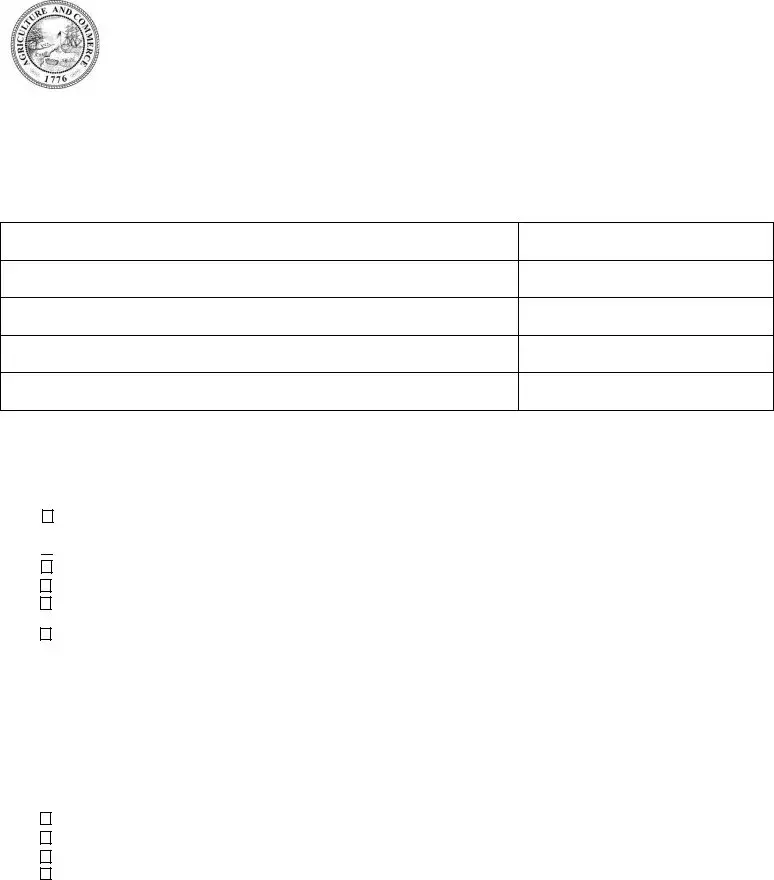
ATTENTION: If you are using this application to renew your license, a $50 late penalty is assessed on any person or business that renews after January 31 of that year.
YOUR LOCATION AND PLANTS WILL BE INSPECTED PERIODICALLY Your location must be free of weeds that could interfere with a dependable
inspection or pose a safety hazard to the inspector. Your location must be free of Fire Ants.
Your plants must be free of insects, diseases, weeds, and other plant pests. Your plants must be in good physical condition - no wilting, no waterlogging, no
nutrient deficiencies, no dead or dying plants.
*****Your location could be quarantined if you do not pass inspection as a result of serious problems relating to the health or condition of plants. If the problems noted by your inspector are not corrected, you could lose your license and be prohibited from engaging in business as a Live Plant Grower or Dealer.*****
SAVE US ALL TIME AND TROUBLE
BY KEEPING YOUR LOCATION IN EXCELLENT SHAPE.
| Fact Name | Description |
|---|---|
| Governing Law | The application is governed by the Georgia Plant Protection Act. |
| License Expiration | Licenses expire on December 31 of the year issued. |
| Application Fee | Fees vary by business type, ranging from $0 for non-profits to $125 for retail dealers. |
| Inspection Requirements | Locations and plants are subject to periodic inspections for health and safety compliance. |
| Late Renewal Penalty | A $50 late penalty applies for renewals after January 31. |
| Contact Information | For questions, contact the Georgia Department of Agriculture at 404-586-1140. |
Filling out the Georgia Plant License Application form is a straightforward process. Once completed, this form will help you apply for or renew your plant license. Follow the steps below to ensure you fill out the form correctly.
After submitting your application, your location and plants will be inspected periodically. Ensure that your business location is well-maintained to avoid issues during inspections.
What is the purpose of the Georgia Plant License Application form?
The Georgia Plant License Application form is used to apply for a license to operate as a live plant grower or dealer in Georgia. This license is required for various types of businesses, including landscapers, florists, and commercial growers. The application ensures compliance with state regulations regarding the sale and distribution of live plants.
What types of businesses need to complete this application?
Several categories of businesses must complete the application. These include landscapers, florists selling live plants, hobby growers, agents or brokers, retail dealers, rewholesalers, mail order dealers, and commercial live plant growers. Government agencies and non-profit organizations may also need to apply, although they may not incur a license fee.
What are the fees associated with the application?
Fees vary based on the type of business. For example, hobby growers pay $75, while agents, brokers, and retail dealers pay $125. Commercial live plant growers pay $105 plus an acreage fee, which can range from $5 to $14 per acre, depending on the type of plant grown. Non-profit organizations are exempt from license fees.
How is the acreage fee calculated?
The acreage fee is calculated based on the number of acres dedicated to different types of plant growth. For example, sod or sprigs incur a fee of $5 per acre, while field-grown and container-grown plants incur fees of $8 and $14 per acre, respectively. Additionally, plants collected from the wild are also subject to a fee of $14 per acre.
What happens if I miss the renewal deadline?
If the license is not renewed by January 31, a $50 late penalty will be assessed. It is important to renew the license on time to avoid additional fees and potential disruptions to business operations.
What are the inspection requirements for my location?
Locations must be kept in excellent condition to pass inspection. This includes being free of weeds, pests, and diseases. Additionally, the plants must be healthy, with no signs of wilting, waterlogging, or nutrient deficiencies. Regular inspections will be conducted to ensure compliance with these standards.
What are the consequences of failing an inspection?
Failure to pass an inspection can result in serious consequences, including the potential quarantine of the location. If problems identified during the inspection are not corrected, the business may lose its license and be prohibited from operating as a live plant grower or dealer.
How should I submit my application?
Completed applications, along with the appropriate payment, should be mailed to the Georgia Department of Agriculture at the address provided on the form. It is advisable to ensure that all required information is filled out accurately to avoid delays in processing.
Who can I contact if I have questions about the application?
For any inquiries regarding the application process, individuals can contact the Georgia Department of Agriculture at 404-586-1140. This number is available for assistance with questions related to the application or licensing process.
Incomplete Business Information: Failing to provide all required details, such as the business name, mailing address, and contact information, can lead to delays in processing the application.
Incorrect Fee Calculation: Miscalculating the total fees due, especially when multiple acreage fees apply, can result in insufficient payment and processing issues.
Neglecting to Check the Appropriate Business Type: Selecting the wrong category for the type of business can lead to incorrect licensing and potential penalties.
Failure to Provide Proof of Non-Profit Status: Non-profit organizations must include documentation proving their status; omitting this can result in denial of the application.
Ignoring the Deadline for Renewal: Submitting a renewal application after January 31 incurs a late penalty, which can be avoided by timely submission.
Inadequate Inspection Preparation: Not ensuring that the location is free of weeds, pests, and diseases can lead to failed inspections and potential quarantines.
Omitting the Contact Person's Information: Failing to designate a contact person can create communication barriers and slow down the application process.
Incorrect Acreage Reporting: Misreporting the number of acres for different plant types can lead to incorrect fees and licensing issues.
Providing Inaccurate or Outdated Contact Information: Using old phone numbers or email addresses can hinder communication from the Georgia Department of Agriculture.
Not Keeping a Copy of the Application: Failing to retain a copy for personal records can lead to confusion or disputes regarding the application status.
The Georgia Plant License Application is an essential document for businesses involved in the live plant industry. However, several other forms and documents are often required to ensure compliance with state regulations. Below is a list of these related documents.
Having these documents ready can streamline the application process and help ensure that your business remains compliant with Georgia's regulations for live plant operations. Proper preparation can save time and avoid potential issues during inspections or renewals.
When filling out the Georgia Plant License Application form, there are certain best practices to follow, as well as common pitfalls to avoid. Below is a list of things you should and shouldn't do.
Understanding the Georgia Plant License Application form is crucial for anyone in the live plant business. Here are nine common misconceptions that can lead to confusion:
Awareness of these misconceptions can help you navigate the application process more effectively. Stay informed and ensure compliance to maintain your business operations smoothly.
When filling out and using the Georgia Plant License Application form, consider the following key takeaways: