The Georgia Operating Agreement form plays a crucial role in the management and operation of limited liability companies (LLCs) within the state. This document outlines the internal workings of an LLC, detailing the rights, responsibilities, and obligations of its members. It typically covers essential aspects such as the distribution of profits and losses, the decision-making process, and the procedures for adding or removing members. Additionally, the agreement addresses how disputes among members will be resolved and lays out the process for amending the agreement itself. By establishing clear guidelines, the Operating Agreement helps prevent misunderstandings and provides a framework for the LLC's operations, thereby promoting a harmonious business environment. While not legally required in Georgia, having an Operating Agreement is highly recommended, as it can protect members’ interests and provide legal clarity in various situations.
Georgia Operating Agreement Template
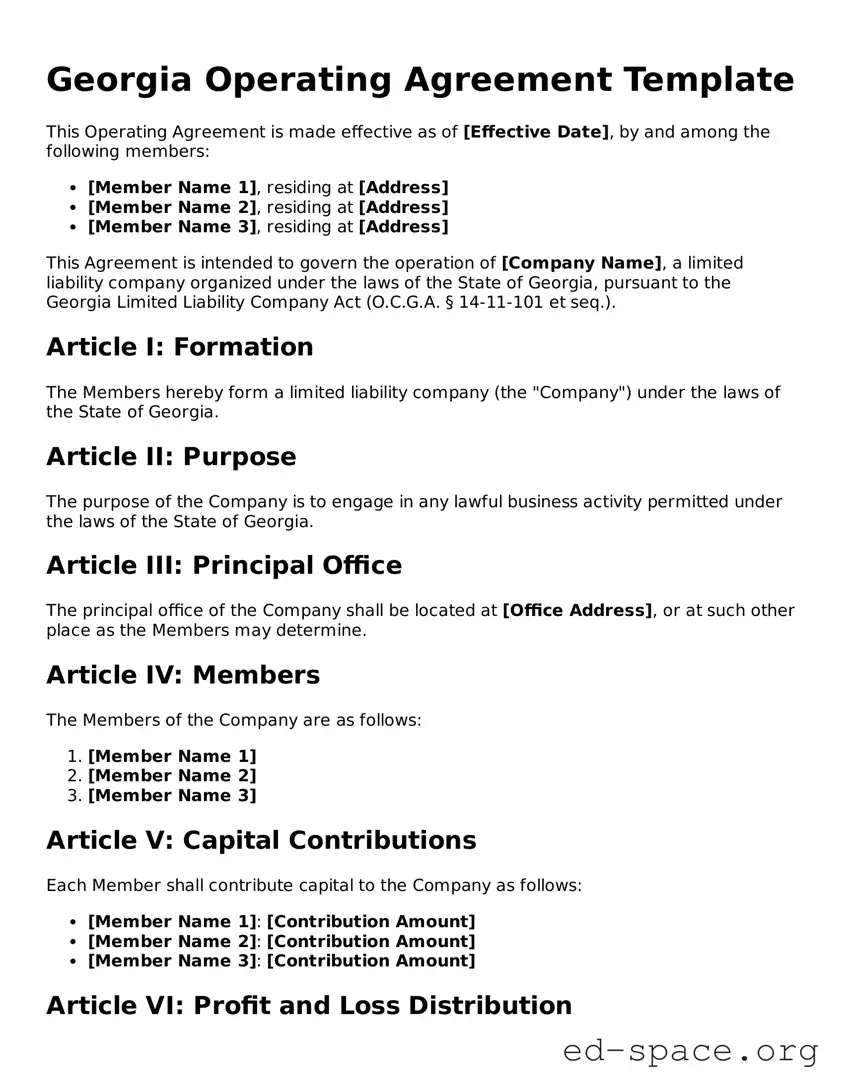
This Operating Agreement is made effective as of [Effective Date], by and among the following members:
This Agreement is intended to govern the operation of [Company Name], a limited liability company organized under the laws of the State of Georgia, pursuant to the Georgia Limited Liability Company Act (O.C.G.A. § 14-11-101 et seq.).
Article I: Formation
The Members hereby form a limited liability company (the "Company") under the laws of the State of Georgia.
Article II: Purpose
The purpose of the Company is to engage in any lawful business activity permitted under the laws of the State of Georgia.
Article III: Principal Office
The principal office of the Company shall be located at [Office Address], or at such other place as the Members may determine.
Article IV: Members
The Members of the Company are as follows:
Article V: Capital Contributions
Each Member shall contribute capital to the Company as follows:
Article VI: Profit and Loss Distribution
The profits and losses of the Company shall be allocated to the Members in proportion to their respective capital contributions.
Article VII: Management
The management of the Company shall be vested in the Members. Decisions shall be made by a majority vote of the Members.
Article VIII: Indemnification
The Company shall indemnify any Member or Manager against any loss or damage incurred in connection with the Company, to the fullest extent permitted by law.
Article IX: Amendments
This Operating Agreement may be amended only by a written agreement signed by all Members.
Article X: Governing Law
This Agreement shall be governed by and construed in accordance with the laws of the State of Georgia.
IN WITNESS WHEREOF, the Members have executed this Operating Agreement as of the date first above written.
_____________________________
[Member Name 1]
_____________________________
[Member Name 2]
_____________________________
[Member Name 3]
| Fact Name | Description |
|---|---|
| Definition | The Georgia Operating Agreement is a legal document that outlines the management structure and operating procedures of a limited liability company (LLC) in Georgia. |
| Governing Law | This agreement is governed by the laws of the State of Georgia, specifically under the Georgia Limited Liability Company Act. |
| Purpose | The primary purpose of the Operating Agreement is to establish the rights and responsibilities of the members and managers of the LLC. |
| Flexibility | Georgia law allows LLCs to customize their Operating Agreements to fit their specific needs, offering flexibility in management and profit distribution. |
| Not Mandatory | While it is not legally required to have an Operating Agreement in Georgia, having one is highly recommended to avoid disputes and clarify expectations. |
| Member Contributions | The agreement typically details the contributions of each member, whether in cash, property, or services, and how these contributions affect ownership percentages. |
| Amendments | Members can amend the Operating Agreement as needed, provided they follow the procedures outlined within the document for making changes. |
| Dispute Resolution | Many Operating Agreements include provisions for resolving disputes among members, which can help avoid costly litigation. |
| Duration | The Operating Agreement can specify the duration of the LLC, whether it is perpetual or for a fixed term, based on the members' preferences. |
Filling out the Georgia Operating Agreement form is an essential step for those forming a limited liability company (LLC) in Georgia. Once you have completed the form, you will be ready to finalize your business structure and move forward with your plans.
What is a Georgia Operating Agreement?
A Georgia Operating Agreement is a legal document that outlines the management structure and operating procedures of a limited liability company (LLC) in Georgia. It defines the roles and responsibilities of members, how profits and losses are distributed, and the process for making decisions within the company.
Is an Operating Agreement required in Georgia?
No, an Operating Agreement is not legally required in Georgia. However, having one is highly recommended. It helps clarify the management structure and can prevent disputes among members. It also provides a framework for operations, which can be beneficial for both internal and external parties.
Who should draft the Operating Agreement?
What should be included in the Operating Agreement?
Key elements of an Operating Agreement typically include the company name, purpose, member contributions, profit and loss distribution, management structure, voting rights, and procedures for adding or removing members. It may also cover dispute resolution methods and procedures for dissolution.
Can the Operating Agreement be amended?
Yes, the Operating Agreement can be amended. The process for making amendments should be outlined in the original agreement. Typically, all members must agree to any changes, ensuring that everyone is on the same page.
How does the Operating Agreement affect liability protection?
The Operating Agreement helps reinforce the limited liability status of the LLC. By clearly defining the roles and responsibilities of members, it can protect personal assets from business debts and liabilities, provided that the LLC is operated in compliance with state laws.
Where should the Operating Agreement be kept?
The Operating Agreement should be kept in a safe place, such as a secure file or document management system. All members should have access to it, and it is wise to keep a copy with other important business documents.
What happens if there is no Operating Agreement?
If there is no Operating Agreement, the LLC will be governed by Georgia's default laws for LLCs. This may not align with the members' intentions and can lead to confusion or disputes. It is best to create an Operating Agreement to ensure clarity and consistency in operations.
Not Including All Members: One common mistake is failing to list all members of the LLC. Every member should be clearly identified to ensure everyone’s rights and responsibilities are documented.
Vague Roles and Responsibilities: Some people don’t specify the roles and responsibilities of each member. Clear definitions help prevent misunderstandings and disputes down the line.
Ignoring Profit Distribution: A frequent oversight is not detailing how profits and losses will be shared among members. This can lead to confusion and conflict if not explicitly stated.
Not Addressing Decision-Making Processes: Failing to outline how decisions will be made can create chaos. It’s important to establish whether decisions require a simple majority, unanimous consent, or another method.
Overlooking Amendment Procedures: Many overlook the need to include how the Operating Agreement can be amended. This is crucial for adapting to future changes in the business or membership.
Neglecting to Include a Dissolution Clause: Not having a plan for how the LLC will be dissolved can lead to complications. A clear dissolution process helps ensure a smooth exit for members.
Using Inaccurate or Outdated Information: Some individuals submit forms with incorrect or outdated information. Always double-check names, addresses, and other details before finalizing.
Failing to Have the Agreement Signed: Lastly, a simple but critical mistake is neglecting to have all members sign the agreement. Without signatures, the document may not be legally binding.
When forming a limited liability company (LLC) in Georgia, the Operating Agreement is a crucial document that outlines the management structure and operating procedures of the business. However, several other forms and documents are often used in conjunction with the Operating Agreement to ensure compliance and effective operation. Below is a list of some of these essential documents.
Each of these documents plays a vital role in the formation and operation of an LLC in Georgia. Together with the Operating Agreement, they help ensure that the business runs smoothly and complies with all necessary regulations. Understanding these forms can greatly assist members in navigating the complexities of business ownership.
The Operating Agreement is a vital document for LLCs, outlining the management structure and operational guidelines. Several other documents serve similar purposes in different contexts. Here’s a list of seven documents that share similarities with the Operating Agreement:
When filling out the Georgia Operating Agreement form, it’s important to be careful and thorough. Here’s a helpful list of things you should and shouldn’t do:
Following these guidelines will help ensure that your Operating Agreement is properly completed and legally sound.
Understanding the Georgia Operating Agreement form is essential for anyone looking to establish a limited liability company (LLC) in the state. However, several misconceptions can lead to confusion. Here’s a list of common misunderstandings about this important document:
By addressing these misconceptions, individuals can better navigate the process of forming an LLC in Georgia and ensure they have the necessary documentation to protect their business interests.
When it comes to filling out and using the Georgia Operating Agreement form, there are several important points to keep in mind. Understanding these key takeaways can help ensure that your agreement is effective and legally sound.
By keeping these takeaways in mind, you can create an operating agreement that not only meets legal requirements but also supports the smooth operation of your business.