The Georgia Notice to Quit form is an essential document in the landlord-tenant relationship, serving as a formal notification that a tenant must vacate the rental property. This notice typically arises when a tenant fails to comply with the terms of their lease, such as non-payment of rent or violation of property rules. The form outlines the specific reasons for the eviction and provides a timeline for the tenant to respond or vacate the premises. In Georgia, landlords must follow certain legal procedures when issuing this notice, ensuring that the tenant is given adequate time to rectify the situation or prepare for relocation. Understanding the intricacies of the Notice to Quit form can help both landlords and tenants navigate their rights and responsibilities, fostering a more informed approach to property management and rental agreements. By adhering to these guidelines, landlords can protect their interests while ensuring that tenants are treated fairly throughout the eviction process.
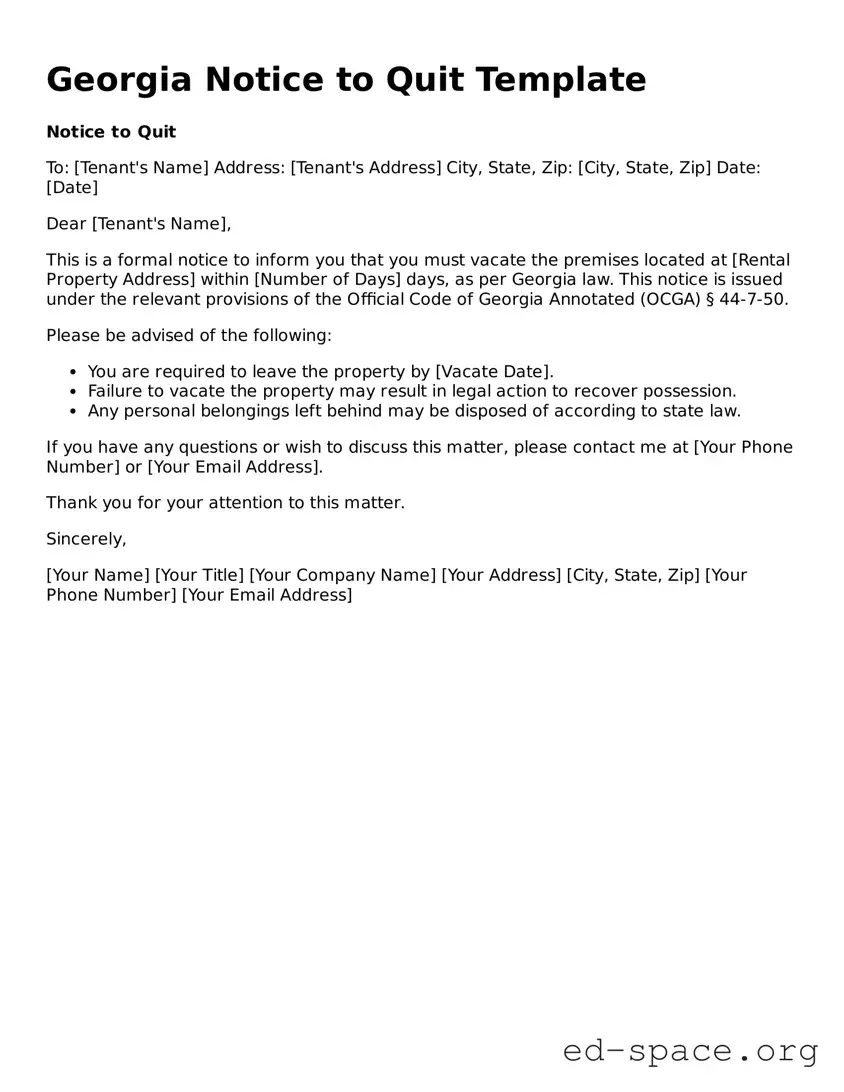
Georgia Notice to Quit Template
Notice to Quit
To: [Tenant's Name] Address: [Tenant's Address] City, State, Zip: [City, State, Zip] Date: [Date]
Dear [Tenant's Name],
This is a formal notice to inform you that you must vacate the premises located at [Rental Property Address] within [Number of Days] days, as per Georgia law. This notice is issued under the relevant provisions of the Official Code of Georgia Annotated (OCGA) § 44-7-50.
Please be advised of the following:
If you have any questions or wish to discuss this matter, please contact me at [Your Phone Number] or [Your Email Address].
Thank you for your attention to this matter.
Sincerely,
[Your Name] [Your Title] [Your Company Name] [Your Address] [City, State, Zip] [Your Phone Number] [Your Email Address]
| Fact Name | Description |
|---|---|
| Purpose | The Georgia Notice to Quit form is used by landlords to inform tenants that they must vacate the rental property. |
| Governing Law | This form is governed by Georgia law, specifically O.C.G.A. § 44-7-50 et seq. |
| Notice Period | Landlords must provide tenants with a notice period of at least 60 days for lease violations. |
| Delivery Method | The notice can be delivered in person, by mail, or posted on the property. |
| Tenant Response | Tenants have the right to respond to the notice and may contest the eviction in court. |
| Contents Required | The form must include the date, the tenant's name, and the address of the rental property. |
| Legal Consequences | If the tenant does not comply, the landlord may proceed with eviction proceedings in court. |
After obtaining the Georgia Notice to Quit form, the next step involves carefully completing it to ensure clarity and compliance with the requirements. This form is essential for initiating the process of notifying a tenant about the need to vacate a rental property. Following these steps will help you fill out the form accurately.
Once the form is completed and delivered to the tenant, you may need to prepare for the next steps, which could involve waiting for the tenant's response or taking further legal action if necessary.
What is a Georgia Notice to Quit form?
The Georgia Notice to Quit form is a legal document that a landlord uses to inform a tenant that they must vacate the rental property. This notice is typically issued when a tenant has violated the terms of the lease or has failed to pay rent on time.
When should a landlord issue a Notice to Quit?
A landlord should issue a Notice to Quit when a tenant has not paid rent, has violated lease terms, or has engaged in illegal activities on the premises. It serves as a formal request for the tenant to leave the property within a specified time frame.
How much notice is required in Georgia?
In Georgia, the notice period can vary. For non-payment of rent, a landlord typically provides a 3-day notice. For lease violations, the notice period may be longer, often 30 days, depending on the lease terms and the nature of the violation.
Can a tenant contest a Notice to Quit?
Yes, a tenant can contest a Notice to Quit. They may do so by responding to the notice or by addressing the issues in court if the landlord proceeds with eviction. It’s important for tenants to understand their rights and seek legal advice if necessary.
What happens if a tenant does not comply with the Notice to Quit?
If a tenant does not comply with the Notice to Quit, the landlord may initiate eviction proceedings. This typically involves filing a complaint with the local court and attending a hearing where both parties can present their case.
Is the Notice to Quit the same as an eviction notice?
No, a Notice to Quit is not the same as an eviction notice. The Notice to Quit is a preliminary step that informs the tenant of the need to vacate. An eviction notice is issued after the tenant fails to comply with the Notice to Quit and legal action is taken.
Do I need to provide a reason for the Notice to Quit?
Yes, the landlord should provide a clear reason for issuing the Notice to Quit. This helps the tenant understand why they are being asked to leave and can be crucial if the situation escalates to court.
Can a tenant receive a Notice to Quit for reasons other than non-payment?
Yes, a tenant can receive a Notice to Quit for various reasons, including lease violations, illegal activities, or damage to the property. The specific reasons should be clearly stated in the notice.
What should a tenant do upon receiving a Notice to Quit?
Upon receiving a Notice to Quit, a tenant should carefully read the document and understand the reasons for the notice. They should consider addressing the issue, seeking legal advice, or preparing to move out within the specified time frame.
Can a Notice to Quit be served electronically?
In Georgia, a Notice to Quit is typically required to be served in person or via certified mail. Electronic service may not be considered valid unless agreed upon in the lease. Always check local laws for specific requirements.
Incorrect Tenant Information: One common mistake is failing to accurately list the tenant's name and address. Ensure that the name matches the one on the lease agreement and that the address is complete. Missing or incorrect details can lead to delays or complications in the eviction process.
Improper Date of Notice: The date on which the notice is issued is crucial. Some individuals forget to include the date or mistakenly put the wrong date. This can affect the timeline for eviction proceedings, so always double-check the date before submitting.
Failure to State the Reason for Eviction: It's important to clearly outline the reason for the eviction in the notice. Whether it's for non-payment of rent or lease violations, omitting this information can render the notice ineffective.
Not Providing Sufficient Time for Compliance: Georgia law requires landlords to give tenants a specific amount of time to respond to the notice. Many people mistakenly provide too little time, which can invalidate the notice. Familiarize yourself with the required notice period for your situation.
Neglecting to Sign the Notice: A signature is a critical component of the Notice to Quit. Some individuals forget to sign the document or fail to provide their printed name. Without a signature, the notice may not be legally binding.
Not Keeping a Copy: After filling out the Notice to Quit, it’s essential to keep a copy for your records. Some people overlook this step. Having a copy can serve as proof of the notice being issued and can be helpful in any future legal proceedings.
When dealing with rental agreements and potential evictions in Georgia, it's essential to be familiar with various forms and documents that may accompany the Georgia Notice to Quit. Understanding these documents can help you navigate the process more effectively and ensure that you are well-prepared for any legal proceedings. Here are some important forms you might encounter:
By familiarizing yourself with these documents, you can better understand your rights and responsibilities as a landlord or tenant in Georgia. Each form plays a crucial role in ensuring that the rental process runs smoothly and that all parties are aware of their obligations. Always consider seeking professional advice if you have questions about these forms or the eviction process.
The Notice to Quit form is an important document in the realm of landlord-tenant relationships. It serves as a formal notice to a tenant to vacate a rental property. Several other documents share similarities with this form, often serving related purposes in the eviction process or landlord-tenant communications. Here’s a look at eight documents that are similar to the Notice to Quit:
Each of these documents plays a crucial role in the landlord-tenant relationship, ensuring that both parties understand their rights and responsibilities. While they may vary in specific details and purposes, they all contribute to the overall process of managing rental agreements and addressing disputes.
When filling out the Georgia Notice to Quit form, it's essential to be thorough and accurate. Here are some key things to keep in mind:
By adhering to these guidelines, you can ensure that the Notice to Quit form is filled out correctly and effectively communicates your intent.
Understanding the Georgia Notice to Quit form is essential for both landlords and tenants. However, several misconceptions can lead to confusion. Here are eight common misunderstandings about this important document:
Many people believe that a Notice to Quit means the tenant is being evicted immediately. In reality, it is a formal request for the tenant to leave the property, but it does not automatically result in eviction.
Landlords must have a valid reason to issue a Notice to Quit, such as non-payment of rent or lease violations. Simply wanting a tenant to leave is not enough.
For it to be legally valid, a Notice to Quit must be in writing. Verbal notices do not hold up in court.
Receiving a Notice to Quit does not strip tenants of their rights. They can contest the notice and seek legal advice.
While personal delivery is one method, landlords can also send the notice via certified mail or post it on the property, depending on state laws.
Ignoring a Notice to Quit can lead to serious consequences, including eviction proceedings. It is crucial for tenants to respond appropriately.
A Notice to Quit is not a lease termination. It is a request to vacate, while lease termination involves ending the lease agreement itself.
Different situations may require different types of Notices to Quit. The specific wording and requirements can vary based on the reason for the notice.
By clearing up these misconceptions, both landlords and tenants can navigate the rental process more effectively and understand their rights and responsibilities.
Filling out and using the Georgia Notice to Quit form is an important step in the eviction process. Here are some key takeaways to consider:
By following these guidelines, you can navigate the eviction process more effectively and ensure that your rights as a property owner are protected.