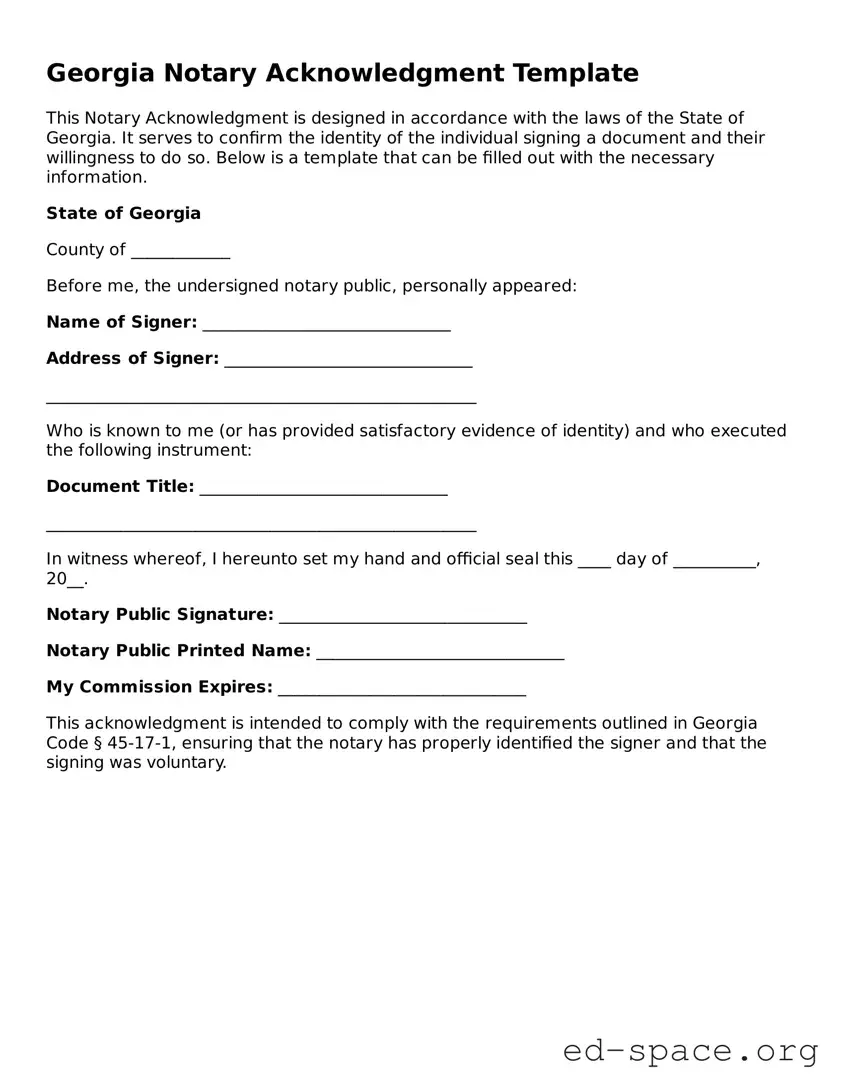
The Georgia Notary Acknowledgement form serves a vital purpose in the realm of legal documentation. This form is essential for verifying the identity of individuals signing important documents, ensuring that the signatures are authentic and made willingly. In Georgia, the notary public plays a key role in this process, acting as an impartial witness. The form typically includes details such as the name of the signer, the date of the acknowledgment, and the notary's signature and seal. It is crucial for various legal documents, including deeds, contracts, and affidavits, as it helps prevent fraud and protects the rights of all parties involved. Understanding the components and significance of this form can empower individuals to navigate legal processes with confidence. It fosters trust in transactions and provides a safeguard for those who rely on the integrity of signed documents.
Georgia Notary Acknowledgment Template
This Notary Acknowledgment is designed in accordance with the laws of the State of Georgia. It serves to confirm the identity of the individual signing a document and their willingness to do so. Below is a template that can be filled out with the necessary information.
State of Georgia
County of ____________
Before me, the undersigned notary public, personally appeared:
Name of Signer: ______________________________
Address of Signer: ______________________________
____________________________________________________
Who is known to me (or has provided satisfactory evidence of identity) and who executed the following instrument:
Document Title: ______________________________
____________________________________________________
In witness whereof, I hereunto set my hand and official seal this ____ day of __________, 20__.
Notary Public Signature: ______________________________
Notary Public Printed Name: ______________________________
My Commission Expires: ______________________________
This acknowledgment is intended to comply with the requirements outlined in Georgia Code § 45-17-1, ensuring that the notary has properly identified the signer and that the signing was voluntary.
| Fact Name | Description |
|---|---|
| Purpose | The Georgia Notary Acknowledgment form is used to verify the identity of a signer and confirm that they signed a document willingly. |
| Governing Law | This form is governed by the Official Code of Georgia Annotated (O.C.G.A.) § 45-17-1 et seq. |
| Signature Requirement | The signer must physically appear before the notary public to sign the document in their presence. |
| Notary's Role | The notary public is responsible for confirming the identity of the signer and ensuring they understand the document they are signing. |
| Form Components | The form typically includes the notary's signature, seal, and the date of the acknowledgment. |
| Validity | Once completed, the acknowledgment serves as proof that the document was signed in accordance with Georgia law. |
| Record Keeping | Notaries are encouraged to maintain a journal of all acknowledgments performed for accountability. |
| Fees | Georgia law allows notaries to charge a fee for their services, typically not exceeding $2 per signature. |
Filling out the Georgia Notary Acknowledgement form is a straightforward process. Once completed, the form will be ready for use in various legal and official matters that require notarization. Follow these steps to ensure accuracy.
Once you have filled out the form, double-check all the information for accuracy. This step is crucial to avoid any issues later on. After verification, the form is ready for submission or use as required.
What is a Georgia Notary Acknowledgement form?
The Georgia Notary Acknowledgement form is a document used to verify that a signature on a legal document is genuine. It is typically signed in the presence of a notary public, who confirms the identity of the signer and witnesses the signing process. This form is often required for documents like deeds, contracts, and affidavits to ensure their validity.
Who can act as a notary public in Georgia?
In Georgia, a notary public must be at least 18 years old, a resident of the state, and able to read and write in English. They must also complete an application and be appointed by the Superior Court in their county. Once appointed, notaries have the authority to perform various notarial acts, including acknowledgements.
How do I complete a Georgia Notary Acknowledgement form?
To complete the form, the signer must appear before the notary. The notary will fill in the details, including the date, the name of the signer, and the type of document being acknowledged. The signer will then sign the document in the presence of the notary, who will also sign and stamp the form to finalize the acknowledgment.
Is there a fee for notarization in Georgia?
Yes, notaries in Georgia can charge a fee for their services. The maximum fee allowed is $2.00 per signature. However, notaries may choose to offer their services for free or charge different amounts based on their discretion. It’s advisable to confirm the fee before the notarization process begins.
Do I need to bring any identification to the notary?
Yes, it is important to bring a valid form of identification when meeting with a notary. Acceptable forms of ID include a driver’s license, passport, or any government-issued identification that includes a photo and signature. This helps the notary confirm your identity before proceeding with the acknowledgment.
Can I sign the document before meeting with the notary?
No, the signer must not sign the document before meeting with the notary. The notary needs to witness the signing to properly complete the acknowledgment. Signing beforehand may invalidate the notary's certification, as they must confirm that the signature is made in their presence.
Where can I find a notary public in Georgia?
Notaries can be found in various locations, including banks, law offices, and shipping centers. Additionally, many notaries offer mobile services and can meet you at a convenient location. You can also search online directories to find a notary public in your area. Always check their credentials and availability before scheduling an appointment.
Incorrect Signer Information: One common mistake is providing inaccurate details about the person signing the document. Ensure that the name matches the identification presented. This includes checking for spelling errors and confirming that the name is consistent throughout the document.
Missing Date: Failing to include the date of the acknowledgment can lead to confusion. It is essential to clearly indicate when the document was signed. Always double-check that the date is filled in correctly.
Notarization without Presence: A notary must witness the signer’s signature. Some individuals mistakenly think they can notarize a document without the signer present. This is not permissible and can invalidate the notarization.
Improper Notary Signature and Seal: The notary’s signature and seal must be clear and properly placed. Sometimes, individuals forget to apply the seal or do not sign in the designated area. Ensure that both are completed to avoid issues.
When engaging in legal or formal transactions in Georgia, several documents often accompany the Notary Acknowledgement form. Each document serves a specific purpose and contributes to the overall validity of the transaction. Below is a list of commonly used forms and documents that may be utilized alongside the Notary Acknowledgement form.
Understanding these documents and their purposes can help ensure that legal transactions are completed smoothly and effectively. Each form plays a vital role in protecting the rights and interests of the parties involved.
The Notary Acknowledgment form serves a specific purpose in verifying the identity of individuals signing documents. Several other documents share similarities with the Notary Acknowledgment in terms of function and intent. Here’s a list of six such documents:
When filling out the Georgia Notary Acknowledgement form, it is essential to follow specific guidelines to ensure accuracy and compliance. Below is a list of things you should and shouldn't do.
Understanding the Georgia Notary Acknowledgment form is essential for anyone involved in legal documents. However, several misconceptions can lead to confusion. Here are four common misunderstandings:
Many people believe that a notary can certify a document even if it is not signed in their presence. This is incorrect. A notary's role is to verify the identity of the signer and witness the signing of the document.
This misconception is widespread. Notaries do not need to be lawyers. While some lawyers are notaries, many notaries come from various backgrounds and professions.
While related, these terms are not interchangeable. A notary acknowledgment specifically refers to the process of a notary confirming that the signer willingly signed the document. Notarization can encompass various acts, including administering oaths.
This is a common belief, but notary acknowledgments can be used for many types of documents, including powers of attorney, affidavits, and contracts. They serve a broader purpose in verifying signatures on various legal documents.
By addressing these misconceptions, individuals can better navigate the requirements and processes associated with the Georgia Notary Acknowledgment form.
When filling out and using the Georgia Notary Acknowledgement form, it is essential to understand the key elements involved. Here are six important takeaways:
Understanding these key points will help ensure that the Georgia Notary Acknowledgement form is filled out correctly and used effectively. Take the time to familiarize yourself with the requirements to avoid any potential pitfalls.