In Georgia, a Non-disclosure Agreement (NDA) is a crucial tool for individuals and businesses looking to protect sensitive information. This legal document helps maintain confidentiality between parties, ensuring that proprietary data, trade secrets, and other private information are not disclosed to unauthorized individuals. When entering into an NDA, it’s important to clearly define what constitutes confidential information, the obligations of the parties involved, and the duration of the confidentiality requirement. Additionally, the agreement may outline the consequences of a breach, providing a sense of security for all parties. Understanding the nuances of the Georgia NDA form can empower you to safeguard your interests effectively while fostering trust in business relationships.
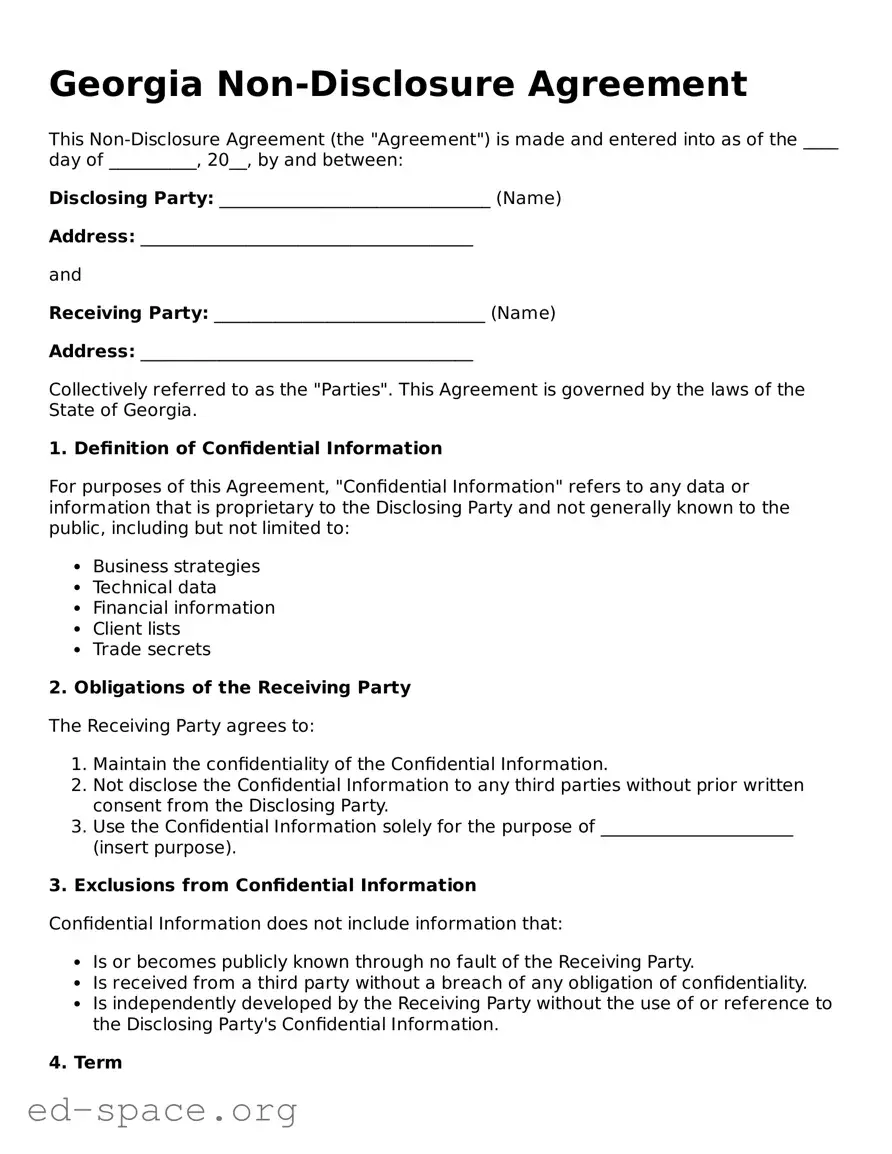
Georgia Non-Disclosure Agreement
This Non-Disclosure Agreement (the "Agreement") is made and entered into as of the ____ day of __________, 20__, by and between:
Disclosing Party: _______________________________ (Name)
Address: ______________________________________
and
Receiving Party: _______________________________ (Name)
Address: ______________________________________
Collectively referred to as the "Parties". This Agreement is governed by the laws of the State of Georgia.
1. Definition of Confidential Information
For purposes of this Agreement, "Confidential Information" refers to any data or information that is proprietary to the Disclosing Party and not generally known to the public, including but not limited to:
2. Obligations of the Receiving Party
The Receiving Party agrees to:
3. Exclusions from Confidential Information
Confidential Information does not include information that:
4. Term
This Agreement shall commence on the date first written above and shall continue in effect for a period of ____ years, unless terminated earlier by either party with ____ days written notice.
5. Return of Materials
Upon termination of this Agreement, the Receiving Party agrees to return or destroy all materials containing Confidential Information.
6. Miscellaneous
This Agreement constitutes the entire understanding between the Parties regarding the subject matter herein and supersedes all prior agreements. This Agreement may only be amended in writing and signed by both Parties.
IN WITNESS WHEREOF, the Parties hereto have executed this Non-Disclosure Agreement as of the date first above written.
Disclosing Party: _______________________________
Signature: _______________________________
Date: _______________________________
Receiving Party: _______________________________
Signature: _______________________________
Date: _______________________________
| Fact Name | Description |
|---|---|
| Purpose | A Georgia Non-disclosure Agreement (NDA) protects confidential information shared between parties. |
| Governing Law | The NDA is governed by the laws of the State of Georgia. |
| Parties Involved | Typically, the NDA involves a disclosing party and a receiving party. |
| Duration | The duration of confidentiality can vary, often lasting for a specified number of years. |
| Exclusions | Information that is public knowledge or independently developed is usually excluded from the NDA. |
| Enforceability | For an NDA to be enforceable, it must be clear, reasonable, and not overly broad. |
| Consequences of Breach | Breaching the NDA can lead to legal action and potential damages for the disclosing party. |
Filling out the Georgia Non-disclosure Agreement form is a straightforward process. Once you complete the form, you can move forward with your business discussions, ensuring that sensitive information remains protected.
What is a Georgia Non-disclosure Agreement (NDA)?
A Georgia Non-disclosure Agreement (NDA) is a legally binding contract designed to protect sensitive information shared between parties. This agreement ensures that confidential information, such as trade secrets, business strategies, or proprietary data, remains private and is not disclosed to unauthorized individuals or entities. NDAs are commonly used in various business contexts, including partnerships, employment relationships, and joint ventures.
Who should use a Non-disclosure Agreement in Georgia?
Any individual or organization that intends to share confidential information with another party may benefit from using a Non-disclosure Agreement. This includes businesses seeking to protect their intellectual property, employers wishing to safeguard trade secrets, and individuals engaging in negotiations that involve sensitive information. Essentially, if there is a need to keep information private, an NDA is a useful tool.
What are the key components of a Georgia NDA?
A well-drafted Georgia NDA typically includes several essential components: a clear definition of what constitutes confidential information, the obligations of both parties regarding the handling of that information, the duration of confidentiality, and any exclusions from confidentiality (such as information that is publicly available). Additionally, the agreement may outline the consequences of a breach, providing a framework for resolution.
How long does the confidentiality obligation last under a Georgia NDA?
The duration of confidentiality obligations in a Georgia NDA can vary based on the agreement between the parties. Generally, the term can range from a specific number of years to an indefinite period, depending on the nature of the information shared. It is crucial for both parties to agree on a timeframe that adequately protects the sensitive information while also allowing for reasonable use in the future.
Can a Non-disclosure Agreement be enforced in Georgia?
Yes, a Non-disclosure Agreement can be enforced in Georgia as long as it meets the necessary legal requirements. For an NDA to be enforceable, it must be clear, reasonable in scope, and not violate public policy. If a dispute arises, parties can seek legal remedies through the courts, which may include injunctions or monetary damages for breaches of the agreement.
Not clearly identifying the parties involved. It's essential to include the full names and addresses of all parties to avoid confusion.
Failing to define what constitutes confidential information. Be specific about what information is protected to ensure clarity.
Omitting the duration of confidentiality. Specify how long the information should remain confidential to prevent misunderstandings.
Not including the purpose of sharing the information. Clearly state why the information is being shared to provide context.
Neglecting to outline the obligations of each party. Each party should understand their responsibilities regarding the confidential information.
Using vague language. Be precise and clear in your wording to avoid ambiguity that could lead to disputes later.
Failing to consider exceptions to confidentiality. It’s important to outline any situations where disclosure is permitted, such as legal requirements.
Not signing and dating the agreement. Ensure all parties sign and date the document to make it legally binding.
A Georgia Non-disclosure Agreement (NDA) is often accompanied by several other documents that help clarify the terms of confidentiality and protect sensitive information. Below are four commonly used forms that complement an NDA.
These documents work together to create a comprehensive framework for protecting sensitive information and ensuring that all parties are aware of their responsibilities. It is advisable to review these forms carefully to ensure they meet your specific needs.
A Non-disclosure Agreement (NDA) is a crucial document that protects confidential information. However, there are several other documents that serve similar purposes in safeguarding sensitive information or relationships. Here’s a list of eight documents that share similarities with an NDA:
Understanding these documents can help individuals and businesses protect their interests effectively. Each one serves a specific purpose but shares the common goal of safeguarding sensitive information.
When filling out the Georgia Non-disclosure Agreement (NDA) form, it's important to approach the task with care. Here are some guidelines to help ensure that you complete the form correctly and effectively.
By following these do's and don'ts, you can help ensure that your Non-disclosure Agreement is completed accurately and serves its intended purpose.
Understanding the nuances of a Non-disclosure Agreement (NDA) in Georgia is essential for anyone considering entering into such an agreement. Unfortunately, several misconceptions can lead to confusion. Here is a list of common misunderstandings regarding the Georgia Non-disclosure Agreement form:
By addressing these misconceptions, individuals and businesses can better navigate the complexities of Non-disclosure Agreements in Georgia. A clear understanding of what an NDA entails can lead to more effective and secure partnerships.
When filling out and using the Georgia Non-disclosure Agreement (NDA) form, consider the following key takeaways: