Homepage Free Non-compete Agreement Form for Georgia
Content Overview

In the competitive landscape of business, protecting your interests is paramount, and one essential tool for doing so is the Georgia Non-compete Agreement form. This legal document serves as a safeguard for employers, helping to prevent employees from sharing sensitive information or engaging in activities that could harm the business after their employment ends. The form outlines specific terms, including the duration of the non-compete period, the geographical area in which the restrictions apply, and the types of activities that are prohibited. It is designed to be clear and enforceable, ensuring that both parties understand their rights and obligations. By establishing these parameters, the agreement not only fosters trust between employer and employee but also contributes to a fair and competitive market environment. Understanding the key components of this form can empower both employers and employees to navigate their professional relationships with clarity and confidence.

Document Preview

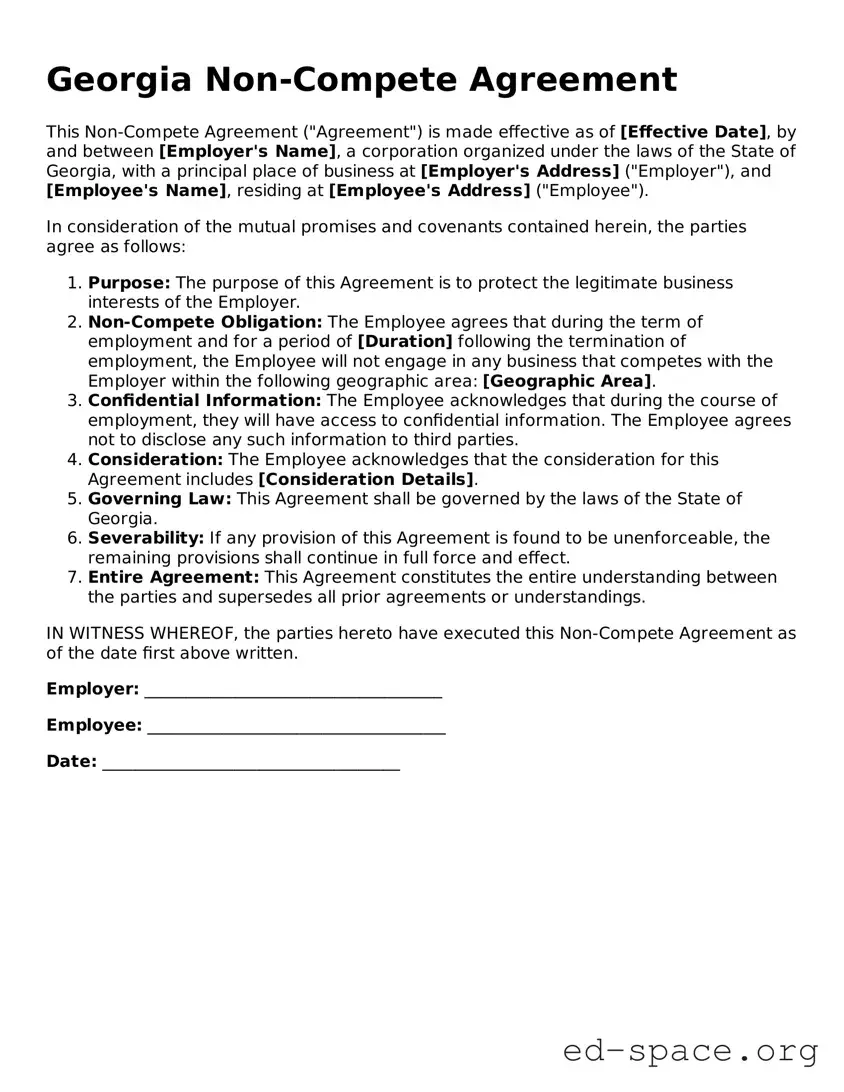
Georgia Non-Compete Agreement

This Non-Compete Agreement ("Agreement") is made effective as of [Effective Date], by and between [Employer's Name], a corporation organized under the laws of the State of Georgia, with a principal place of business at [Employer's Address] ("Employer"), and [Employee's Name], residing at [Employee's Address] ("Employee").

In consideration of the mutual promises and covenants contained herein, the parties agree as follows:

  1. Purpose: The purpose of this Agreement is to protect the legitimate business interests of the Employer.
  2. Non-Compete Obligation: The Employee agrees that during the term of employment and for a period of [Duration] following the termination of employment, the Employee will not engage in any business that competes with the Employer within the following geographic area: [Geographic Area].
  3. Confidential Information: The Employee acknowledges that during the course of employment, they will have access to confidential information. The Employee agrees not to disclose any such information to third parties.
  4. Consideration: The Employee acknowledges that the consideration for this Agreement includes [Consideration Details].
  5. Governing Law: This Agreement shall be governed by the laws of the State of Georgia.
  6. Severability: If any provision of this Agreement is found to be unenforceable, the remaining provisions shall continue in full force and effect.
  7. Entire Agreement: This Agreement constitutes the entire understanding between the parties and supersedes all prior agreements or understandings.

IN WITNESS WHEREOF, the parties hereto have executed this Non-Compete Agreement as of the date first above written.

Employer: ____________________________________

Employee: ____________________________________

Date: ____________________________________

PDF Form Details

Fact Name Details
Governing Law The Georgia Non-compete Agreement is governed by Georgia law, specifically O.C.G.A. § 13-8-50 et seq.
Enforceability Non-compete agreements in Georgia are enforceable if they are reasonable in time, geographic area, and scope of activity.
Duration Typically, a duration of two years is considered reasonable for non-compete agreements in Georgia.
Consideration For a non-compete agreement to be valid, there must be adequate consideration, such as employment or access to trade secrets.
Restrictions on Employees Employers can restrict employees from working for competitors or starting a competing business after leaving the company.
Modification Georgia courts may modify overly broad non-compete agreements to make them enforceable, rather than voiding them entirely.

Georgia Non-compete Agreement: Usage Guidelines

Filling out the Georgia Non-compete Agreement form is an important step in establishing the terms of a non-compete arrangement between an employer and an employee. This process involves providing specific information about the parties involved, the nature of the agreement, and the geographic scope of the restrictions. Following these steps carefully will ensure that the form is completed accurately.

  1. Obtain the Form: Start by downloading or printing the Georgia Non-compete Agreement form from a reliable source.
  2. Fill in the Date: Write the date on which the agreement is being executed at the top of the form.
  3. Identify the Parties: Clearly state the names and addresses of both the employer and the employee. Ensure that the spelling is correct.
  4. Define the Scope: Specify the nature of the business and the activities that are subject to the non-compete clause.
  5. Set the Duration: Indicate the time period during which the non-compete restrictions will apply. This could range from a few months to several years.
  6. Specify the Geographic Area: Clearly define the geographic limits within which the employee agrees not to compete.
  7. Include Additional Terms: If applicable, add any other terms or conditions that are relevant to the agreement.
  8. Review the Agreement: Carefully read through the entire form to ensure that all information is accurate and complete.
  9. Sign the Agreement: Both parties must sign and date the form to make it legally binding.
  10. Keep Copies: Make copies of the signed agreement for both the employer and the employee for future reference.

Once the form is filled out and signed, it becomes a formal document that outlines the expectations and limitations regarding competition. It is advisable to keep a copy for your records and to consult with a legal professional if there are any uncertainties about the terms or implications of the agreement.

Your Questions, Answered

What is a Non-compete Agreement in Georgia?

A Non-compete Agreement is a legal contract between an employer and an employee that restricts the employee from engaging in certain competitive activities after leaving the company. In Georgia, these agreements are enforceable under specific conditions, which aim to protect legitimate business interests without unduly restricting an individual's right to work.

What are the key elements of a valid Non-compete Agreement in Georgia?

For a Non-compete Agreement to be enforceable in Georgia, it must be reasonable in scope, duration, and geographic area. The agreement should protect legitimate business interests, such as trade secrets or customer relationships. Additionally, it must not impose an undue hardship on the employee's ability to find work in their field.

How long can a Non-compete Agreement last in Georgia?

The duration of a Non-compete Agreement in Georgia varies based on the specific circumstances of the employment. Generally, a duration of one to two years is considered reasonable. However, the length must be justifiable based on the nature of the business and the employee's role.

Are there any geographic limitations for Non-compete Agreements in Georgia?

Yes, geographic limitations are an important aspect of Non-compete Agreements in Georgia. The area in which the employee is restricted from competing must be clearly defined and reasonable in relation to the employer's business operations. A vague or overly broad geographic scope may render the agreement unenforceable.

Can an employee negotiate the terms of a Non-compete Agreement?

Yes, employees can negotiate the terms of a Non-compete Agreement before signing. It is advisable for employees to seek clarification on any terms they find unreasonable or unclear. Negotiation can lead to a more balanced agreement that protects the employer's interests while allowing the employee to pursue future opportunities.

What happens if a Non-compete Agreement is violated?

If a Non-compete Agreement is violated, the employer may pursue legal action against the employee. This could result in a court issuing an injunction to prevent further competition or awarding damages to the employer. The specific consequences depend on the terms of the agreement and the circumstances surrounding the violation.

Can a Non-compete Agreement be enforced if the employee is terminated?

Yes, a Non-compete Agreement can still be enforced even if the employee is terminated, provided the agreement is valid and enforceable under Georgia law. However, the circumstances of the termination may influence the enforceability. For instance, if the termination was without cause, a court may be less likely to enforce the agreement.

Common mistakes

  1. Not clearly defining the scope of the non-compete clause. This can lead to ambiguity and disputes later on.

  2. Failing to specify the duration of the non-compete agreement. A reasonable time frame should be established to ensure enforceability.

  3. Neglecting to identify the geographic area covered by the agreement. This should be clearly outlined to avoid confusion.

  4. Using overly broad language that may be deemed unenforceable. Specificity is crucial to uphold the agreement in court.

  5. Not considering the employee's role and responsibilities. The agreement should align with the position held by the employee.

  6. Omitting the consideration or compensation provided for signing the agreement. This is often necessary for the contract to be valid.

  7. Failing to include a severability clause. This allows parts of the agreement to remain enforceable even if one part is struck down.

  8. Not having the agreement reviewed by a legal professional. A review can help identify potential issues before signing.

  9. Forgetting to update the agreement as business needs change. Regular reviews can ensure the agreement remains relevant.

  10. Not discussing the agreement with the employee prior to signing. Open communication can prevent misunderstandings and foster trust.

Documents used along the form

When entering into a Non-compete Agreement in Georgia, it’s essential to have a clear understanding of other related documents that can support or complement this agreement. Each of these forms plays a role in defining the relationship between the parties involved and ensuring that expectations are clear. Below is a list of commonly used documents that often accompany a Non-compete Agreement.

  • Employment Agreement: This document outlines the terms of employment, including job responsibilities, compensation, and benefits. It often includes clauses related to confidentiality and non-compete provisions, setting the stage for the Non-compete Agreement.
  • Confidentiality Agreement: Also known as a Non-disclosure Agreement (NDA), this form protects sensitive information shared between parties. It ensures that proprietary information remains confidential, which can be crucial when discussing trade secrets or business strategies.
  • Severance Agreement: This document provides terms for an employee’s departure from a company. It may include severance pay, benefits continuation, and stipulations regarding non-compete clauses, ensuring that both parties understand their rights and obligations post-employment.
  • Independent Contractor Agreement: If a business engages independent contractors, this agreement outlines the terms of the relationship, including payment, project scope, and any non-compete clauses that may apply to protect the business interests.
  • Intellectual Property Assignment Agreement: This document ensures that any intellectual property created during the course of employment or contract work is owned by the company. It helps clarify ownership rights and can be tied to the Non-compete Agreement when discussing proprietary technologies or products.

Incorporating these documents into your contractual framework can enhance clarity and protect both parties' interests. Understanding their purpose and how they interact with the Non-compete Agreement is key to fostering a successful business relationship.

Similar forms

A Non-compete Agreement is a legal document that restricts an individual from engaging in business activities that compete with their employer after leaving a job. This agreement is just one of several documents that serve similar purposes in protecting business interests and intellectual property. Here are seven documents that share similarities with a Non-compete Agreement:

  • Non-disclosure Agreement (NDA): This document prevents individuals from sharing confidential information. Like a Non-compete Agreement, it safeguards a company’s sensitive data, ensuring that trade secrets remain protected even after employment ends.
  • Non-solicitation Agreement: This type of agreement prohibits an employee from soliciting clients or employees after leaving a company. It focuses on maintaining business relationships, much like a Non-compete Agreement aims to protect market share.
  • Employment Contract: An employment contract outlines the terms of employment, including duties and responsibilities. It may contain clauses similar to those found in a Non-compete Agreement, detailing restrictions on post-employment activities.
  • Confidentiality Agreement: Similar to an NDA, this agreement ensures that employees do not disclose proprietary information. Both documents aim to protect a company’s intellectual property, reinforcing the importance of confidentiality.
  • Intellectual Property Assignment Agreement: This document transfers ownership of inventions or creations made during employment to the employer. Like a Non-compete Agreement, it secures the company’s assets and innovations from potential competition.
  • Partnership Agreement: In a partnership, this document outlines the roles and responsibilities of each partner. It may include non-compete clauses to prevent partners from competing against each other, similar to the restrictions in a Non-compete Agreement.
  • Severance Agreement: Often provided when an employee leaves a company, this agreement may include terms that restrict future employment with competitors. This aligns with the intent of a Non-compete Agreement to limit competitive activities after separation.

Each of these documents plays a crucial role in maintaining a company’s competitive edge and protecting its interests. Understanding their similarities can help individuals navigate the complexities of employment agreements more effectively.

Dos and Don'ts

When filling out the Georgia Non-compete Agreement form, it’s important to be careful and thorough. Here are some key do's and don'ts to keep in mind:

  • Do read the entire agreement carefully before signing.
  • Do clearly define the scope of the non-compete, including duration and geographical limits.
  • Do consult with a legal professional if you have questions or concerns.
  • Do ensure all parties involved sign the agreement.
  • Do keep a copy of the signed agreement for your records.
  • Don't rush through the form; take your time to understand each section.
  • Don't leave any sections blank; provide all required information.
  • Don't ignore state laws that may affect the enforceability of the agreement.
  • Don't sign the agreement if you feel pressured or uncertain.
  • Don't forget to review the agreement periodically for any updates or changes.

Misconceptions

Here are ten common misconceptions about the Georgia Non-compete Agreement form:

  1. Non-compete agreements are always enforceable in Georgia. Many people believe that all non-compete agreements will hold up in court. However, they must meet certain criteria to be enforceable.
  2. Employees cannot negotiate non-compete terms. Some assume that the terms are set in stone. In reality, employees can negotiate aspects like duration and geographic scope.
  3. Non-compete agreements apply to all employees. This is not true. The enforceability often depends on the employee's role and level of access to confidential information.
  4. Signing a non-compete means you cannot work in your field again. While it can limit certain job opportunities, it does not completely bar someone from working in their industry.
  5. All non-compete agreements are the same. Each agreement can vary significantly based on the specific terms and the needs of the employer.
  6. Non-compete agreements must be signed before employment starts. While many employers prefer this, it is not a legal requirement. They can be signed during employment as well.
  7. Non-compete agreements are only for high-level employees. They can apply to a range of positions, not just executives or those with sensitive information.
  8. Once a non-compete is signed, it lasts forever. Most non-compete agreements have a specific duration. After this period, they no longer apply.
  9. Employers can enforce non-compete agreements in any state. Enforcement depends on state laws. A non-compete may not be valid in states with stricter regulations.
  10. Non-compete agreements are not worth the paper they are written on. While they can be difficult to enforce, many employers successfully uphold them in court under the right circumstances.

Key takeaways

When considering the Georgia Non-compete Agreement form, it’s essential to understand the implications and requirements. Here are key takeaways to keep in mind:

  1. Purpose: The agreement is designed to protect a business's legitimate interests by restricting an employee's ability to work for competitors after leaving the company.
  2. Reasonableness: The terms must be reasonable in scope, duration, and geographic area to be enforceable in Georgia.
  3. Employee Awareness: Employees should be fully aware of the agreement before signing. Transparency is crucial.
  4. Consideration: There must be adequate consideration for the agreement, such as a job offer or promotion, to make it valid.
  5. Duration: The duration of the non-compete period should be clearly stated. Typically, a duration of one to two years is considered reasonable.
  6. Geographic Scope: Define the geographic area where the restrictions apply. It should be limited to areas where the business operates.
  7. Specificity: Clearly outline the types of activities that are restricted. Vague language may lead to unenforceability.
  8. Legal Review: It’s advisable to have the agreement reviewed by a legal professional to ensure compliance with Georgia laws.
  9. Enforcement: Understand that the agreement can be enforced in court, but only if it meets legal standards.
  10. Modification: Be aware that courts may modify unreasonable terms rather than voiding the entire agreement.

These points are critical for both employers and employees to consider when dealing with a Georgia Non-compete Agreement. Proper understanding and execution can help avoid future disputes.