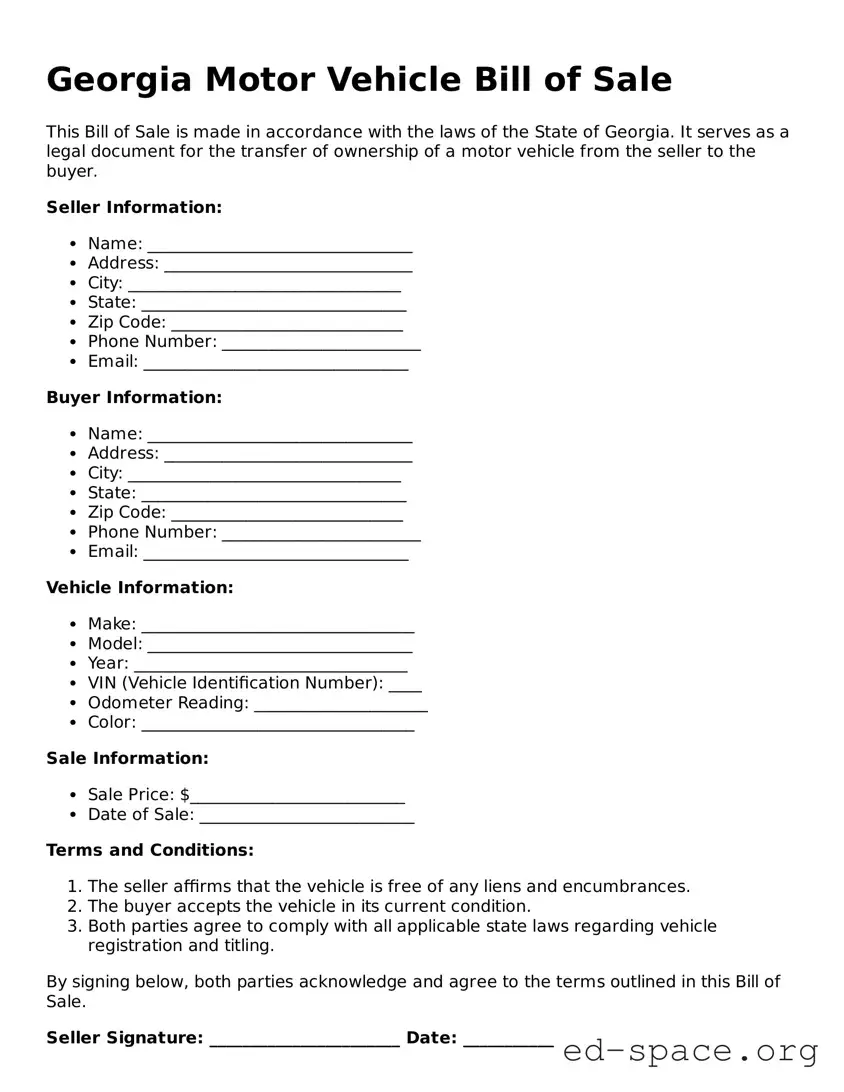
In the state of Georgia, the Motor Vehicle Bill of Sale form serves as a crucial document for individuals engaging in the buying and selling of vehicles. This form not only provides a written record of the transaction but also outlines essential details that protect both the buyer and the seller. Key components of the form include the names and addresses of both parties, the vehicle's identification number (VIN), make, model, year, and the sale price. Additionally, it often includes information about the vehicle's condition and any warranties or representations made by the seller. By documenting these details, the Bill of Sale helps to establish clear ownership and can be vital in the event of disputes or legal issues arising after the sale. Furthermore, this form may be required for the buyer to register the vehicle with the state, making it an indispensable part of the vehicle transfer process in Georgia.
Georgia Motor Vehicle Bill of Sale
This Bill of Sale is made in accordance with the laws of the State of Georgia. It serves as a legal document for the transfer of ownership of a motor vehicle from the seller to the buyer.
Seller Information:
Buyer Information:
Vehicle Information:
Sale Information:
Terms and Conditions:
By signing below, both parties acknowledge and agree to the terms outlined in this Bill of Sale.
Seller Signature: _______________________ Date: ___________
Buyer Signature: _______________________ Date: ___________
| Fact Name | Details |
|---|---|
| Purpose | The Georgia Motor Vehicle Bill of Sale form is used to document the sale of a vehicle between a buyer and a seller. |
| Required Information | The form requires details such as the vehicle's make, model, year, VIN, and the sale price. |
| Governing Law | This form is governed by the Official Code of Georgia Annotated (O.C.G.A.) § 10-1-200 et seq. |
| Importance | Having a Bill of Sale can protect both parties in the transaction and serves as proof of ownership transfer. |
To complete the Georgia Motor Vehicle Bill of Sale form, gather the necessary information about the vehicle and the parties involved in the transaction. After filling out the form, both the buyer and seller should keep a copy for their records.
What is a Georgia Motor Vehicle Bill of Sale?
A Georgia Motor Vehicle Bill of Sale is a legal document that records the transfer of ownership of a motor vehicle from one party to another. This document serves as proof of the transaction and includes essential details such as the vehicle's make, model, year, Vehicle Identification Number (VIN), and the names and addresses of both the buyer and seller.
Is a Bill of Sale required in Georgia?
While a Bill of Sale is not legally required for all vehicle transactions in Georgia, it is highly recommended. This document can protect both the buyer and seller by providing a clear record of the transaction. Additionally, a Bill of Sale can be useful for tax purposes and when registering the vehicle with the state.
What information should be included in the Bill of Sale?
The Bill of Sale should include the following information: the full names and addresses of both the buyer and seller, the date of the sale, a description of the vehicle (including make, model, year, and VIN), the sale price, and any warranties or conditions of the sale. Both parties should sign the document to validate it.
Can I create my own Bill of Sale?
Yes, you can create your own Bill of Sale in Georgia. However, it is crucial to ensure that it contains all the necessary information and complies with state requirements. Many templates are available online, which can simplify the process. Alternatively, you may choose to use a standard form provided by the Georgia Department of Revenue.
Do I need to notarize the Bill of Sale?
Notarization is not required for a Bill of Sale in Georgia, but it can add an extra layer of authenticity and protection. Having the document notarized can help prevent disputes about the transaction in the future. If you choose to have it notarized, both the buyer and seller should be present during the notarization process.
What should I do with the Bill of Sale after the sale?
After the sale is complete, both the buyer and seller should keep a copy of the Bill of Sale for their records. The buyer will need it to register the vehicle in their name with the Georgia Department of Revenue. The seller should retain a copy to document the sale and protect themselves from any future liability related to the vehicle.
Where can I obtain a Georgia Motor Vehicle Bill of Sale form?
You can obtain a Georgia Motor Vehicle Bill of Sale form from various sources. The Georgia Department of Revenue provides a downloadable form on its website. Additionally, many legal websites offer templates that you can customize. Local DMV offices may also provide printed forms upon request.
Incomplete Information: Many individuals fail to provide all required details. This includes missing the seller's or buyer's name, address, or vehicle identification number (VIN).
Incorrect VIN: The VIN is crucial for identifying the vehicle. Mistakes in this number can lead to complications in registration or title transfer.
Omitting the Sale Price: Not stating the sale price can create issues for tax purposes. It's important to include this information to avoid future disputes.
Failure to Sign: Both the seller and buyer must sign the document. Neglecting to do so can invalidate the bill of sale.
Not Keeping Copies: After filling out the form, some forget to make copies. Retaining a copy for personal records is essential for both parties.
The Georgia Motor Vehicle Bill of Sale form is a crucial document for anyone buying or selling a vehicle in Georgia. However, several other forms and documents often accompany it to ensure a smooth transaction. Here is a list of these essential documents:
Each of these documents plays a vital role in ensuring that the vehicle sale is legitimate and compliant with state laws. Properly completing and submitting these forms can help avoid future complications for both buyers and sellers.
Boat Bill of Sale: Similar to the Motor Vehicle Bill of Sale, this document serves as proof of ownership transfer for a boat. It includes details such as the boat's identification number, make, model, and the buyer and seller's information.
Aircraft Bill of Sale: This document is used to transfer ownership of an aircraft. Like the Motor Vehicle Bill of Sale, it contains specific details about the aircraft, including its registration number and the parties involved in the transaction.
Mobile Home Bill of Sale: When selling a mobile home, this document is essential. It outlines the sale terms and includes information about the mobile home, similar to what is required for vehicles.
Motorcycle Bill of Sale: This form is specifically for the sale of motorcycles. It shares similarities with the Motor Vehicle Bill of Sale, detailing the motorcycle's specifications and the transaction details.
Trailer Bill of Sale: When transferring ownership of a trailer, this document is necessary. It includes pertinent information about the trailer, much like the details required for motor vehicles.
Equipment Bill of Sale: This document is used for the sale of various types of equipment, such as construction tools or machinery. It captures the essential details of the equipment and the transaction, paralleling the Motor Vehicle Bill of Sale.
Pet Bill of Sale: Although it pertains to animals, this document serves a similar purpose. It provides proof of ownership transfer for pets, including details about the pet and the buyer and seller, akin to vehicle transactions.
When filling out the Georgia Motor Vehicle Bill of Sale form, it’s crucial to get it right. Here are some important dos and don'ts to keep in mind:
By following these guidelines, you can help ensure a smooth transaction. Take your time and double-check your work to avoid any potential issues.
The Georgia Motor Vehicle Bill of Sale form is an important document for anyone buying or selling a vehicle in the state. However, several misconceptions often arise regarding its use and requirements. Below is a list of seven common misunderstandings.
Some individuals believe that a Bill of Sale is optional. In reality, having this document is crucial for legal protection and to establish proof of ownership.
While notarization adds an extra layer of authenticity, it is not a requirement for the Bill of Sale in Georgia. The form can be valid without a notary's signature.
Both the buyer and seller should sign the document. This ensures that both parties agree to the terms of the sale and provides a record of the transaction.
Many people think they need to submit the Bill of Sale to a government office. However, it is primarily a private agreement between the buyer and seller, and filing is not required.
This is a misconception. Certain details, such as the vehicle identification number (VIN), sale price, and the names of both parties, are essential for the document to be valid.
Some individuals believe that this form is only necessary for used vehicle transactions. In fact, it can also be used for new vehicle purchases to document the sale.
While signing the Bill of Sale is a significant step, it does not complete the transaction. The buyer must also register the vehicle and pay any applicable taxes to finalize the ownership transfer.
Understanding these misconceptions can help ensure a smoother vehicle transaction process in Georgia. Awareness of the requirements and proper use of the Bill of Sale can protect the interests of both buyers and sellers.
When filling out and using the Georgia Motor Vehicle Bill of Sale form, keep the following key takeaways in mind:
By following these guidelines, you can ensure a smooth transaction when buying or selling a vehicle in Georgia.