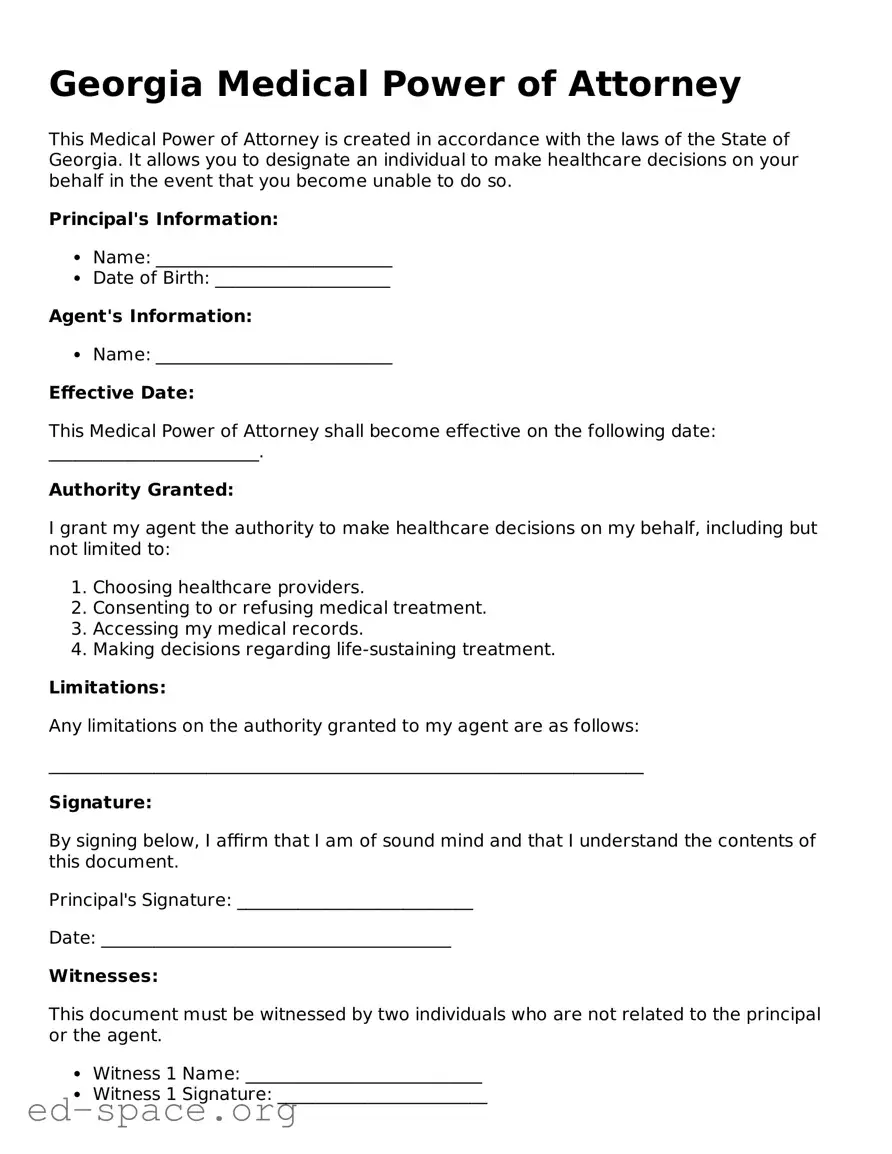
In Georgia, the Medical Power of Attorney form serves as a crucial legal document that empowers individuals to designate a trusted person to make healthcare decisions on their behalf when they are unable to do so. This form is particularly important in situations involving serious illness, injury, or incapacitation, ensuring that one's medical preferences are honored even when they cannot communicate them directly. The appointed agent, often a family member or close friend, gains the authority to discuss treatment options, consent to or refuse medical procedures, and access medical records. It is essential that the person chosen as the agent understands the principal's values and wishes regarding healthcare, as their decisions can significantly impact the principal's quality of life. Additionally, the form requires specific signatures and may need to be notarized or witnessed to ensure its validity. By taking the time to complete this document, individuals can provide peace of mind for themselves and their loved ones, knowing that their healthcare decisions will be managed by someone they trust.
Georgia Medical Power of Attorney
This Medical Power of Attorney is created in accordance with the laws of the State of Georgia. It allows you to designate an individual to make healthcare decisions on your behalf in the event that you become unable to do so.
Principal's Information:
Agent's Information:
Effective Date:
This Medical Power of Attorney shall become effective on the following date: ________________________.
Authority Granted:
I grant my agent the authority to make healthcare decisions on my behalf, including but not limited to:
Limitations:
Any limitations on the authority granted to my agent are as follows:
____________________________________________________________________
Signature:
By signing below, I affirm that I am of sound mind and that I understand the contents of this document.
Principal's Signature: ___________________________
Date: ________________________________________
Witnesses:
This document must be witnessed by two individuals who are not related to the principal or the agent.
Notarization:
This document may also be notarized to enhance its validity.
Notary Public Signature: ______________________
Date: ______________________________________
My Commission Expires: ______________________
| Fact Name | Description |
|---|---|
| Definition | A Georgia Medical Power of Attorney allows a person to designate someone to make medical decisions on their behalf if they become unable to do so. |
| Governing Law | The form is governed by the Georgia Code, specifically O.C.G.A. § 31-36-1 et seq. |
| Eligibility | Any adult resident of Georgia can create a Medical Power of Attorney. |
| Agent Requirements | The appointed agent must be at least 18 years old and cannot be your healthcare provider or an employee of your healthcare provider. |
| Durability | The power of attorney remains effective even if the principal becomes incapacitated. |
| Revocation | The principal can revoke the Medical Power of Attorney at any time, as long as they are competent to do so. |
| Signature Requirements | The form must be signed by the principal and witnessed by two individuals or notarized. |
| Scope of Authority | The agent can make decisions about medical treatment, including life-sustaining measures, based on the principal's wishes. |
| Additional Considerations | It is advisable to discuss your wishes with your agent and healthcare providers to ensure they understand your preferences. |
Filling out the Georgia Medical Power of Attorney form is an important step in ensuring that your healthcare decisions are made according to your wishes. After completing the form, you will need to ensure that it is signed and witnessed properly to be legally valid.
What is a Georgia Medical Power of Attorney?
A Georgia Medical Power of Attorney is a legal document that allows an individual to designate another person, known as an agent, to make medical decisions on their behalf in case they become unable to do so. This can occur due to illness, injury, or incapacitation. The agent's authority typically includes decisions about treatments, surgeries, and end-of-life care, ensuring that the individual's healthcare preferences are honored.
Who can serve as an agent in a Georgia Medical Power of Attorney?
In Georgia, any competent adult can be appointed as an agent. This includes family members, friends, or trusted individuals. However, it is advisable to choose someone who understands your values and wishes regarding medical care. Importantly, healthcare providers cannot serve as your agent if they are involved in your medical treatment.
How do I create a Medical Power of Attorney in Georgia?
To create a Medical Power of Attorney in Georgia, you must complete a specific form that outlines your preferences and appoints your agent. This form must be signed in the presence of two witnesses or a notary public. The witnesses cannot be your agent or related to you by blood or marriage. Once completed, it is essential to share copies with your agent and healthcare providers to ensure they are aware of your wishes.
Can I revoke my Medical Power of Attorney?
Yes, you can revoke your Medical Power of Attorney at any time as long as you are mentally competent. To do this, you should notify your agent and any healthcare providers who have a copy of the document. It is also advisable to create a written revocation statement and, if possible, destroy any copies of the original document to avoid confusion.
What happens if I do not have a Medical Power of Attorney?
If you do not have a Medical Power of Attorney and become unable to make your own medical decisions, your family members may need to go through a legal process to obtain guardianship or conservatorship. This can be time-consuming and may not reflect your personal wishes regarding healthcare. Having a Medical Power of Attorney in place helps avoid this situation and ensures your preferences are respected.
Can I include specific medical wishes in my Medical Power of Attorney?
Yes, you can include specific medical wishes in your Medical Power of Attorney. It is beneficial to discuss your preferences with your agent and outline them in the document. This can include your desires regarding life-sustaining treatments, organ donation, and other medical procedures. The more detailed you are, the better your agent can advocate for your wishes.
Is a Medical Power of Attorney valid if I move to another state?
A Medical Power of Attorney created in Georgia is generally valid in other states, but it is wise to check the laws of the new state to ensure compliance. Some states have different requirements for medical powers of attorney, and updating your document may be necessary to align with local laws. Consulting with a legal professional in the new state can provide clarity.
How does a Medical Power of Attorney differ from an Advance Directive?
A Medical Power of Attorney and an Advance Directive are related but serve different purposes. A Medical Power of Attorney specifically designates an agent to make healthcare decisions for you, while an Advance Directive outlines your preferences for medical treatment in specific situations. You can have both documents to ensure comprehensive planning for your healthcare.
Can I appoint more than one agent in my Medical Power of Attorney?
Yes, you can appoint more than one agent in your Medical Power of Attorney. However, it is crucial to specify whether the agents can act independently or if they must make decisions together. Clear instructions will help avoid confusion and potential conflicts when making medical decisions on your behalf.
Not Specifying the Agent Clearly: One common mistake is failing to clearly identify the agent. The form should include the full name and contact information of the person you want to make medical decisions on your behalf. Without this information, the document may be considered invalid.
Neglecting to Sign and Date: It is crucial to sign and date the form. Some individuals forget this step, which can render the document ineffective. The signature indicates that you agree with the choices made in the document.
Not Including Alternate Agents: Many people overlook the importance of naming alternate agents. If your primary agent is unavailable or unable to act, an alternate can step in. Without this provision, your wishes may not be honored in critical situations.
Failing to Discuss Wishes with the Agent: It's vital to have a conversation with your designated agent about your medical preferences. Some individuals fill out the form without discussing their wishes, which can lead to confusion and decisions that do not reflect their desires.
Not Keeping Copies of the Document: After completing the form, individuals often forget to make copies. It is important to keep several copies and share them with your agent, family members, and healthcare providers. This ensures that your wishes are known and can be acted upon when necessary.
A Georgia Medical Power of Attorney form allows individuals to designate someone to make healthcare decisions on their behalf if they become unable to do so. This document is often used in conjunction with other forms to ensure comprehensive planning for medical care. Below are several documents that are commonly associated with the Medical Power of Attorney.
Using these documents together with the Georgia Medical Power of Attorney can create a robust framework for managing healthcare decisions. This approach ensures that personal preferences are respected and that there is clarity in medical care during critical times.
The Medical Power of Attorney (MPOA) form allows an individual to designate someone else to make medical decisions on their behalf if they become unable to do so. This document shares similarities with several other important legal documents. Here are four of them:
Understanding these documents can help ensure that your medical and personal wishes are respected when it matters most.
When filling out the Georgia Medical Power of Attorney form, it’s important to approach the process with care. Here are nine things you should and shouldn’t do to ensure the document is completed correctly.
Here are six common misconceptions about the Georgia Medical Power of Attorney form:
Filling out and using the Georgia Medical Power of Attorney form involves several important considerations. Here are key takeaways to keep in mind:
Understanding these key points can help ensure that the Georgia Medical Power of Attorney is executed effectively, providing peace of mind regarding future medical decisions.