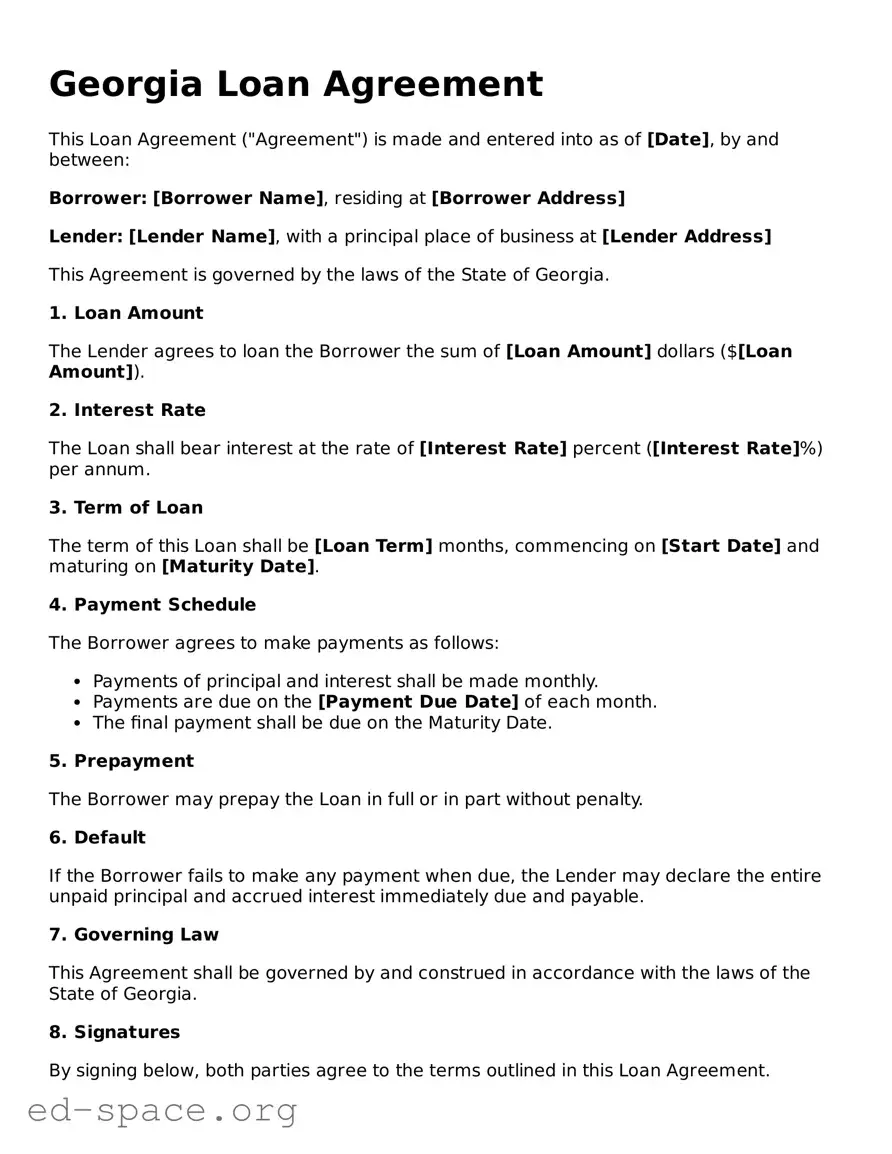
When entering into a financial arrangement, clarity and structure are essential. The Georgia Loan Agreement form serves as a vital tool for both lenders and borrowers, outlining the terms of the loan in a clear and concise manner. This document typically includes key elements such as the loan amount, interest rate, repayment schedule, and any collateral involved. Additionally, it addresses potential fees and penalties for late payments, ensuring that both parties understand their obligations. The agreement also stipulates the rights and responsibilities of each party, providing a framework for resolving disputes should they arise. By having a well-drafted loan agreement in place, individuals can protect their interests and foster a transparent lending relationship, ultimately contributing to a smoother financial transaction.
Georgia Loan Agreement
This Loan Agreement ("Agreement") is made and entered into as of [Date], by and between:
Borrower: [Borrower Name], residing at [Borrower Address]
Lender: [Lender Name], with a principal place of business at [Lender Address]
This Agreement is governed by the laws of the State of Georgia.
1. Loan Amount
The Lender agrees to loan the Borrower the sum of [Loan Amount] dollars ($[Loan Amount]).
2. Interest Rate
The Loan shall bear interest at the rate of [Interest Rate] percent ([Interest Rate]%) per annum.
3. Term of Loan
The term of this Loan shall be [Loan Term] months, commencing on [Start Date] and maturing on [Maturity Date].
4. Payment Schedule
The Borrower agrees to make payments as follows:
5. Prepayment
The Borrower may prepay the Loan in full or in part without penalty.
6. Default
If the Borrower fails to make any payment when due, the Lender may declare the entire unpaid principal and accrued interest immediately due and payable.
7. Governing Law
This Agreement shall be governed by and construed in accordance with the laws of the State of Georgia.
8. Signatures
By signing below, both parties agree to the terms outlined in this Loan Agreement.
Borrower Signature: ___________________________ Date: _______________
Lender Signature: ___________________________ Date: _______________
| Fact Name | Description |
|---|---|
| Purpose | The Georgia Loan Agreement form is used to outline the terms and conditions of a loan between a lender and a borrower. |
| Governing Law | This agreement is governed by the laws of the State of Georgia. |
| Parties Involved | The form identifies the lender and the borrower, including their legal names and addresses. |
| Loan Amount | The total amount of money being borrowed is clearly stated in the agreement. |
| Interest Rate | The form specifies the interest rate applicable to the loan, which can be fixed or variable. |
| Repayment Terms | Details regarding the repayment schedule, including due dates and payment methods, are included. |
| Default Conditions | The agreement outlines what constitutes a default and the potential consequences for the borrower. |
| Signatures | Both parties must sign the agreement to indicate their acceptance of the terms. |
Completing the Georgia Loan Agreement form is an important step in securing a loan. Once you have filled out the necessary information, you will be ready to submit the form to the lender for review and approval. Follow these steps to ensure you complete the form accurately.
What is a Georgia Loan Agreement form?
The Georgia Loan Agreement form is a legal document that outlines the terms and conditions of a loan between a lender and a borrower. It specifies the amount of the loan, interest rates, repayment schedule, and any collateral involved. This form serves to protect both parties by clearly defining their rights and obligations.
Who needs a Georgia Loan Agreement form?
Anyone involved in a loan transaction in Georgia should consider using this form. This includes individuals, businesses, or organizations lending or borrowing money. It is particularly important for larger sums or when the loan terms are complex.
What information is required to complete the form?
To complete the Georgia Loan Agreement form, you will need to provide details such as the names and addresses of both the lender and the borrower, the loan amount, the interest rate, the repayment schedule, and any collateral. Additionally, both parties should include their signatures and the date of signing.
Is the Georgia Loan Agreement form legally binding?
Yes, once both parties sign the Georgia Loan Agreement form, it becomes a legally binding contract. This means that both the lender and the borrower are obligated to adhere to the terms specified in the agreement. If either party fails to comply, legal action may be taken.
Can the terms of the loan be modified after signing?
Yes, the terms of the loan can be modified after signing, but both parties must agree to the changes. It is advisable to document any modifications in writing and have both parties sign the revised agreement to ensure clarity and enforceability.
What happens if the borrower defaults on the loan?
If the borrower defaults, the lender may take legal action to recover the owed amount. This could include pursuing a judgment in court or seizing collateral if applicable. The specific consequences will depend on the terms outlined in the loan agreement and Georgia state laws.
Where can I obtain a Georgia Loan Agreement form?
A Georgia Loan Agreement form can be obtained from various sources, including legal stationery stores, online legal document services, or through an attorney. It is important to ensure that the form complies with Georgia state laws and meets the specific needs of the loan transaction.
Not reading the entire form carefully. Many individuals rush through the process, missing important sections that require their attention.
Failing to provide accurate personal information. Mistakes in names, addresses, or Social Security numbers can lead to delays or complications.
Overlooking the terms and conditions. It’s essential to understand the loan’s interest rate, repayment schedule, and any fees involved.
Ignoring the need for signatures. Some people forget to sign the document, rendering it invalid.
Not including necessary documentation. Lenders often require proof of income, employment verification, or other financial documents.
Underestimating the importance of accurate financial information. Discrepancies in income or debt can affect loan approval.
Assuming all loans are the same. Each loan agreement can have unique terms, so it’s crucial to understand what you’re signing.
Forgetting to ask questions. If something is unclear, it’s important to seek clarification before submitting the form.
Neglecting to keep a copy of the completed form. Retaining a copy can be helpful for future reference or disputes.
Not double-checking the form for errors. A final review can catch mistakes that might have been overlooked during the initial filling out.
A Georgia Loan Agreement is a critical document that outlines the terms and conditions of a loan between a lender and a borrower. However, several other forms and documents often accompany this agreement to ensure clarity and compliance with legal standards. Below is a list of related documents that are commonly used in conjunction with the Georgia Loan Agreement.
Each of these documents plays a vital role in the loan process, ensuring both parties have a clear understanding of their rights and responsibilities. Properly managing these documents can facilitate smoother transactions and reduce the likelihood of disputes.
A Loan Agreement is a crucial document in financial transactions, but it shares similarities with several other important documents. Here are four documents that resemble a Loan Agreement, along with a brief explanation of how they relate:
When filling out the Georgia Loan Agreement form, it’s essential to follow certain guidelines to ensure accuracy and compliance. Below are six important dos and don’ts.
Following these guidelines will help ensure that your loan agreement process goes smoothly.
Understanding the Georgia Loan Agreement form is essential for both lenders and borrowers. However, several misconceptions can lead to confusion. Here are eight common misconceptions:
Addressing these misconceptions can help individuals navigate the loan process more effectively.
When filling out and using the Georgia Loan Agreement form, it’s important to keep several key points in mind. Here are some essential takeaways:
By following these guidelines, you can create a comprehensive and effective Loan Agreement that protects the interests of both the lender and the borrower.