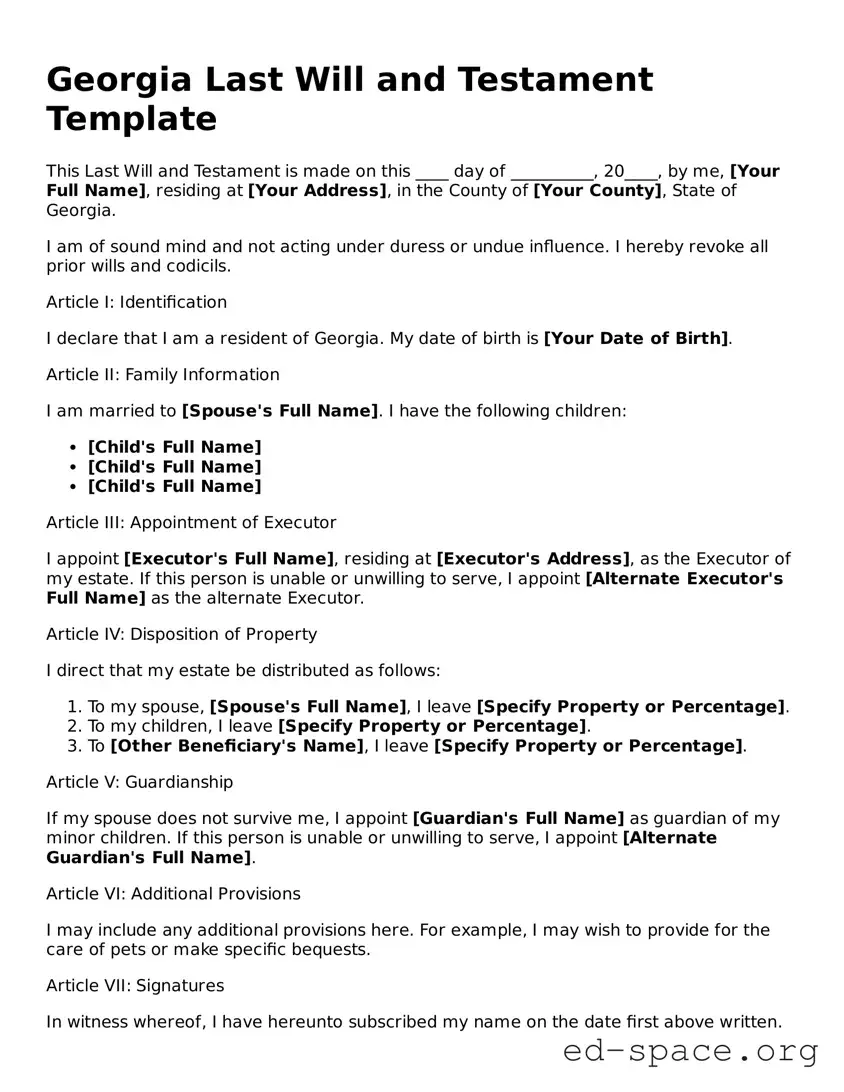
Creating a Last Will and Testament is an essential step in ensuring that your wishes are honored after your passing. In Georgia, this legal document serves as a guide for distributing your assets and taking care of any dependents you may have. The form outlines who will inherit your property, names an executor to manage your estate, and can even designate guardians for minor children. It is important to note that the Georgia Last Will and Testament form must be signed and witnessed according to state laws to be considered valid. Additionally, you have the option to include specific bequests, which allow you to leave particular items or amounts of money to chosen individuals or organizations. Understanding these key elements can help you navigate the process of drafting your will, ensuring that your intentions are clearly communicated and legally recognized.
Georgia Last Will and Testament Template
This Last Will and Testament is made on this ____ day of __________, 20____, by me, [Your Full Name], residing at [Your Address], in the County of [Your County], State of Georgia.
I am of sound mind and not acting under duress or undue influence. I hereby revoke all prior wills and codicils.
Article I: Identification
I declare that I am a resident of Georgia. My date of birth is [Your Date of Birth].
Article II: Family Information
I am married to [Spouse's Full Name]. I have the following children:
Article III: Appointment of Executor
I appoint [Executor's Full Name], residing at [Executor's Address], as the Executor of my estate. If this person is unable or unwilling to serve, I appoint [Alternate Executor's Full Name] as the alternate Executor.
Article IV: Disposition of Property
I direct that my estate be distributed as follows:
Article V: Guardianship
If my spouse does not survive me, I appoint [Guardian's Full Name] as guardian of my minor children. If this person is unable or unwilling to serve, I appoint [Alternate Guardian's Full Name].
Article VI: Additional Provisions
I may include any additional provisions here. For example, I may wish to provide for the care of pets or make specific bequests.
Article VII: Signatures
In witness whereof, I have hereunto subscribed my name on the date first above written.
__________________________
[Your Full Name], Testator
Witnesses:
We, the undersigned witnesses, do hereby declare that the Testator, [Your Full Name], signed this Last Will and Testament in our presence, and we affirm that we are not beneficiaries of this Will.
__________________________
[Witness 1 Full Name]
[Witness 1 Address]
__________________________
[Witness 2 Full Name]
[Witness 2 Address]
Signed in the presence of the above witnesses on this ____ day of __________, 20____.
| Fact Name | Description |
|---|---|
| Definition | A Last Will and Testament is a legal document that outlines how a person's assets will be distributed after their death. |
| Governing Law | The Georgia Last Will and Testament is governed by the Georgia Probate Code, specifically O.C.G.A. § 53-4-1 et seq. |
| Requirements | In Georgia, a will must be in writing, signed by the testator, and witnessed by at least two individuals. |
| Age Requirement | The testator must be at least 14 years old to create a valid will in Georgia. |
| Revocation | A will can be revoked by the testator at any time, provided they create a new will or physically destroy the existing one. |
| Holographic Wills | Georgia recognizes holographic wills, which are handwritten and signed by the testator, as valid if they meet specific criteria. |
| Executor Appointment | The testator can appoint an executor in the will, who will be responsible for managing the estate and ensuring the will's provisions are followed. |
| Witness Requirements | Witnesses must be at least 14 years old and cannot be beneficiaries of the will to ensure impartiality. |
| Probate Process | After the testator's death, the will must be submitted to the probate court to validate its authenticity and initiate the distribution of assets. |
| Changes and Amendments | Changes to a will can be made through a codicil, which is an amendment that must also be signed and witnessed according to Georgia law. |
After obtaining the Georgia Last Will and Testament form, you will need to complete it carefully to ensure that your wishes are accurately reflected. Once filled out, the form will require signatures and potentially witnesses, depending on your specific circumstances.
What is a Last Will and Testament in Georgia?
A Last Will and Testament is a legal document that outlines how a person's assets and affairs will be managed after their death. In Georgia, this document allows individuals to specify who will inherit their property, name guardians for minor children, and appoint an executor to carry out their wishes. It ensures that your desires are respected and provides clarity for your loved ones during a difficult time.
Who can create a Last Will and Testament in Georgia?
In Georgia, any person who is at least 14 years old and of sound mind can create a Last Will and Testament. It is essential that the individual understands the nature of their actions and the implications of the document they are signing. However, it is advisable for those over 18 to prepare a will to ensure that their wishes are clearly documented.
What are the requirements for a valid Last Will and Testament in Georgia?
To be valid in Georgia, a Last Will and Testament must be in writing and signed by the testator (the person creating the will). Additionally, it must be witnessed by at least two individuals who are present at the same time. These witnesses must also sign the will, affirming that they observed the testator signing the document. It is important that the witnesses are not beneficiaries of the will to avoid potential conflicts.
Can I change or revoke my Last Will and Testament in Georgia?
Yes, you can change or revoke your Last Will and Testament at any time while you are alive and of sound mind. To make changes, you can create a new will that explicitly states it revokes any previous wills. Alternatively, you can make amendments through a codicil, which is a legal document that modifies the original will. Remember to follow the same witnessing requirements when making any changes.
What happens if I die without a Last Will and Testament in Georgia?
If you pass away without a Last Will and Testament, your estate will be distributed according to Georgia's intestacy laws. This means that the state will determine how your assets are divided, typically favoring your closest relatives. Dying intestate can lead to outcomes that do not align with your wishes, making it crucial to have a will in place.
Can I write my own Last Will and Testament in Georgia?
Yes, you can write your own Last Will and Testament in Georgia, provided it meets all legal requirements. However, it is important to ensure that the language is clear and unambiguous. While DIY wills can be valid, seeking legal advice or using a reputable template can help prevent potential issues or disputes later on.
What should I include in my Last Will and Testament?
Your Last Will and Testament should include several key elements: your personal information, a declaration that the document is your will, the appointment of an executor, details about how your assets will be distributed, and the naming of guardians for any minor children. You may also wish to include any specific bequests, such as gifts to friends or charities, to ensure your wishes are honored.
Not being specific about beneficiaries. It's crucial to clearly identify who will inherit your assets. Vague terms can lead to confusion and disputes.
Failing to date the document. A will should always have a date. This helps establish which version is the most current and valid.
Overlooking witness requirements. Georgia law requires at least two witnesses to sign the will. Without this, the document may not be valid.
Not signing the will in front of witnesses. It's not enough for witnesses to be present; you must also sign the will in their presence.
Using outdated forms. Laws change, and so do legal forms. Always ensure you're using the most current version of the Georgia Last Will and Testament form.
Neglecting to name an executor. Failing to appoint someone to manage your estate can create complications. An executor ensures your wishes are carried out.
Not considering alternate beneficiaries. If a primary beneficiary passes away before you, having alternates ensures your assets are still distributed according to your wishes.
Being unclear about asset distribution. Clearly outline how you want your assets divided. Ambiguity can lead to disagreements among heirs.
Forgetting to update the will. Life changes, such as marriage, divorce, or the birth of children, should prompt a review and potential update of your will.
Not storing the will in a safe place. Once completed, it’s essential to keep your will in a secure location where your loved ones can easily access it when needed.
When planning for the future, it's essential to understand that a Last Will and Testament is just one piece of the puzzle. In Georgia, several other forms and documents can complement your will, ensuring that your wishes are honored and your loved ones are protected. Here’s a brief overview of some key documents you might consider.
Understanding these documents can help you create a comprehensive estate plan that reflects your wishes and provides peace of mind. Each form serves a unique purpose, and together, they can ensure that your desires are met and your loved ones are cared for in the way you envision.
Creating a Last Will and Testament is an important step in ensuring your wishes are honored after you pass away. Here are ten essential dos and don’ts to consider when filling out the Georgia Last Will and Testament form:
By following these guidelines, you can help ensure that your Last Will and Testament is valid and reflects your true intentions. Taking the time to prepare properly can provide peace of mind for both you and your loved ones.
When it comes to the Georgia Last Will and Testament form, several misconceptions can lead to confusion. Understanding these misconceptions can help individuals make informed decisions about their estate planning. Below are five common misconceptions:
This is not true. Regardless of the size of one’s estate, having a will ensures that one’s wishes are honored after death. It provides clarity and direction for loved ones, regardless of financial status.
While it is true that Georgia has specific requirements for a valid will, handwritten wills, also known as holographic wills, can be valid if they are signed and the material provisions are in the testator's handwriting. However, it is advisable to follow formal procedures to avoid disputes.
This misconception is misleading. A will can be amended or revoked at any time before death, as long as the testator is of sound mind. This flexibility allows individuals to update their wishes as life circumstances change.
In Georgia, while a surviving spouse does have rights to certain assets, not all property automatically transfers to them. Assets may be distributed according to the will or, if there is no will, according to state intestacy laws.
In Georgia, a will must be signed in the presence of at least two witnesses who are not beneficiaries. This requirement helps to ensure the will's validity and can prevent potential challenges in the future.
By understanding these misconceptions, individuals can better navigate the process of creating a Last Will and Testament in Georgia, ensuring their intentions are clear and legally sound.
When filling out and using the Georgia Last Will and Testament form, keep the following key takeaways in mind:
By following these guidelines, you can create a clear and effective Last Will and Testament in Georgia.