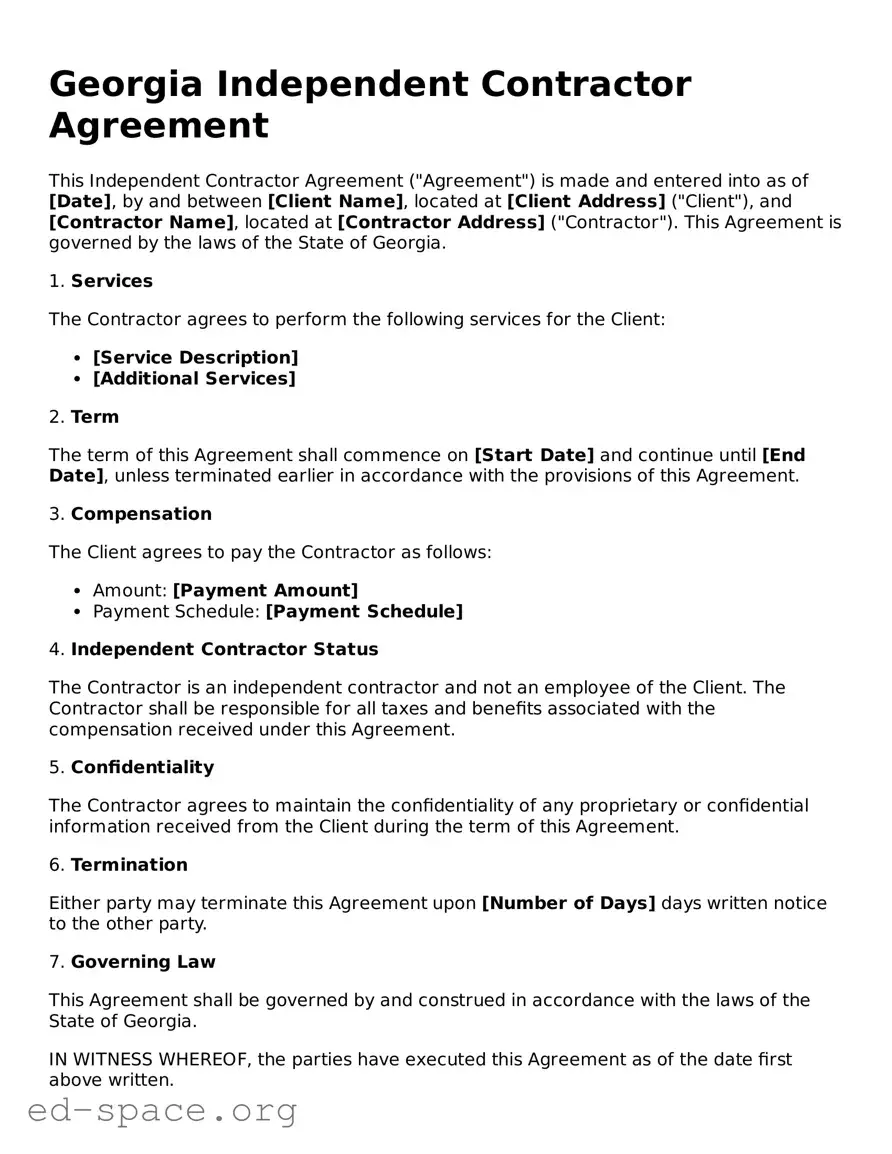
The Georgia Independent Contractor Agreement form is a vital document for anyone looking to engage independent contractors in the state. This agreement outlines the relationship between the contractor and the hiring party, ensuring clarity and mutual understanding. Key aspects of the form include the scope of work, payment terms, and deadlines, which help define the expectations for both parties. Additionally, it addresses important issues such as confidentiality, ownership of work, and liability, protecting the interests of the hiring entity while also respecting the contractor's rights. By using this form, businesses can establish a solid foundation for their working relationships, minimizing potential disputes and fostering a professional environment.
Georgia Independent Contractor Agreement
This Independent Contractor Agreement ("Agreement") is made and entered into as of [Date], by and between [Client Name], located at [Client Address] ("Client"), and [Contractor Name], located at [Contractor Address] ("Contractor"). This Agreement is governed by the laws of the State of Georgia.
1. Services
The Contractor agrees to perform the following services for the Client:
2. Term
The term of this Agreement shall commence on [Start Date] and continue until [End Date], unless terminated earlier in accordance with the provisions of this Agreement.
3. Compensation
The Client agrees to pay the Contractor as follows:
4. Independent Contractor Status
The Contractor is an independent contractor and not an employee of the Client. The Contractor shall be responsible for all taxes and benefits associated with the compensation received under this Agreement.
5. Confidentiality
The Contractor agrees to maintain the confidentiality of any proprietary or confidential information received from the Client during the term of this Agreement.
6. Termination
Either party may terminate this Agreement upon [Number of Days] days written notice to the other party.
7. Governing Law
This Agreement shall be governed by and construed in accordance with the laws of the State of Georgia.
IN WITNESS WHEREOF, the parties have executed this Agreement as of the date first above written.
Client Signature: ____________________________ Date: _______________
Contractor Signature: ________________________ Date: _______________
| Fact Name | Details |
|---|---|
| Definition | A Georgia Independent Contractor Agreement outlines the terms between a business and an independent contractor. |
| Governing Law | The agreement is governed by the laws of the State of Georgia. |
| Purpose | This form clarifies the relationship, responsibilities, and rights of both parties involved. |
| Payment Terms | The agreement should specify payment terms, including rates, methods, and schedules. |
| Duration | It is important to define the duration of the contract, whether it is for a specific project or an ongoing relationship. |
| Confidentiality | Many agreements include confidentiality clauses to protect sensitive information shared during the contract. |
| Termination Clause | Termination conditions should be clearly stated, detailing how either party can end the agreement. |
| Liability | The agreement often includes liability provisions to outline responsibilities in case of disputes or damages. |
| Signatures | Both parties must sign the agreement for it to be legally binding, indicating their acceptance of the terms. |
Completing the Georgia Independent Contractor Agreement form is a straightforward process. This document outlines the terms of the working relationship between a contractor and a client. After filling out the form, both parties should review the details carefully to ensure mutual understanding and agreement.
What is a Georgia Independent Contractor Agreement?
A Georgia Independent Contractor Agreement is a legal document that outlines the terms and conditions between a business and an independent contractor. This agreement specifies the scope of work, payment terms, duration of the contract, and other important details. It helps both parties understand their rights and responsibilities, reducing the risk of misunderstandings or disputes.
What are the key components of the agreement?
The key components of a Georgia Independent Contractor Agreement typically include the following: a clear description of the services to be provided, payment terms (including rates and schedule), the duration of the agreement, confidentiality provisions, and termination clauses. Additionally, it may address issues like intellectual property rights and liability limitations.
Do I need a written agreement for independent contractors?
How does this agreement affect tax obligations?
An Independent Contractor Agreement can significantly impact tax obligations. Independent contractors are typically responsible for their own taxes, including self-employment tax. The agreement should clarify that the contractor is not an employee, which means the business will not withhold taxes. It's important for both parties to understand their tax responsibilities to avoid any legal issues with the IRS.
Can the agreement be modified after it is signed?
Failing to accurately identify the parties involved. It is crucial to provide the full legal names of both the contractor and the hiring entity. Incomplete or incorrect names can lead to confusion or disputes later on.
Omitting essential details about the scope of work. The agreement should clearly outline the specific tasks and responsibilities of the contractor. Without this information, expectations may be misaligned.
Neglecting to specify payment terms. Including details about payment amounts, schedules, and methods is important. Inadequate payment information can result in misunderstandings regarding compensation.
Not including a termination clause. A well-drafted agreement should outline the conditions under which either party can terminate the contract. This protects both parties and clarifies their rights.
Ignoring the need for signatures. Both parties must sign the agreement to make it legally binding. Failing to obtain signatures can render the agreement unenforceable.
The Georgia Independent Contractor Agreement is a crucial document that outlines the terms of the working relationship between a business and an independent contractor. Alongside this agreement, several other forms and documents are often utilized to ensure clarity and compliance in the working arrangement. Here is a list of related documents that may be needed:
These documents complement the Georgia Independent Contractor Agreement and help create a comprehensive framework for the working relationship. Ensuring that all necessary forms are in place can contribute to a smoother and more transparent collaboration between businesses and independent contractors.
The Independent Contractor Agreement is a vital document that outlines the relationship between a business and an independent contractor. There are several other documents that serve similar purposes, each with its own specific focus and details. Below is a list of eight documents that share similarities with the Independent Contractor Agreement:
When filling out the Georgia Independent Contractor Agreement form, it's important to follow certain guidelines to ensure accuracy and compliance. Here are five things you should do and five things you shouldn't do:
Things You Should Do:
Things You Shouldn't Do:
Misconceptions about the Georgia Independent Contractor Agreement form can lead to confusion and potential legal issues for both parties involved. It is crucial to clarify these misunderstandings to ensure compliance and protect rights. Here is a list of seven common misconceptions:
Many believe that a verbal agreement suffices. However, having a written contract helps outline expectations and responsibilities, providing clarity and legal protection.
This is false. Independent contractors must adhere to certain state and federal regulations, including tax obligations and workplace safety standards.
In reality, independent contractors can vary widely in terms of their services, expertise, and the terms of their agreements. Each contract should be tailored to the specific relationship.
This is misleading. While independent contractors do not have the same rights as employees, they still possess certain legal protections, including the right to payment for services rendered.
Contracts can be amended with the agreement of both parties. Flexibility is often necessary to adapt to changing circumstances or requirements.
While independent contractors do enjoy more job security than employees in some respects, they can still be terminated based on the terms outlined in their contract.
This is incorrect. Independent contractors are responsible for their own taxes, including self-employment tax, whereas employers withhold taxes for employees.
Understanding these misconceptions is vital for anyone engaging in an independent contractor relationship in Georgia. Clarity in agreements not only protects the interests of both parties but also fosters a professional working environment.
When engaging an independent contractor in Georgia, it is essential to understand the implications of the Independent Contractor Agreement. Here are key takeaways to consider:
Understanding these elements can help both parties navigate their professional relationship more effectively and reduce the potential for conflicts.