In Georgia, families who choose to educate their children at home must navigate specific legal requirements, one of which is the Homeschool Letter of Intent form. This essential document serves as a formal notification to the local school district of a family's intention to homeschool. It must be submitted within 30 days of beginning the homeschooling process or when a child reaches the age of six. The form requires basic information, including the names and ages of the children being homeschooled, as well as the name and address of the parent or guardian. Importantly, the submission of this letter is not just a formality; it establishes the family's commitment to providing an educational experience outside the traditional school system. Additionally, it opens the door for parents to take advantage of certain resources and support available to homeschooling families in Georgia. Understanding the nuances of this form is crucial for ensuring compliance with state regulations and for fostering a successful homeschooling journey.
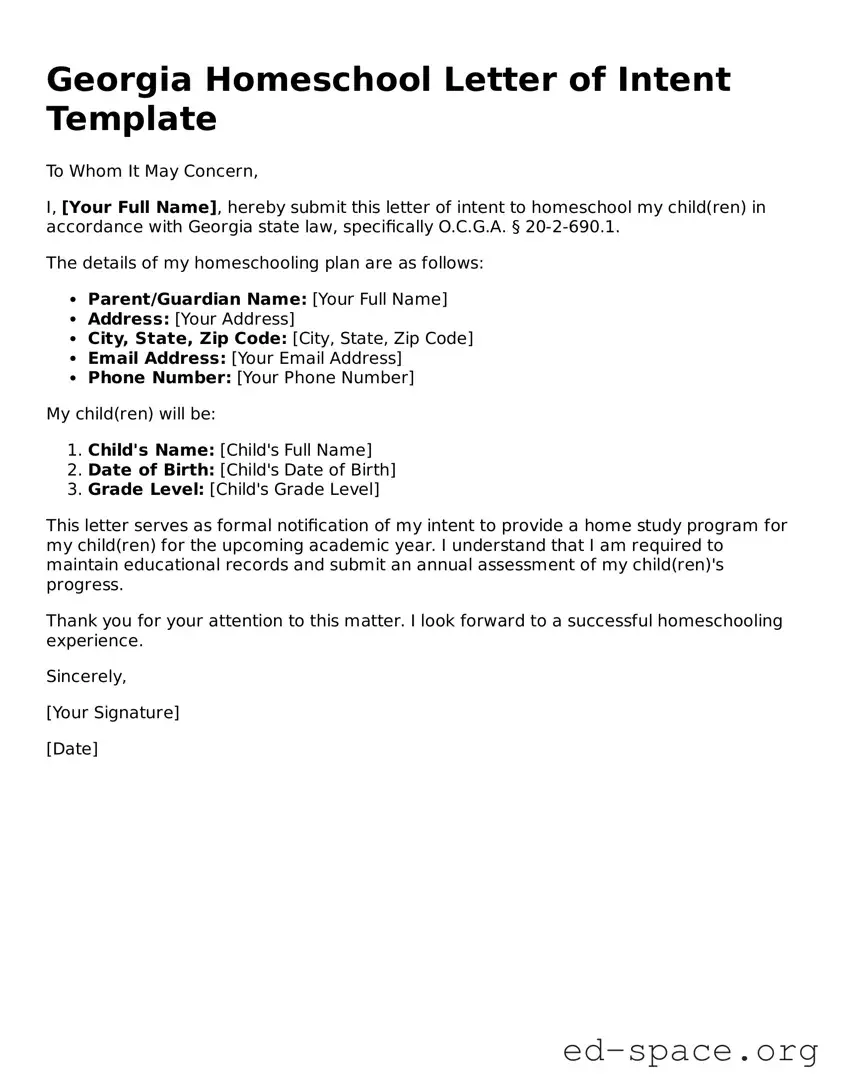
Georgia Homeschool Letter of Intent Template
To Whom It May Concern,
I, [Your Full Name], hereby submit this letter of intent to homeschool my child(ren) in accordance with Georgia state law, specifically O.C.G.A. § 20-2-690.1.
The details of my homeschooling plan are as follows:
My child(ren) will be:
This letter serves as formal notification of my intent to provide a home study program for my child(ren) for the upcoming academic year. I understand that I am required to maintain educational records and submit an annual assessment of my child(ren)'s progress.
Thank you for your attention to this matter. I look forward to a successful homeschooling experience.
Sincerely,
[Your Signature]
[Date]
| Fact Name | Description |
|---|---|
| Governing Law | The Georgia Homeschool Letter of Intent is governed by the Georgia Code, specifically O.C.G.A. § 20-2-690. |
| Filing Requirement | Parents must submit the Letter of Intent to the local school district within 30 days of beginning homeschooling. |
| Annual Submission | The form is required to be submitted annually, indicating the intent to homeschool for each school year. |
| Information Included | The form typically requires the names and ages of the children being homeschooled, along with the address of the homeschooling family. |
| Signature Requirement | The Letter of Intent must be signed by the parent or guardian who is responsible for the child's education. |
| Submission Method | Parents can submit the Letter of Intent via mail or in person to their local school district office. |
| Consequences of Non-Compliance | Failure to submit the Letter of Intent may result in the local school district considering the child truant and could lead to legal implications. |
After obtaining the Georgia Homeschool Letter of Intent form, you will need to fill it out carefully. This form is essential for notifying the state of your intent to homeschool your child. Once completed, you will submit it to the appropriate local school district.
What is the Georgia Homeschool Letter of Intent form?
The Georgia Homeschool Letter of Intent form is a document that parents or guardians must submit to the local school superintendent. This form officially notifies the school system of the intent to homeschool a child. It is a crucial first step in establishing a homeschooling program in Georgia.
Who needs to file the Letter of Intent?
Parents or guardians who wish to homeschool their children in Georgia must file the Letter of Intent. This applies to children who are between the ages of 6 and 16, which is the compulsory school age in the state. If you have multiple children, you will need to include each child's name on the form.
When should the Letter of Intent be submitted?
The Letter of Intent should be submitted by the start of the school year or within 30 days of beginning to homeschool. If you are withdrawing a child from public school to begin homeschooling, it is advisable to submit the form as soon as possible to ensure compliance with state regulations.
What information is required on the form?
The form requires basic information about the child, including their name, age, and the date of birth. Additionally, you will need to provide your name, address, and a statement of intent to homeschool. It is essential to ensure that all information is accurate and complete to avoid any issues.
Is there a fee to file the Letter of Intent?
No, there is no fee associated with filing the Georgia Homeschool Letter of Intent. This process is free of charge, making it accessible for families who choose to educate their children at home.
What happens after I submit the Letter of Intent?
Once you submit the Letter of Intent, the local school superintendent will acknowledge receipt of your form. You are not required to wait for approval before starting your homeschooling program. However, it is important to keep a copy of the submitted form for your records.
Can I change my mind after submitting the Letter of Intent?
Yes, you can change your mind about homeschooling after submitting the Letter of Intent. If you decide to enroll your child back into public school or another educational program, simply inform the school system of your decision. It is a good practice to keep documentation of any communications regarding your child's educational status.
Failing to include the full name of the student. It’s essential to provide the complete legal name as it appears on the birth certificate or other official documents.
Not providing the correct address. Ensure that the address listed is the current residence where the homeschooling will take place.
Omitting the parent or guardian’s information. This includes the name, address, and contact information of the person responsible for the homeschooling.
Leaving out the date of birth of the student. This information helps to verify the age and eligibility for homeschooling.
Not checking for spelling errors. Simple typos can lead to confusion and may delay the processing of your letter.
Failing to sign the form. A signature is necessary to validate the intent to homeschool.
Not submitting the form by the required deadline. Be aware of when the letter needs to be sent to avoid any compliance issues.
Using the wrong form version. Ensure you are using the most current version of the Homeschool Letter of Intent.
Neglecting to include any additional documentation if required. Some situations may call for extra paperwork to accompany the letter.
Not keeping a copy of the submitted form. Always retain a copy for your records in case you need to reference it later.
By avoiding these common mistakes, you can ensure a smoother process when filing your Georgia Homeschool Letter of Intent. Taking the time to double-check your information can save you from potential headaches down the road.
When you decide to homeschool in Georgia, the Letter of Intent is just the first step. Several other forms and documents can help ensure you meet state requirements and keep your educational journey on track. Below is a list of essential documents you may need alongside the Homeschool Letter of Intent.
Having these documents organized and ready will help you navigate the homeschooling process smoothly. They serve not only to fulfill legal obligations but also to support your child's educational experience effectively.
The Homeschool Letter of Intent form serves as a key document for families choosing to educate their children at home. It shares similarities with several other documents that also establish intent or provide necessary information. Here’s a list of ten documents that are similar to the Homeschool Letter of Intent:
Filling out the Georgia Homeschool Letter of Intent form can feel daunting, but it doesn’t have to be. Keeping a few key points in mind can make the process smoother and ensure you meet all requirements. Here’s a list of things you should and shouldn’t do:
By following these guidelines, you can confidently navigate the process and ensure that your homeschooling journey starts off on the right foot.
Misconception 1: The Letter of Intent is optional.
In Georgia, submitting a Letter of Intent is a legal requirement for families who wish to homeschool their children. Failure to submit this form can lead to legal complications.
Misconception 2: The Letter of Intent must be submitted every year.
Families only need to submit the Letter of Intent once per child, unless there is a change in the child's educational status or the family's intent to homeschool.
Misconception 3: The form requires detailed curriculum information.
The Letter of Intent does not require families to provide specific details about the curriculum they plan to use. It is a simple notification of intent to homeschool.
Misconception 4: The Letter of Intent is only for new homeschoolers.
Returning homeschoolers must also submit the Letter of Intent if they have not previously filed one for that child.
Misconception 5: The form can be submitted at any time.
The Letter of Intent must be submitted within 30 days of beginning to homeschool. This timeline is crucial to remain compliant with state laws.
Misconception 6: There is a fee associated with the Letter of Intent.
There is no fee for submitting the Letter of Intent in Georgia. It is a free process designed to facilitate homeschooling.
Misconception 7: The Letter of Intent is a public document.
The Letter of Intent is not publicly accessible. It is kept confidential and used solely for educational purposes by the state.
Filling out and using the Georgia Homeschool Letter of Intent form is an important step for families choosing to homeschool their children. Here are some key takeaways to keep in mind:
By following these guidelines, families can ensure a smooth start to their homeschooling journey in Georgia.