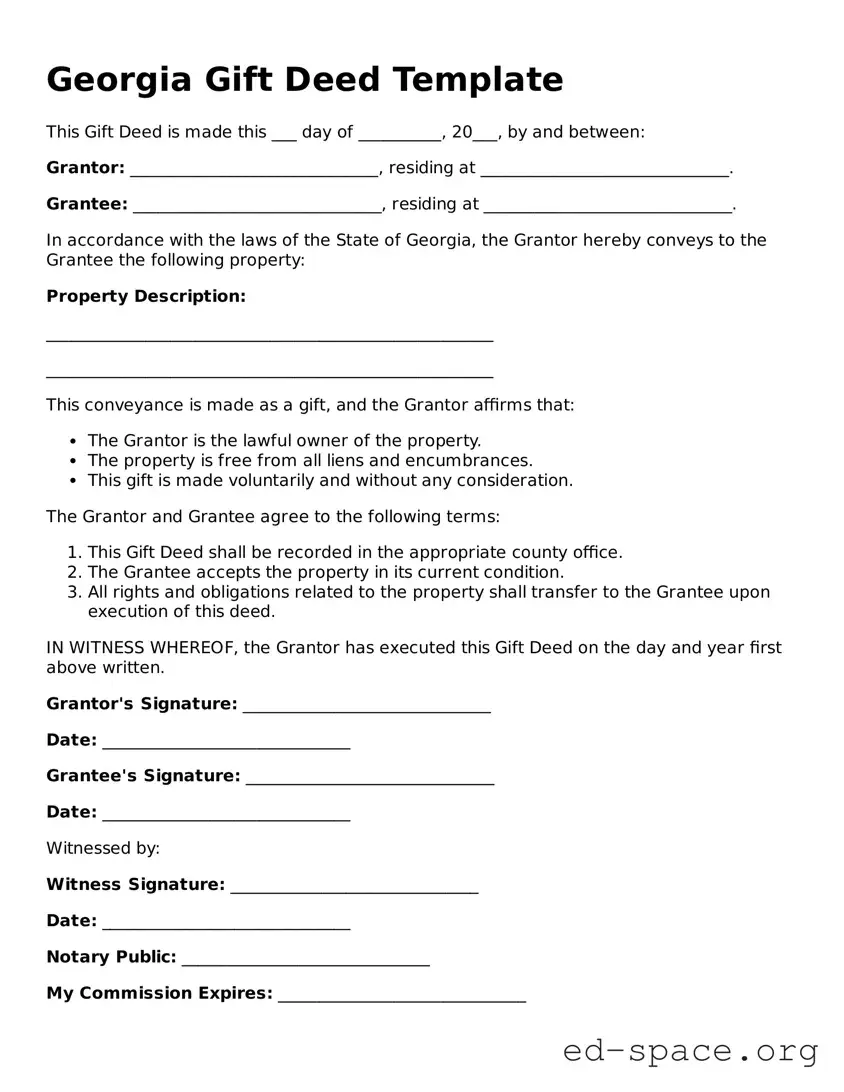
In the state of Georgia, the Gift Deed form serves as a crucial legal instrument for individuals wishing to transfer property without any exchange of money. This document allows a donor to convey their property rights to a recipient, known as the donee, thereby facilitating a straightforward and often heartfelt transfer of ownership. Typically, the Gift Deed must include essential details such as the names of both the donor and the donee, a clear description of the property being gifted, and the donor's intent to make a gift. Importantly, the form may also require the signature of a notary public to ensure its validity, which adds an extra layer of protection against disputes. Moreover, the Gift Deed must be filed with the appropriate county clerk's office to formalize the transfer and update public records. Understanding these key elements can help individuals navigate the process smoothly, ensuring that their intentions are honored and legally recognized.
Georgia Gift Deed Template
This Gift Deed is made this ___ day of __________, 20___, by and between:
Grantor: ______________________________, residing at ______________________________.
Grantee: ______________________________, residing at ______________________________.
In accordance with the laws of the State of Georgia, the Grantor hereby conveys to the Grantee the following property:
Property Description:
______________________________________________________
______________________________________________________
This conveyance is made as a gift, and the Grantor affirms that:
The Grantor and Grantee agree to the following terms:
IN WITNESS WHEREOF, the Grantor has executed this Gift Deed on the day and year first above written.
Grantor's Signature: ______________________________
Date: ______________________________
Grantee's Signature: ______________________________
Date: ______________________________
Witnessed by:
Witness Signature: ______________________________
Date: ______________________________
Notary Public: ______________________________
My Commission Expires: ______________________________
| Fact Name | Description |
|---|---|
| Definition | A Georgia Gift Deed is a legal document used to transfer property ownership as a gift without any exchange of money. |
| Governing Law | The Gift Deed in Georgia is governed by Georgia Title 44, Chapter 5 of the Official Code of Georgia Annotated (OCGA). |
| Requirements | The deed must be in writing, signed by the donor, and notarized to be legally valid. |
| Tax Implications | Gift tax may apply if the value of the gift exceeds the annual exclusion limit set by the IRS. |
| Revocation | Once executed, a Gift Deed is generally irrevocable unless specific conditions for revocation are included. |
| Recording | To protect the interests of the recipient, the Gift Deed should be recorded in the county where the property is located. |
After obtaining the Georgia Gift Deed form, you will need to provide specific information to complete it. This process ensures that the transfer of property is documented properly. Follow the steps carefully to fill out the form accurately.
Once the form is filled out and submitted, it will be processed by the local authorities. Keep a copy for your records, as it serves as proof of the gift transfer.
What is a Georgia Gift Deed?
A Georgia Gift Deed is a legal document used to transfer property from one person to another without any exchange of money. It’s a way to give a gift of real estate, such as a house or land, to someone else. This deed must be signed by the person giving the gift (the donor) and can be a wonderful way to pass on property to family members or friends.
Who can use a Gift Deed in Georgia?
Any property owner in Georgia can use a Gift Deed to transfer their property to another individual. This can include individuals giving property to family members, friends, or even charitable organizations. However, it’s important that the donor has the legal capacity to make the gift, which generally means they must be of sound mind and at least 18 years old.
Are there any tax implications when using a Gift Deed?
Yes, there can be tax implications when transferring property through a Gift Deed. The donor may be subject to gift taxes if the value of the property exceeds the annual exclusion limit set by the IRS. It’s wise to consult with a tax professional to understand how this might affect your specific situation.
What information is required on a Gift Deed?
A Gift Deed must include specific information to be valid. This includes the names and addresses of both the donor and the recipient, a description of the property being transferred, and the date of the gift. It’s also important to include a statement that the property is being given as a gift, without any compensation.
Does a Gift Deed need to be notarized?
Yes, in Georgia, a Gift Deed must be notarized to be legally binding. This means that the donor must sign the deed in the presence of a notary public, who will then affix their seal to the document. Notarization helps to verify the identities of the parties involved and ensures that the deed is executed properly.
How do I record a Gift Deed in Georgia?
To record a Gift Deed in Georgia, you must take the notarized document to the county clerk’s office in the county where the property is located. There may be a small fee for recording the deed. Once recorded, the deed becomes part of the public record, which helps protect the recipient’s ownership rights.
Can a Gift Deed be revoked?
Once a Gift Deed is executed and recorded, it typically cannot be revoked. This is because the property has been legally transferred to the recipient. However, if the donor included specific conditions or retained certain rights in the deed, those terms might allow for some level of control. It’s essential to clearly understand the implications before proceeding.
What should I do if I have more questions about Gift Deeds?
If you have more questions about Gift Deeds or need assistance with the process, consider reaching out to a real estate attorney or a qualified contract specialist. They can provide personalized guidance based on your unique situation and help ensure that everything is done correctly.
Failing to include the full names of both the donor and the recipient. This can lead to confusion about who is giving and who is receiving the property.
Not providing the correct property description. A vague or incomplete description can cause issues in the future.
Leaving out the date of the gift. This information is crucial for legal purposes and helps establish the timeline of the transaction.
Not signing the form in the presence of a notary public. Without notarization, the deed may not be considered valid.
Using incorrect legal terminology or abbreviations. This can create misunderstandings or misinterpretations of the deed.
Neglecting to check for property liens or encumbrances before gifting. This oversight can lead to complications for the recipient.
Forgetting to include any conditions or restrictions on the gift. If there are specific terms, they must be clearly stated.
Not keeping a copy of the signed deed for personal records. This is important for future reference and proof of the transaction.
Overlooking the need to file the deed with the county clerk’s office. This step is essential to ensure the gift is officially recorded.
Assuming that the gift deed is the only document needed. Additional paperwork may be required depending on the property type and local regulations.
When completing a Georgia Gift Deed, several other forms and documents may be necessary to ensure the process is thorough and legally sound. Below are some commonly used documents that can accompany the Gift Deed.
Utilizing these forms and documents can facilitate a smoother transfer process and help avoid potential disputes or legal complications in the future. Always ensure that all paperwork is completed accurately and thoroughly.
Filling out a Georgia Gift Deed form requires attention to detail. Here are some important dos and don'ts to consider:
Understanding the Georgia Gift Deed form is essential for anyone considering transferring property as a gift. However, several misconceptions can lead to confusion. Here are four common misconceptions:
Understanding these misconceptions can help individuals make informed decisions when considering a gift deed in Georgia.
When it comes to transferring property as a gift in Georgia, understanding the Gift Deed form is crucial. Here are some key takeaways to keep in mind:
Understanding these key points will help ensure a smooth process when filling out and using the Georgia Gift Deed form. Always consider consulting a legal professional for personalized guidance.