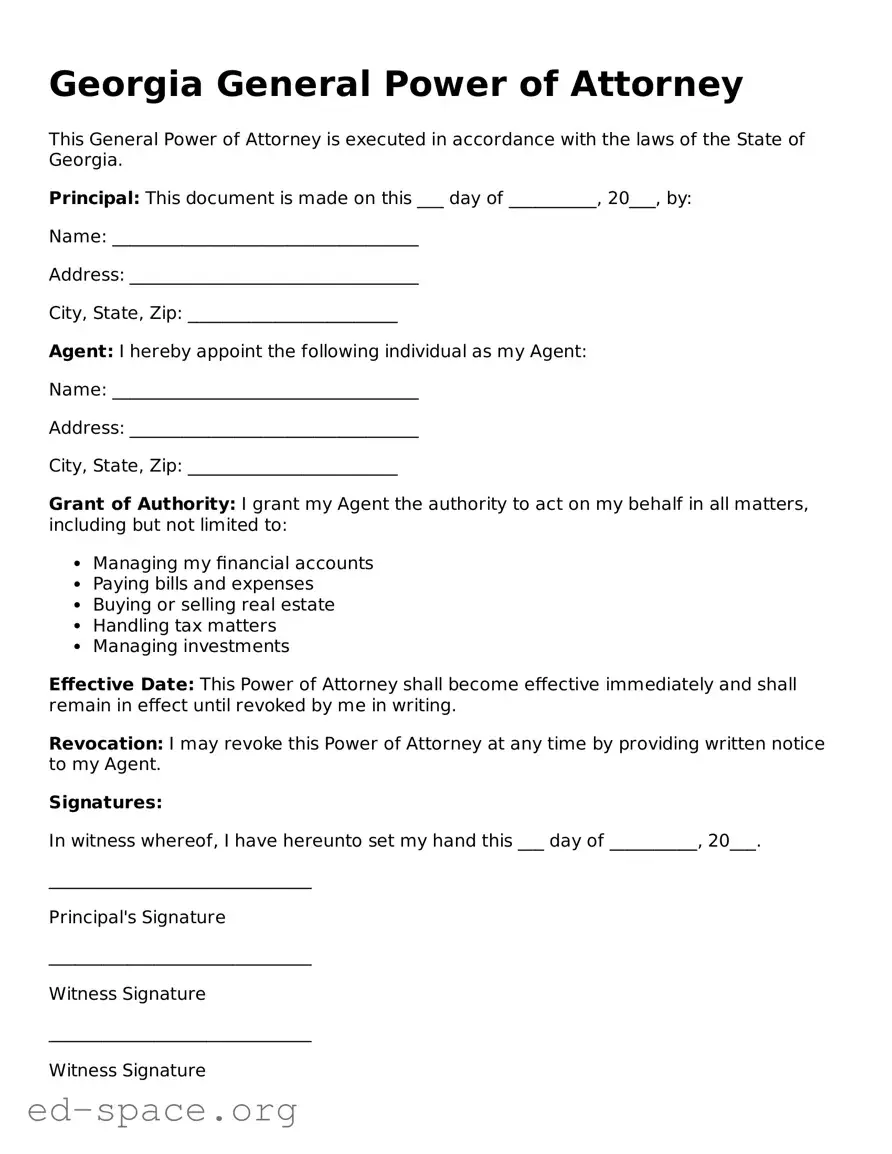
The Georgia General Power of Attorney form serves as a vital legal tool that allows individuals to appoint a trusted person to make decisions on their behalf. This document grants authority to the designated agent, empowering them to handle a range of financial and legal matters, such as managing bank accounts, signing contracts, and making healthcare decisions. It is essential for those who may become incapacitated or wish to ensure their affairs are managed smoothly in their absence. The form must be completed with careful consideration, as it requires the principal's signature and the agent's acceptance. Additionally, it is important to note that the powers granted can be broad or limited, depending on the principal's preferences. This flexibility allows individuals to tailor the document to their specific needs while ensuring that their wishes are honored. Understanding the implications and responsibilities associated with this form is crucial for both the principal and the agent, making it a significant step in planning for the future.
Georgia General Power of Attorney
This General Power of Attorney is executed in accordance with the laws of the State of Georgia.
Principal: This document is made on this ___ day of __________, 20___, by:
Name: ___________________________________
Address: _________________________________
City, State, Zip: ________________________
Agent: I hereby appoint the following individual as my Agent:
Name: ___________________________________
Address: _________________________________
City, State, Zip: ________________________
Grant of Authority: I grant my Agent the authority to act on my behalf in all matters, including but not limited to:
Effective Date: This Power of Attorney shall become effective immediately and shall remain in effect until revoked by me in writing.
Revocation: I may revoke this Power of Attorney at any time by providing written notice to my Agent.
Signatures:
In witness whereof, I have hereunto set my hand this ___ day of __________, 20___.
______________________________
Principal's Signature
______________________________
Witness Signature
______________________________
Witness Signature
Notary Public:
State of Georgia
County of ______________________
Subscribed and sworn to before me this ___ day of __________, 20___.
______________________________
Notary Public Signature
My Commission Expires: _______________
| Fact Name | Description |
|---|---|
| Definition | The Georgia General Power of Attorney form allows an individual to appoint someone else to handle their financial and legal matters. |
| Governing Law | This form is governed by the Georgia Uniform Power of Attorney Act, found in O.C.G.A. § 10-6B-1 et seq. |
| Durability | The General Power of Attorney can be made durable, meaning it remains effective even if the principal becomes incapacitated. |
| Revocation | The principal can revoke the General Power of Attorney at any time, as long as they are mentally competent to do so. |
Once you have the Georgia General Power of Attorney form in hand, you will need to complete it carefully. This process involves providing specific information about yourself, the person you are designating as your agent, and the powers you wish to grant. Follow these steps to ensure that you fill out the form accurately.
After completing the form, keep a copy for your records. You may also want to provide copies to your agent and any relevant financial institutions or healthcare providers. This ensures that your wishes are clear and can be acted upon when necessary.
What is a Georgia General Power of Attorney?
A Georgia General Power of Attorney is a legal document that allows one person, known as the principal, to grant another person, called the agent or attorney-in-fact, the authority to make decisions on their behalf. This authority can cover a wide range of matters, including financial and legal decisions, as specified in the document.
Who can create a General Power of Attorney in Georgia?
In Georgia, any adult who is mentally competent can create a General Power of Attorney. This means the individual must understand the nature and consequences of the document they are signing. Minors and those deemed mentally incapacitated cannot execute this form.
What powers can be granted through a General Power of Attorney?
The powers granted can be quite broad. They may include handling financial transactions, managing real estate, making legal claims, and conducting business operations. However, the principal can specify limitations or conditions on these powers in the document.
Does a General Power of Attorney need to be notarized in Georgia?
Yes, in Georgia, a General Power of Attorney must be notarized to be legally valid. Additionally, it is advisable to have it witnessed by at least one person, although this is not a strict requirement. Notarization helps ensure that the document is recognized by financial institutions and other entities.
Can I revoke a General Power of Attorney in Georgia?
Yes, a principal can revoke a General Power of Attorney at any time, as long as they are mentally competent. To revoke, the principal should create a written notice of revocation and notify the agent. It is also wise to inform any institutions or parties that have relied on the original document.
What happens if the principal becomes incapacitated?
If the principal becomes incapacitated, a General Power of Attorney typically remains in effect unless it is specifically stated to terminate upon incapacity. However, many individuals choose to create a Durable Power of Attorney, which specifically remains valid even if the principal becomes incapacitated.
Can an agent be compensated for their services?
Yes, an agent can be compensated for their services if the principal specifies this in the General Power of Attorney document. If compensation is not mentioned, the agent is generally expected to act without payment, although they can be reimbursed for reasonable expenses incurred while performing their duties.
Is a General Power of Attorney valid in other states?
A Georgia General Power of Attorney may be valid in other states, but this can depend on the laws of the other state. It is advisable to check the requirements in the state where the powers will be exercised to ensure compliance and validity.
What should I do if I have more questions about the General Power of Attorney?
If you have further questions, consider consulting with an attorney who specializes in estate planning or elder law. They can provide personalized guidance based on your specific situation and help ensure that your General Power of Attorney meets all legal requirements.
Not Understanding the Authority Granted: Many individuals fail to fully grasp what powers they are granting. It’s essential to read the document carefully and understand the implications of the authority being given.
Forgetting to Specify the Agent: Some people neglect to clearly identify the agent who will act on their behalf. This can lead to confusion or disputes later on.
Not Including Successor Agents: It’s a common oversight to not name successor agents. If the primary agent is unable or unwilling to serve, having a backup is crucial.
Failing to Date the Document: A date is vital. Without it, the power of attorney may be questioned regarding its validity and effectiveness.
Ignoring State-Specific Requirements: Each state, including Georgia, has specific requirements for a power of attorney. Not adhering to these can render the document invalid.
Not Signing in the Presence of a Notary: Many people forget that a notary public must witness the signing. This step is important for the document's legal standing.
Overlooking Revocation of Previous Powers: If there are prior powers of attorney, failing to revoke them can create confusion. It’s wise to clarify which document is currently in effect.
Not Discussing the Document with the Agent: Open communication with the chosen agent is often overlooked. Discussing the responsibilities and expectations can help ensure that the agent acts in the best interest of the principal.
When creating a Georgia General Power of Attorney, it is often helpful to have additional forms and documents that can support your needs. These documents can provide clarity and ensure that all legal aspects are covered.
Using these documents in conjunction with the Georgia General Power of Attorney can help ensure that your wishes are respected and that your affairs are managed according to your preferences.
A General Power of Attorney (GPOA) is a powerful document that grants someone the authority to act on your behalf. However, there are other documents that serve similar purposes. Here’s a list of eight documents that share similarities with a General Power of Attorney:
Understanding these documents can help you make informed decisions about how to manage your affairs and ensure your wishes are respected.
When filling out the Georgia General Power of Attorney form, it's crucial to approach the process with care and attention to detail. Here are nine essential dos and don'ts to guide you through this important legal task.
Understanding the Georgia General Power of Attorney form is crucial for anyone considering its use. Unfortunately, several misconceptions can lead to confusion. Here are nine common misunderstandings:
Clarifying these misconceptions can help individuals make informed decisions about their legal needs and ensure that their interests are protected.
Filling out and utilizing the Georgia General Power of Attorney form is an important step in managing your legal affairs. Here are some key takeaways to consider:
By following these guidelines, you can ensure that your General Power of Attorney is effective and aligns with your intentions.