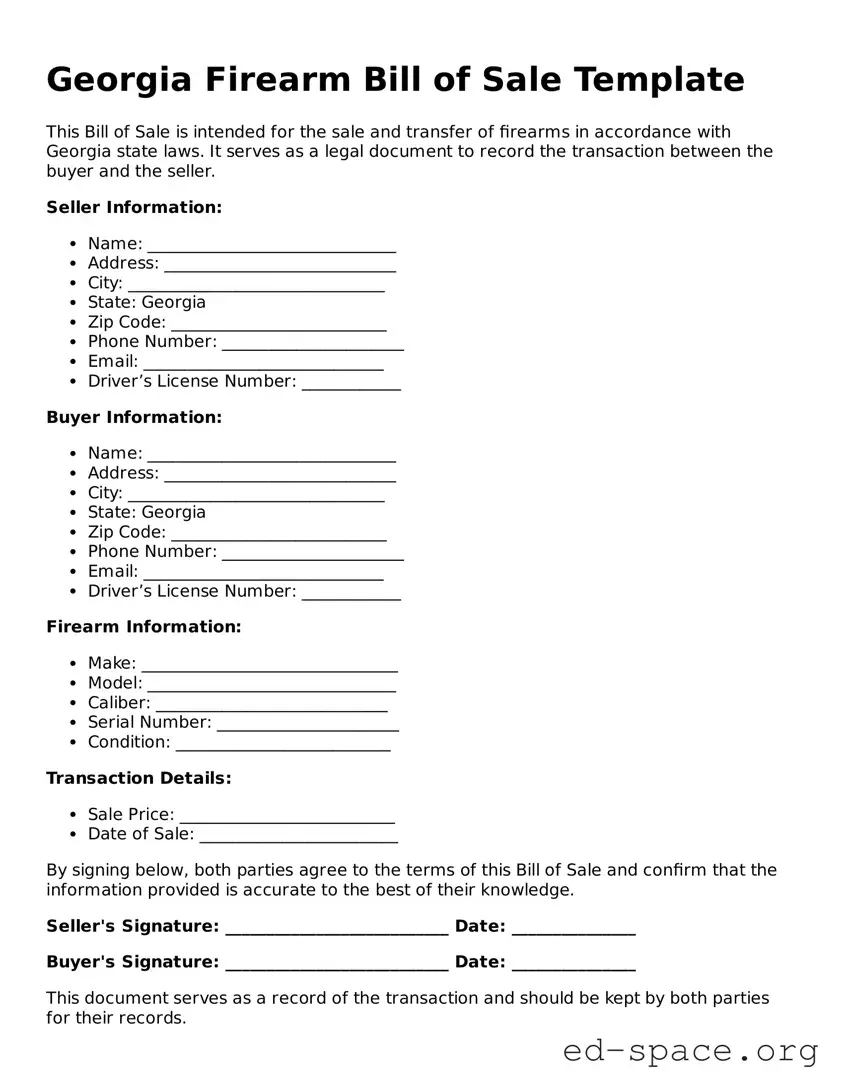
The Georgia Firearm Bill of Sale form serves as a crucial document for individuals engaged in the private sale or transfer of firearms within the state. This form is designed to facilitate a clear and legal transaction between the buyer and the seller, ensuring that both parties have a record of the sale. Key elements of the form include the names and contact information of both the buyer and seller, a detailed description of the firearm being sold—including make, model, caliber, and serial number—and the date of the transaction. Additionally, the form may include a statement affirming that both parties are legally eligible to buy or sell firearms, which helps to uphold state and federal regulations. By documenting the transfer, the Firearm Bill of Sale not only protects the interests of both parties but also provides a layer of accountability in the event of future legal inquiries regarding the firearm. Understanding the importance of this document is essential for anyone participating in firearm transactions in Georgia.
Georgia Firearm Bill of Sale Template
This Bill of Sale is intended for the sale and transfer of firearms in accordance with Georgia state laws. It serves as a legal document to record the transaction between the buyer and the seller.
Seller Information:
Buyer Information:
Firearm Information:
Transaction Details:
By signing below, both parties agree to the terms of this Bill of Sale and confirm that the information provided is accurate to the best of their knowledge.
Seller's Signature: ___________________________ Date: _______________
Buyer's Signature: ___________________________ Date: _______________
This document serves as a record of the transaction and should be kept by both parties for their records.
| Fact Name | Description |
|---|---|
| Purpose | The Georgia Firearm Bill of Sale form serves as a legal document to record the sale or transfer of firearms between parties. |
| Governing Law | This form is governed by Georgia state law, specifically O.C.G.A. § 16-11-131. |
| Parties Involved | The form must include information about both the seller and the buyer, including their names and addresses. |
| Firearm Details | Details about the firearm being sold must be included, such as make, model, caliber, and serial number. |
| Signature Requirement | Both parties must sign the document to validate the sale or transfer of the firearm. |
| Record Keeping | It is advisable for both parties to keep a copy of the signed Bill of Sale for their records. |
| Legal Protection | This form provides legal protection for both the seller and the buyer in case of disputes regarding the transaction. |
Completing the Georgia Firearm Bill of Sale form is a straightforward process that ensures both the buyer and seller have a clear record of the transaction. After filling out the form, keep a copy for your records and provide one to the other party involved in the sale. This documentation is essential for future reference and legal purposes.
What is a Firearm Bill of Sale in Georgia?
A Firearm Bill of Sale is a legal document that records the transfer of ownership of a firearm from one person to another. In Georgia, this form is important for both the buyer and the seller, as it provides proof of the transaction and can help protect both parties in case of future legal issues regarding the firearm.
Is a Firearm Bill of Sale required in Georgia?
No, a Firearm Bill of Sale is not legally required in Georgia for private sales of firearms. However, having one is highly recommended. It serves as a record of the transaction and can help establish the legality of the sale, especially if questions arise later about the firearm's ownership or history.
What information should be included in a Firearm Bill of Sale?
A comprehensive Firearm Bill of Sale should include several key pieces of information. This includes the names and addresses of both the buyer and the seller, the date of the transaction, a description of the firearm (including make, model, caliber, and serial number), and the purchase price. Both parties should sign the document to validate the sale.
Can I sell a firearm to someone from another state using a Bill of Sale?
While you can use a Bill of Sale for the transaction, selling a firearm to someone from another state involves additional legal considerations. Federal law requires that the sale be conducted through a licensed firearms dealer if the buyer is from a different state. This ensures that all background checks and legal requirements are met.
What if the firearm I sold is used in a crime?
If a firearm you sold is later used in a crime, having a Firearm Bill of Sale can help protect you. It serves as evidence that you no longer own the firearm and that you sold it legally. However, it is crucial to ensure that the buyer is legally eligible to own a firearm to minimize your risk.
Do I need to have the Bill of Sale notarized?
No, notarization is not a requirement for a Firearm Bill of Sale in Georgia. However, having the document notarized can add an extra layer of security and authenticity. It may also help in situations where proof of the transaction is necessary.
Can I create my own Firearm Bill of Sale?
Yes, you can create your own Firearm Bill of Sale. There are many templates available online that you can customize to fit your needs. Just ensure that all necessary information is included and that both parties sign the document. Alternatively, you can also use a pre-made form from a reputable source.
What should I do if I lose my Firearm Bill of Sale?
If you lose your Firearm Bill of Sale, it may be challenging to prove the sale took place. If possible, try to obtain a copy from the other party involved in the transaction. It’s always a good practice to keep a copy of the Bill of Sale in a safe place after the sale is completed.
Are there any penalties for not having a Bill of Sale?
While there are no specific penalties for not having a Firearm Bill of Sale in Georgia, not having one can lead to complications if legal questions arise about the firearm's ownership or if it is involved in a crime. It is always advisable to have proper documentation to protect yourself.
Failing to include the date of the transaction. This omission can lead to confusion about when the sale occurred.
Not providing the full name of both the buyer and the seller. Incomplete names can create legal issues regarding ownership.
Neglecting to list the address of both parties. Accurate addresses are essential for identification and record-keeping.
Forgetting to describe the firearm in detail. This includes the make, model, and serial number. A vague description can lead to disputes.
Not signing the form. Both parties must sign to validate the transaction; otherwise, it may not be legally binding.
Using incorrect or outdated form versions. Always ensure that the most current version of the form is being used to avoid legal complications.
Overlooking the need for witness signatures. Some jurisdictions require witnesses to the sale, and failing to include them can invalidate the document.
Not keeping a copy of the completed form. Both parties should retain a copy for their records to ensure accountability.
Assuming that the form is unnecessary for private sales. Even in private transactions, a Bill of Sale serves as important proof of the transfer.
When engaging in the sale or transfer of firearms in Georgia, several additional documents may be necessary to ensure compliance with state laws and to protect the interests of both parties involved. Below is a list of common forms and documents that are often used alongside the Georgia Firearm Bill of Sale form.
Utilizing these documents can help facilitate a smooth and legal transaction. Each form serves a specific purpose, contributing to a transparent and responsible process in the sale or transfer of firearms in Georgia.
When filling out the Georgia Firearm Bill of Sale form, it is important to follow certain guidelines to ensure the process goes smoothly. Here are seven things you should and shouldn't do:
The Georgia Firearm Bill of Sale form is an important document for anyone buying or selling firearms in the state. However, several misconceptions can lead to confusion. Here are four common misunderstandings:
While Georgia law does not require a Bill of Sale for private sales, having one is highly recommended. This document provides proof of the transaction, which can protect both the buyer and seller in case of future legal issues.
In Georgia, notarization is not a requirement for the Firearm Bill of Sale. However, having the document notarized can add an extra layer of legitimacy and help in case of disputes.
In private sales, the seller is not legally obligated to conduct a background check on the buyer. However, it is wise to encourage responsible ownership and consider the implications of selling to someone without verifying their background.
The Firearm Bill of Sale can be used for all types of firearms, including rifles and shotguns. This form is versatile and applies to any firearm transaction in Georgia.
When dealing with the Georgia Firearm Bill of Sale form, it's essential to understand the key elements to ensure a smooth transaction. Here are some important takeaways:
Using the Georgia Firearm Bill of Sale form wisely can make a significant difference in your firearm transaction experience. Being informed and prepared is key.