Creating a comprehensive employee handbook is essential for any business operating in Georgia. This document serves as a guide for employees, outlining workplace policies, expectations, and benefits. It covers critical areas such as company culture, code of conduct, and anti-discrimination policies. Additionally, the handbook addresses employee rights and responsibilities, including leave policies, performance evaluations, and disciplinary procedures. By providing clear information, it helps foster a positive work environment and can protect the company from potential legal issues. A well-structured employee handbook not only sets the tone for workplace behavior but also serves as a valuable resource for both new hires and seasoned employees. Understanding the key components of the Georgia Employee Handbook form can help ensure compliance with state laws while promoting a fair and respectful workplace.
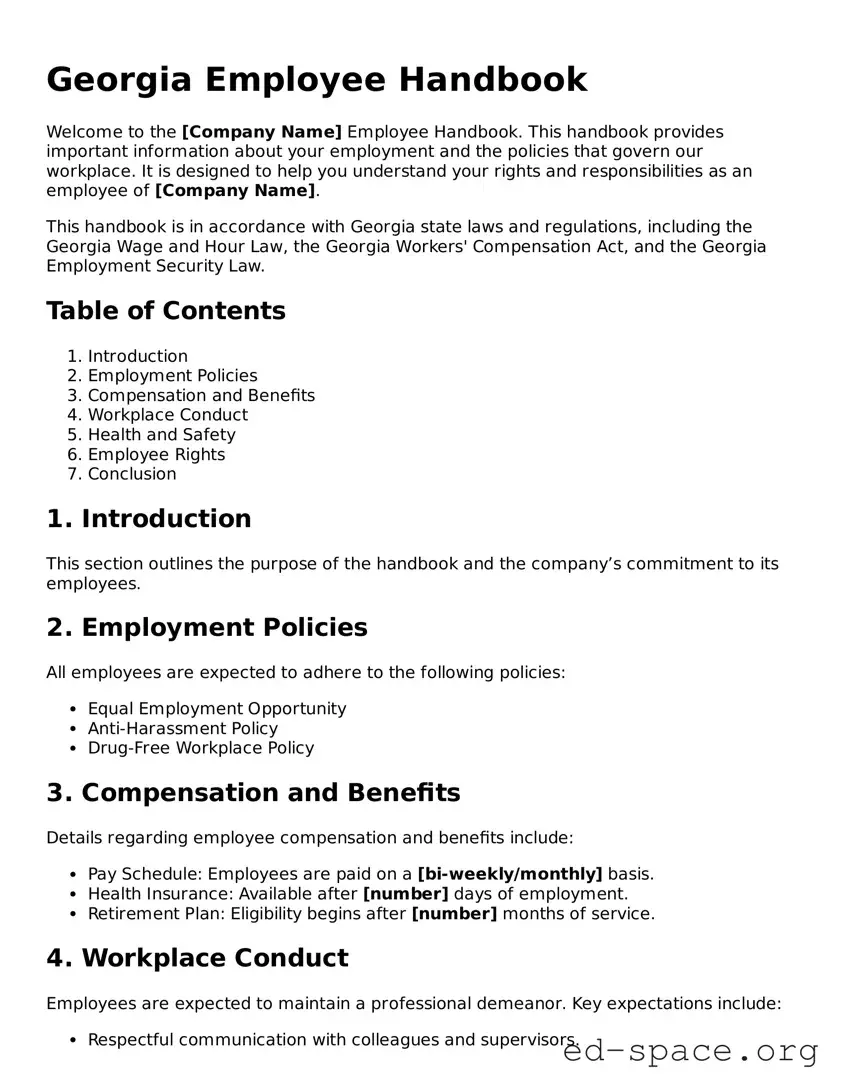
Georgia Employee Handbook
Welcome to the [Company Name] Employee Handbook. This handbook provides important information about your employment and the policies that govern our workplace. It is designed to help you understand your rights and responsibilities as an employee of [Company Name].
This handbook is in accordance with Georgia state laws and regulations, including the Georgia Wage and Hour Law, the Georgia Workers' Compensation Act, and the Georgia Employment Security Law.
Table of Contents
1. Introduction
This section outlines the purpose of the handbook and the company’s commitment to its employees.
2. Employment Policies
All employees are expected to adhere to the following policies:
3. Compensation and Benefits
Details regarding employee compensation and benefits include:
4. Workplace Conduct
Employees are expected to maintain a professional demeanor. Key expectations include:
5. Health and Safety
The safety of our employees is paramount. Employees should:
6. Employee Rights
Employees have rights under Georgia law, including but not limited to:
7. Conclusion
This handbook is a living document and may be updated periodically. Employees will be notified of any changes. For any questions or clarifications, please contact [HR Contact Information].
Thank you for being a valued member of the [Company Name] team.
| Fact Name | Description |
|---|---|
| Purpose | The Georgia Employee Handbook serves as a guide for employees, outlining company policies, procedures, and expectations. |
| Legal Compliance | This handbook helps ensure compliance with federal and state laws, including the Fair Labor Standards Act and the Family and Medical Leave Act. |
| Employee Rights | It informs employees of their rights and responsibilities, promoting a clear understanding of workplace conduct. |
| Customization | Employers are encouraged to tailor the handbook to reflect their specific policies and workplace culture. |
| Distribution | Employees should receive a copy of the handbook upon hire, and it should be accessible throughout their employment. |
Completing the Georgia Employee Handbook form is an essential step for ensuring that all necessary information is accurately recorded. After filling out the form, it will be submitted to the appropriate department for review and processing. This ensures that your employment records are up to date and compliant with company policies.
What is the purpose of the Georgia Employee Handbook form?
The Georgia Employee Handbook form serves as a critical document for employers and employees. It outlines company policies, procedures, and expectations. This handbook helps ensure that all employees understand their rights and responsibilities within the workplace. Additionally, it can protect the employer by providing clear guidelines that can be referenced in case of disputes or misunderstandings.
Who is required to have an Employee Handbook in Georgia?
While not mandated by law, having an Employee Handbook is highly recommended for all employers in Georgia, regardless of size. It is particularly important for businesses with multiple employees, as it fosters a consistent work environment and establishes a clear framework for workplace behavior and policies.
What key topics should be included in the Employee Handbook?
Key topics to include are company mission and values, employee rights, workplace conduct, anti-discrimination policies, leave policies, and disciplinary procedures. Additionally, it is wise to include information about benefits, safety protocols, and grievance procedures. Each section should be clear and easily understandable to ensure all employees can reference it when needed.
How often should the Employee Handbook be updated?
Regular updates are essential to keep the Employee Handbook relevant. It is advisable to review the handbook at least annually or whenever there are significant changes in company policies or employment laws. This ensures that employees are always informed of the latest guidelines and that the company remains compliant with state and federal regulations.
What should an employer do if an employee does not follow the handbook?
If an employee fails to adhere to the policies outlined in the Employee Handbook, the employer should follow the established disciplinary procedures. This may involve verbal warnings, written warnings, or other actions as specified in the handbook. Consistency in enforcing these policies is crucial to maintain fairness and uphold the integrity of the handbook.
Not reading the entire handbook before filling out the form. It's important to understand all the policies and procedures.
Skipping sections that seem unimportant. Every part of the form is designed to gather necessary information.
Failing to provide accurate personal information. Double-check names, addresses, and contact details.
Ignoring the deadlines for submission. Late forms can lead to issues with employment records.
Not signing or dating the form. A signature indicates that you agree to the terms outlined in the handbook.
Using unclear handwriting. Ensure that all written information is legible to avoid confusion.
Overlooking the importance of confidentiality. Sensitive information should be handled with care.
Not asking questions if something is unclear. It's better to seek clarification than to guess.
Forgetting to keep a copy of the completed form. This can be useful for your records and future reference.
When creating an employee handbook in Georgia, several other forms and documents can complement it. These documents help clarify policies, ensure compliance with state and federal laws, and establish clear communication between employers and employees.
Utilizing these forms and documents alongside the Georgia Employee Handbook can create a comprehensive framework for managing employee relations and ensuring compliance with legal requirements. Each document plays a vital role in fostering a positive workplace environment and protecting both the employer and employee rights.
When filling out the Georgia Employee Handbook form, it's important to follow certain guidelines to ensure accuracy and compliance. Here’s a list of things you should and shouldn’t do:
Understanding the nuances of the Georgia Employee Handbook form is crucial for both employers and employees. However, several misconceptions often arise regarding its purpose and requirements. Here’s a breakdown of ten common misunderstandings:
While not legally required, having an employee handbook is highly recommended. It helps establish clear policies and procedures, fostering a better work environment.
Every business is unique, and handbooks should reflect the specific culture, policies, and legal requirements of the organization.
Employee handbooks should be living documents. Regular updates are necessary to reflect changes in laws, company policies, and workplace practices.
While they do provide legal protection, handbooks also serve to inform employees of their rights and responsibilities, promoting transparency and trust.
While consistency is important, flexibility is also essential. Employers should consider the context of situations before enforcing policies.
Part-time, temporary, and contract workers can also benefit from having access to the handbook. It ensures that all individuals understand the workplace expectations.
Even without a signature, employees are generally expected to adhere to the policies outlined in the handbook simply by accepting employment.
Employee handbooks are not contracts. They outline policies and procedures but do not create binding agreements regarding employment terms.
While templates can provide a starting point, customization is key. Each business needs to tailor its handbook to reflect its specific needs and legal obligations.
It is important to encourage employees to ask questions and seek clarification on policies. Understanding can vary, and open communication is vital.
By addressing these misconceptions, both employers and employees can engage more effectively with the employee handbook, ensuring a smoother workplace experience.
When filling out and using the Georgia Employee Handbook form, keep these key takeaways in mind: