Homepage Free Durable Power of Attorney Form for Georgia
Content Overview

The Georgia Durable Power of Attorney form serves as a crucial legal document that empowers individuals to appoint a trusted person, known as an agent or attorney-in-fact, to manage their financial and legal affairs when they are unable to do so themselves. This form is particularly significant because it remains effective even if the principal becomes incapacitated, ensuring that their wishes are honored and their affairs are handled without interruption. Key components of the form include the designation of the agent, the specific powers granted to them, and any limitations the principal wishes to impose. Additionally, the form requires the principal's signature, as well as the signatures of witnesses or a notary public, to validate its authenticity. By carefully considering the responsibilities and authority they grant, individuals can create a tailored arrangement that aligns with their personal circumstances and preferences, providing peace of mind for both themselves and their loved ones.

Document Preview

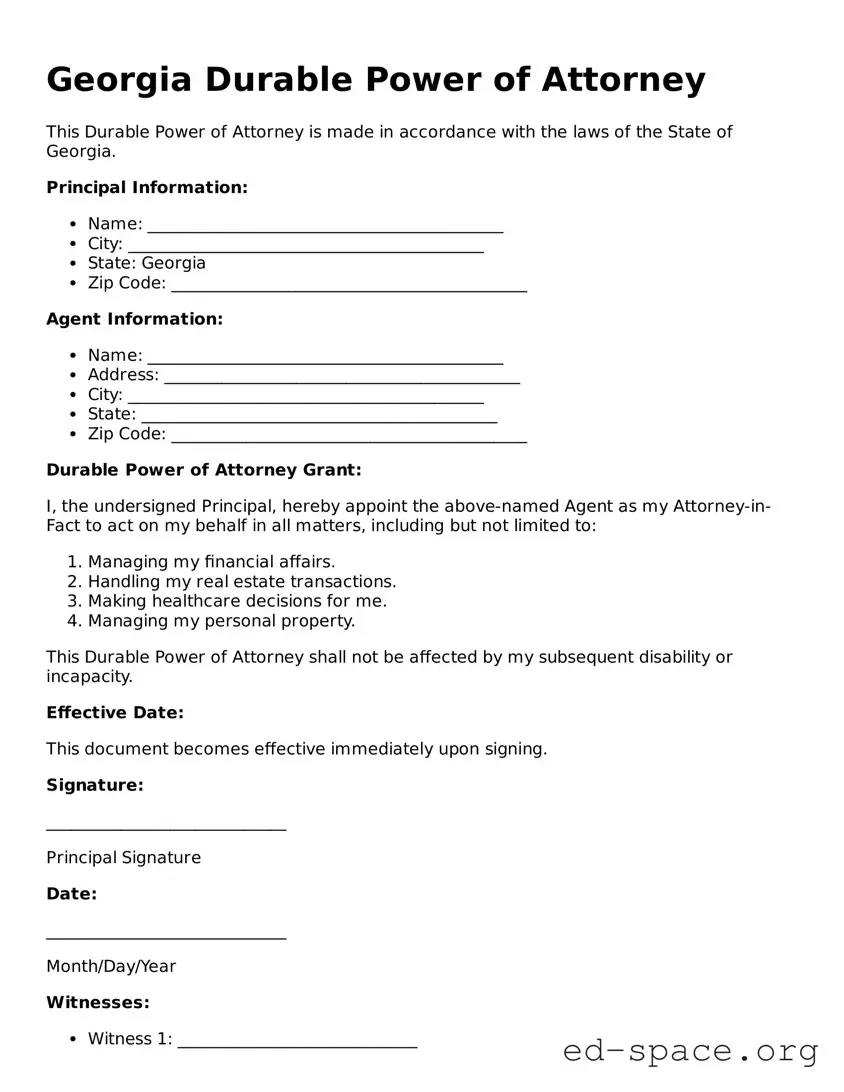
Georgia Durable Power of Attorney

This Durable Power of Attorney is made in accordance with the laws of the State of Georgia.

Principal Information:

  • Name: ___________________________________________
  • City: ___________________________________________
  • State: Georgia
  • Zip Code: ___________________________________________

Agent Information:

  • Name: ___________________________________________
  • Address: ___________________________________________
  • City: ___________________________________________
  • State: ___________________________________________
  • Zip Code: ___________________________________________

Durable Power of Attorney Grant:

I, the undersigned Principal, hereby appoint the above-named Agent as my Attorney-in-Fact to act on my behalf in all matters, including but not limited to:

  1. Managing my financial affairs.
  2. Handling my real estate transactions.
  3. Making healthcare decisions for me.
  4. Managing my personal property.

This Durable Power of Attorney shall not be affected by my subsequent disability or incapacity.

Effective Date:

This document becomes effective immediately upon signing.

Signature:

_____________________________

Principal Signature

Date:

_____________________________

Month/Day/Year

Witnesses:

  • Witness 1: _____________________________
  • Witness 2: _____________________________

Notarization:

State of Georgia

County of _______________________________

Subscribed and sworn to before me this ______ day of __________, 20__.

_____________________________

Notary Public

PDF Form Details

Fact Name Description
Definition A Georgia Durable Power of Attorney form allows an individual to appoint someone to manage their financial and legal affairs if they become incapacitated.
Governing Law This form is governed by the Georgia Uniform Power of Attorney Act, found in O.C.G.A. § 10-6B-1 et seq.
Durability The term "durable" means that the authority granted remains in effect even if the principal becomes incapacitated.
Agent Authority The agent, also known as the attorney-in-fact, can perform various tasks, such as managing bank accounts and making investment decisions.
Revocation The principal can revoke the Durable Power of Attorney at any time, as long as they are mentally competent.
Signing Requirements The form must be signed by the principal in the presence of a notary public and two witnesses to be valid.

Georgia Durable Power of Attorney: Usage Guidelines

Filling out the Georgia Durable Power of Attorney form is an important step in ensuring that your financial and legal matters can be managed by someone you trust in case you become unable to do so yourself. Once the form is completed, it must be signed and witnessed to be legally valid. Follow these steps to ensure you fill out the form correctly.

  1. Obtain the Georgia Durable Power of Attorney form. You can find it online or at your local courthouse.
  2. Begin by entering your full name and address in the designated section at the top of the form.
  3. Identify the person you are appointing as your agent. Write their full name and address clearly.
  4. Decide whether you want to grant your agent broad powers or limited powers. If you choose limited powers, specify which powers you want to grant in the appropriate section.
  5. Include any specific instructions or limitations regarding your agent’s authority, if applicable.
  6. Sign and date the form in the designated area. Make sure to do this in the presence of a notary public or two witnesses, as required by Georgia law.
  7. Ensure that your agent also signs the form, acknowledging their acceptance of the responsibilities.
  8. Make copies of the completed and signed form for your records and for your agent.

After completing these steps, you will have a valid Durable Power of Attorney. It is advisable to keep the original document in a safe place and to inform your agent where it is located. This ensures that they can act on your behalf when needed.

Your Questions, Answered

What is a Durable Power of Attorney in Georgia?

A Durable Power of Attorney (DPOA) in Georgia is a legal document that allows an individual, known as the principal, to appoint another person, referred to as the agent or attorney-in-fact, to make decisions on their behalf. This document remains effective even if the principal becomes incapacitated. The DPOA can cover a wide range of decisions, including financial matters, healthcare decisions, and property management, depending on the specific powers granted within the document.

How do I create a Durable Power of Attorney in Georgia?

To create a Durable Power of Attorney in Georgia, you must be at least 18 years old and mentally competent. You can draft the document yourself or use a template. It is crucial to clearly specify the powers you wish to grant your agent. After drafting the DPOA, you must sign it in the presence of a notary public. While witnesses are not required, having them can add an extra layer of validity. Ensure that your agent understands their responsibilities and is willing to act on your behalf.

Can I revoke a Durable Power of Attorney in Georgia?

Yes, you can revoke a Durable Power of Attorney in Georgia at any time, as long as you are mentally competent. To do so, you should create a written revocation document that clearly states your intention to revoke the DPOA. It is advisable to notify your agent and any institutions or individuals who may have relied on the original document. Additionally, you may want to destroy any copies of the original DPOA to prevent confusion.

What happens if my agent cannot serve or is unavailable?

If your designated agent cannot serve or is unavailable, the Durable Power of Attorney may specify an alternate agent. If no alternate is named, or if the alternate is also unavailable, you may need to seek a court-appointed guardian or conservator to manage your affairs. This process can be time-consuming and may not reflect your wishes, which is why it is essential to choose a reliable agent and consider naming alternates in your DPOA.

Common mistakes

  1. Failing to specify the powers granted. It is essential to clearly outline the specific powers the agent will have. Without this, the document may not serve its intended purpose.

  2. Not naming a successor agent. In case the primary agent is unable or unwilling to act, it is important to designate a backup. This ensures continuity in decision-making.

  3. Signing the document without witnesses. Georgia law requires that the Durable Power of Attorney be signed in the presence of a notary public or two witnesses. Failing to do so can invalidate the document.

  4. Using outdated forms. Legal forms can change over time. Always ensure that the most current version of the Georgia Durable Power of Attorney form is used.

  5. Not reviewing the document thoroughly. Before signing, it is crucial to read the entire document carefully. Overlooking any details can lead to misunderstandings or unintended consequences.

  6. Neglecting to discuss the document with the agent. Open communication about the powers granted and the individual’s wishes is vital. This helps ensure that the agent understands their responsibilities.

  7. Failing to keep copies of the signed document. It is important to retain copies for personal records and to provide copies to the agent and any relevant institutions.

  8. Not updating the document when circumstances change. Life events, such as a change in health or relationships, may necessitate revisions to the Durable Power of Attorney. Regularly reviewing and updating the document is advisable.

Documents used along the form

A Georgia Durable Power of Attorney form allows an individual to designate someone to make decisions on their behalf, particularly in financial matters. When creating or updating this document, several other forms and documents may also be relevant. Here is a list of commonly used documents that often accompany a Durable Power of Attorney in Georgia.

  • Advance Healthcare Directive: This document combines a living will and a healthcare power of attorney, allowing individuals to outline their medical preferences and appoint someone to make healthcare decisions if they become unable to do so.
  • Living Will: A living will specifies an individual’s wishes regarding medical treatment in situations where they cannot communicate their preferences, particularly concerning life-sustaining treatments.
  • Financial Power of Attorney: Similar to a Durable Power of Attorney, this document focuses specifically on financial matters, granting authority to manage bank accounts, real estate, and other financial assets.
  • Will: A will outlines how an individual wishes to distribute their assets after death. It also allows for the appointment of guardians for minor children.
  • Trust Document: A trust can manage assets during an individual’s lifetime and after their death. It allows for the transfer of assets to beneficiaries without going through probate.
  • Property Deed: This document transfers ownership of real estate from one party to another. It may be necessary to update property deeds if ownership is transferred as part of estate planning.
  • Beneficiary Designation Forms: These forms allow individuals to specify beneficiaries for life insurance policies, retirement accounts, and other financial accounts, ensuring that assets are distributed according to their wishes.

When preparing a Durable Power of Attorney in Georgia, consider these documents to ensure comprehensive planning for both financial and healthcare decisions. Each of these forms serves a specific purpose and can provide clarity and direction for your loved ones during critical times.

Similar forms

  • General Power of Attorney: This document grants someone the authority to act on your behalf in a wide range of matters, similar to a Durable Power of Attorney. However, it typically becomes invalid if you become incapacitated.
  • Healthcare Power of Attorney: This form specifically allows someone to make medical decisions for you if you are unable to do so. Like the Durable Power of Attorney, it remains effective even if you become incapacitated.
  • Living Will: While not the same as a Durable Power of Attorney, a Living Will outlines your wishes regarding medical treatment in situations where you cannot communicate. Both documents address issues of incapacity.
  • Financial Power of Attorney: This document focuses solely on financial matters, allowing someone to manage your finances. It can be durable or non-durable, depending on your specifications.
  • Revocable Trust: A Revocable Trust allows you to manage your assets during your lifetime and can continue after your death. It shares similarities with a Durable Power of Attorney in that both allow for the management of your affairs.
  • Advance Directive: This document combines a Living Will and a Healthcare Power of Attorney, guiding medical decisions and appointing someone to make those decisions for you. Both are crucial during times of incapacity.
  • Guardian or Conservatorship Documents: These legal arrangements appoint someone to make decisions for you if you cannot. They are similar in purpose to a Durable Power of Attorney but are often court-appointed.
  • Business Power of Attorney: This form is tailored for business-related decisions. Like a Durable Power of Attorney, it allows someone to act on your behalf but is focused on business operations.
  • Property Management Agreement: This document allows someone to manage your real estate or other properties. It shares the characteristic of granting authority, similar to a Durable Power of Attorney.
  • Medical Authorization Form: This document permits someone to access your medical records and make healthcare decisions. While it serves a different purpose, it aligns with the Durable Power of Attorney in facilitating decision-making during incapacity.

Dos and Don'ts

When filling out the Georgia Durable Power of Attorney form, it's important to follow certain guidelines to ensure that your document is valid and effective. Here’s a list of things you should and shouldn't do:

  • Do clearly identify the principal and the agent. Include full names and addresses.
  • Do specify the powers you are granting to your agent. Be clear about what decisions they can make on your behalf.
  • Do sign the document in the presence of a notary public. This adds an extra layer of validity.
  • Do keep a copy of the signed document for your records. This will help in future reference.
  • Don't leave any sections blank. Incomplete forms can lead to confusion or rejection.
  • Don't choose an agent who may have conflicting interests. Select someone you trust completely.

By following these guidelines, you can ensure that your Durable Power of Attorney form is filled out correctly and serves its intended purpose.

Misconceptions

Understanding the Georgia Durable Power of Attorney form is essential for anyone looking to manage their financial and legal affairs effectively. However, several misconceptions often cloud this important document. Here are ten common misunderstandings:

  1. It only applies to financial matters. Many people think a Durable Power of Attorney (DPOA) is limited to financial decisions. In reality, it can also cover healthcare decisions, depending on how it is drafted.
  2. It becomes effective only when I am incapacitated. A DPOA can be effective immediately upon signing or can be set to activate only when you become incapacitated. The choice is yours.
  3. My agent can do anything they want with my DPOA. While your agent has broad authority, they must act in your best interest and within the limits you set in the document.
  4. Once I sign it, I cannot change it. You can revoke or change your Durable Power of Attorney at any time, as long as you are mentally competent.
  5. It is only necessary for older adults. Anyone, regardless of age, can benefit from having a DPOA in place, especially if they anticipate potential health issues or travel frequently.
  6. My spouse automatically has authority to act on my behalf. A spouse does not automatically have the legal authority to make decisions for you unless a DPOA is in place.
  7. All states use the same DPOA form. Each state has its own laws and forms for Durable Power of Attorney, including Georgia, which has specific requirements.
  8. It can be used for all legal matters. A DPOA has limitations. Certain actions, like making a will or filing for divorce, cannot be delegated through a DPOA.
  9. Once it is in effect, my agent can act without any oversight. Agents are expected to keep records and may be held accountable for their actions, ensuring transparency.
  10. I need a lawyer to create a DPOA. While it is advisable to consult a lawyer for complex situations, many people can create a valid DPOA using state-approved forms.

By clarifying these misconceptions, individuals can make informed decisions about their Durable Power of Attorney and ensure their wishes are respected in the future.

Key takeaways

Filling out and using the Georgia Durable Power of Attorney form is an important process. Here are key takeaways to keep in mind:

  1. Understand the Purpose: The Durable Power of Attorney allows you to appoint someone to make decisions on your behalf if you become unable to do so.
  2. Select a Trusted Agent: Choose someone you trust completely, as they will have significant authority over your financial and legal matters.
  3. Be Specific: Clearly outline the powers you are granting. This can include managing finances, making healthcare decisions, or handling real estate transactions.
  4. Consider Timing: The document can take effect immediately or only when you become incapacitated. Decide which option best suits your needs.
  5. Review and Update: Regularly review the document to ensure it reflects your current wishes and circumstances. Update it as needed.

Following these guidelines will help ensure that your Durable Power of Attorney is effective and meets your needs.