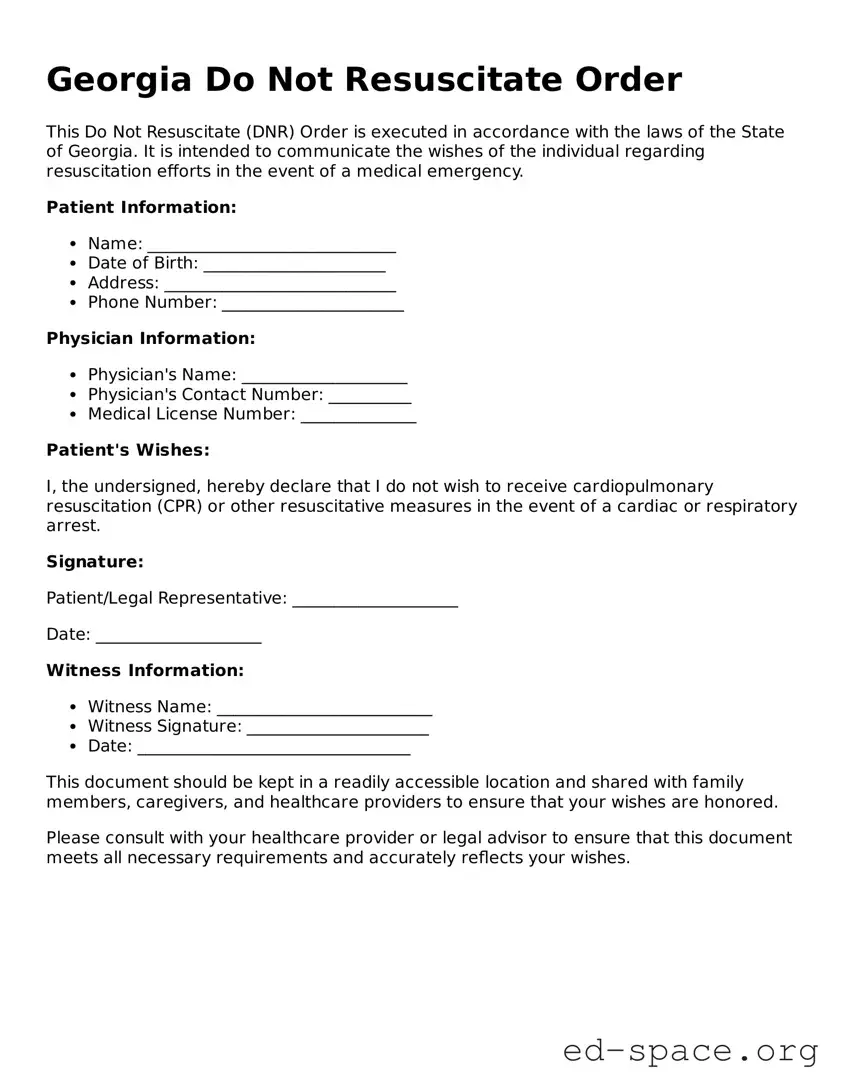
The Georgia Do Not Resuscitate (DNR) Order form is a critical document designed to communicate a patient's wishes regarding resuscitation efforts in the event of a medical emergency. This form is particularly significant for individuals with terminal illnesses or those who wish to avoid aggressive medical interventions at the end of life. The DNR Order must be completed and signed by a physician, ensuring that the patient's preferences are respected in emergency situations. It is essential for patients and their families to understand the implications of this form, as it serves as a legal directive for healthcare providers. Additionally, the form should be easily accessible, often kept in a visible location, such as on the refrigerator or in a medical file, to ensure that first responders can quickly locate it. By clearly outlining a patient's wishes, the Georgia DNR Order helps facilitate conversations about end-of-life care and ensures that individuals receive the type of treatment they desire, preserving their autonomy and dignity during critical moments.
Georgia Do Not Resuscitate Order
This Do Not Resuscitate (DNR) Order is executed in accordance with the laws of the State of Georgia. It is intended to communicate the wishes of the individual regarding resuscitation efforts in the event of a medical emergency.
Patient Information:
Physician Information:
Patient's Wishes:
I, the undersigned, hereby declare that I do not wish to receive cardiopulmonary resuscitation (CPR) or other resuscitative measures in the event of a cardiac or respiratory arrest.
Signature:
Patient/Legal Representative: ____________________
Date: ____________________
Witness Information:
This document should be kept in a readily accessible location and shared with family members, caregivers, and healthcare providers to ensure that your wishes are honored.
Please consult with your healthcare provider or legal advisor to ensure that this document meets all necessary requirements and accurately reflects your wishes.
| Fact Name | Description |
|---|---|
| Definition | A Do Not Resuscitate (DNR) Order in Georgia is a legal document that allows a person to refuse resuscitation efforts in case of cardiac or respiratory arrest. |
| Governing Laws | The DNR Order in Georgia is governed by the Georgia Code Title 31, Chapter 39, which outlines the legal framework for advance directives and medical decision-making. |
| Eligibility | Individuals who are 18 years or older and are capable of making their own medical decisions can complete a DNR Order in Georgia. |
| Signature Requirements | The DNR Order must be signed by the individual or their authorized representative, and it should also be witnessed by at least one person who is not related to the individual. |
| Healthcare Provider Notification | Once completed, the DNR Order must be presented to healthcare providers, who are then required to honor the order in accordance with Georgia law. |
Filling out the Georgia Do Not Resuscitate (DNR) Order form is an important step in expressing your healthcare preferences. This document allows individuals to communicate their wishes regarding resuscitation in medical emergencies. Once you have completed the form, it should be signed and dated, and a copy should be shared with your healthcare providers and loved ones.
What is a Do Not Resuscitate (DNR) Order in Georgia?
A Do Not Resuscitate Order is a legal document that allows individuals to refuse resuscitation efforts in the event of cardiac arrest or respiratory failure. In Georgia, this order is typically used by patients who have a terminal illness or a condition that significantly diminishes their quality of life. It ensures that medical personnel will not perform CPR or other life-saving measures if the individual’s heart stops beating or they stop breathing.
Who can request a DNR Order in Georgia?
In Georgia, a DNR Order can be requested by the patient themselves if they are of sound mind and able to make decisions about their healthcare. If the patient is unable to communicate their wishes, a legally authorized representative, such as a family member or a designated healthcare proxy, may request the order on their behalf. It is crucial that the person requesting the DNR understands the implications of the decision.
How do I obtain a DNR Order form in Georgia?
Obtaining a DNR Order form in Georgia is a straightforward process. You can typically find the official form through healthcare providers, hospitals, or the Georgia Department of Public Health’s website. It is important to ensure that you are using the most current version of the form, as regulations may change. Once the form is completed and signed by the appropriate parties, it should be kept in an easily accessible location, such as with your medical records or at home.
What information is required on the DNR Order form?
The DNR Order form in Georgia requires specific information to be valid. This includes the patient’s full name, date of birth, and a clear statement of the patient’s wishes regarding resuscitation. The form must also be signed by the patient or their authorized representative, as well as a physician. Additionally, the physician’s signature confirms that they have discussed the order with the patient or their representative and that it aligns with the patient’s healthcare goals.
Will a DNR Order affect other medical treatments?
It is a common misconception that a DNR Order means no medical treatment will be provided. In reality, a DNR Order specifically pertains to resuscitation efforts only. Patients who have a DNR Order can still receive other medical treatments, including medications, pain management, and comfort care. It is essential to communicate with healthcare providers about the full scope of treatment preferences to ensure that all aspects of care align with the patient’s wishes.
Can a DNR Order be revoked or changed?
Yes, a DNR Order can be revoked or changed at any time. The patient or their authorized representative may verbally communicate their desire to revoke the order, or they can complete a new DNR Order form that reflects their updated wishes. It is important to ensure that healthcare providers are informed of any changes to avoid confusion during medical emergencies. Keeping the DNR Order in an accessible location and informing family members about any changes can help ensure that the patient’s wishes are respected.
Incomplete Information: One of the most common mistakes is failing to provide all required information. This includes the patient's full name, date of birth, and signature. Omitting any of these details can render the form invalid.
Incorrect Signatures: The form must be signed by the patient or their legal representative. If the wrong person signs it, or if the signature is not witnessed as required, the order may not be honored in an emergency situation.
Misunderstanding Medical Terms: Some individuals may misinterpret what "Do Not Resuscitate" truly means. It is crucial to understand that this order specifically pertains to not performing cardiopulmonary resuscitation (CPR) and does not affect other medical treatments.
Not Discussing with Healthcare Providers: Another frequent error is neglecting to discuss the order with healthcare providers. Having a conversation with doctors or nurses ensures that everyone involved understands the patient's wishes and can provide appropriate care in line with the DNR order.
In addition to the Georgia Do Not Resuscitate (DNR) Order form, several other documents are commonly used to ensure that an individual's healthcare preferences are respected. Each of these forms serves a specific purpose and can be essential in guiding medical decisions during critical situations.
Understanding these documents is vital for individuals and families navigating healthcare decisions. Each form plays a significant role in ensuring that personal wishes are honored, providing peace of mind during challenging times.
When filling out the Georgia Do Not Resuscitate Order form, it is important to follow specific guidelines to ensure the document is valid and reflects your wishes. Here’s a list of things you should and shouldn’t do:
Understanding the Georgia Do Not Resuscitate (DNR) Order form is crucial for patients and their families. However, several misconceptions can lead to confusion and misinterpretation. Here are five common misconceptions:
This is false. A DNR order specifically addresses resuscitation efforts in the event of cardiac or respiratory arrest. It does not prevent other forms of medical care or treatment from being administered.
This misconception is incorrect. Any patient can request a DNR order, regardless of their diagnosis. It is a personal choice that reflects a patient's wishes about resuscitation.
This is not true. A DNR order is valid in various settings, including homes, nursing facilities, and hospitals. It must be honored by all healthcare providers in any location.
This is misleading. In Georgia, a DNR order must be documented in writing and signed by a physician. Verbal requests are not sufficient to establish a legally binding DNR order.
This is incorrect. Patients or their legal representatives can revoke a DNR order at any time. This can be done verbally or in writing, depending on the situation.
Clarifying these misconceptions can help ensure that patients' wishes are respected and that they receive appropriate care in accordance with their preferences.
When considering the Georgia Do Not Resuscitate (DNR) Order form, it's important to understand several key aspects. Here are some essential takeaways: