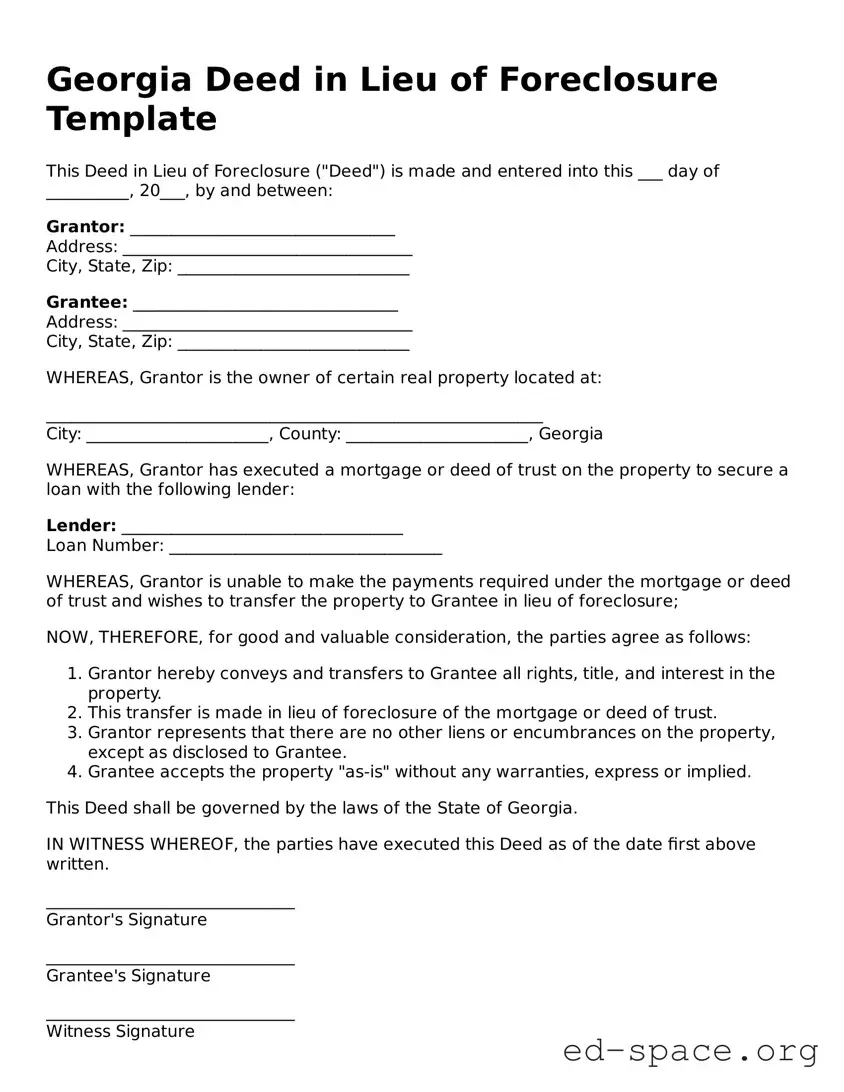
In the state of Georgia, homeowners facing the threat of foreclosure have an alternative option known as the Deed in Lieu of Foreclosure. This process allows a borrower to voluntarily transfer ownership of their property back to the lender, effectively relinquishing their rights to the home in exchange for the cancellation of the mortgage debt. The form itself serves as a legal document that outlines the terms of this agreement, ensuring that both parties are protected throughout the transaction. Key components of the form include details about the property, the parties involved, and any potential liabilities that may arise from the transfer. By completing this form, homeowners can avoid the lengthy and often stressful foreclosure process, while lenders can expedite the recovery of their investment. Understanding the implications of signing a Deed in Lieu of Foreclosure is crucial for homeowners, as it can impact their credit score and future borrowing capabilities. This article will delve deeper into the specifics of the Georgia Deed in Lieu of Foreclosure form, offering insights into its benefits, risks, and the steps involved in executing this option.
Georgia Deed in Lieu of Foreclosure Template
This Deed in Lieu of Foreclosure ("Deed") is made and entered into this ___ day of __________, 20___, by and between:
Grantor: ________________________________
Address: ___________________________________
City, State, Zip: ____________________________
Grantee: ________________________________
Address: ___________________________________
City, State, Zip: ____________________________
WHEREAS, Grantor is the owner of certain real property located at:
____________________________________________________________
City: ______________________, County: ______________________, Georgia
WHEREAS, Grantor has executed a mortgage or deed of trust on the property to secure a loan with the following lender:
Lender: __________________________________
Loan Number: _________________________________
WHEREAS, Grantor is unable to make the payments required under the mortgage or deed of trust and wishes to transfer the property to Grantee in lieu of foreclosure;
NOW, THEREFORE, for good and valuable consideration, the parties agree as follows:
This Deed shall be governed by the laws of the State of Georgia.
IN WITNESS WHEREOF, the parties have executed this Deed as of the date first above written.
______________________________
Grantor's Signature
______________________________
Grantee's Signature
______________________________
Witness Signature
______________________________
Notary Public Signature
My Commission Expires: ________________
| Fact Name | Details |
|---|---|
| Definition | A deed in lieu of foreclosure is a legal document that allows a borrower to transfer the title of their property to the lender to avoid foreclosure proceedings. |
| Governing Law | The deed in lieu of foreclosure in Georgia is governed by the Official Code of Georgia Annotated (O.C.G.A.) § 44-14-162. |
| Eligibility | Homeowners facing financial hardship and unable to meet mortgage obligations may be eligible for a deed in lieu of foreclosure. |
| Process Overview | The borrower must contact the lender, submit necessary documentation, and complete the deed transfer process. |
| Impact on Credit | A deed in lieu of foreclosure typically has a less severe impact on credit scores compared to a foreclosure. |
| Tax Implications | Borrowers may face potential tax consequences, as forgiven debt can be considered taxable income under certain circumstances. |
| Alternative Options | Other options, such as loan modification or short sale, may be available and should be considered before proceeding. |
| Documentation Required | Common documentation includes proof of income, hardship letters, and a completed deed in lieu form. |
| Legal Advice | Consulting with a legal professional is advisable to understand rights and obligations before signing a deed in lieu of foreclosure. |
Once you have the Georgia Deed in Lieu of Foreclosure form, it's important to complete it accurately. This document is crucial for transferring property ownership and resolving mortgage obligations. Follow the steps below to fill out the form correctly.
After filling out the form, submit it to the lender along with any required documents. They will process the deed and provide further instructions on the next steps in the foreclosure resolution process.
What is a Deed in Lieu of Foreclosure in Georgia?
A Deed in Lieu of Foreclosure is a legal document where a homeowner voluntarily transfers their property title to the lender to avoid foreclosure. This process allows the homeowner to resolve their mortgage default without going through the lengthy foreclosure process.
Who can use a Deed in Lieu of Foreclosure?
Homeowners facing financial difficulties and unable to continue making mortgage payments may consider this option. It is essential to communicate with your lender to determine eligibility, as they may have specific requirements or conditions.
What are the benefits of a Deed in Lieu of Foreclosure?
One significant benefit is the potential to avoid foreclosure, which can negatively impact credit scores. Additionally, it may allow homeowners to walk away from the property without further financial obligation, depending on the lender’s policies. The process is often quicker and less stressful than traditional foreclosure proceedings.
What are the drawbacks of a Deed in Lieu of Foreclosure?
While it can be a solution, there are drawbacks to consider. Homeowners may still face tax implications on any forgiven debt. Furthermore, a Deed in Lieu of Foreclosure may still impact credit scores, though typically less severely than a foreclosure. It's important to weigh these factors before proceeding.
How does the process work?
The process begins with the homeowner contacting the lender to express interest in a Deed in Lieu of Foreclosure. The lender will typically require documentation of financial hardship. If approved, both parties will sign the deed, and the homeowner will relinquish ownership of the property. The lender may then release the homeowner from further liability for the mortgage debt.
Do I need a lawyer to complete a Deed in Lieu of Foreclosure?
While it is not legally required to have a lawyer, consulting one is advisable. A legal professional can help ensure that all documents are correctly completed and that the homeowner understands their rights and obligations. This guidance can be invaluable in navigating the complexities of the process.
What happens to my credit score after a Deed in Lieu of Foreclosure?
A Deed in Lieu of Foreclosure will likely affect your credit score, but usually not as severely as a foreclosure. The exact impact can vary based on individual credit history and the scoring model used. Generally, it is important to monitor your credit report after the transaction to understand its effects.
Can I still pursue other options if I choose a Deed in Lieu of Foreclosure?
Once a Deed in Lieu of Foreclosure is executed, it typically concludes the homeowner's options regarding that property. However, homeowners may still explore other avenues for future financial stability, such as seeking new housing or negotiating with creditors for better terms on other debts.
Inaccurate Property Description: One common mistake is failing to provide a complete and accurate description of the property. This includes not specifying the correct address, parcel number, or legal description. Any discrepancies can lead to complications in the transfer process.
Not Including All Necessary Signatures: It's essential to ensure that all required parties sign the form. This often includes the borrower, co-borrowers, and sometimes even spouses or other parties with an interest in the property. Missing a signature can invalidate the deed.
Overlooking the Tax Implications: Many individuals neglect to consider the potential tax consequences of a deed in lieu of foreclosure. The IRS may view the forgiven debt as taxable income, leading to unexpected financial burdens. Consulting with a tax professional can help clarify these issues.
Failing to Notify the Lender: Some people mistakenly think that filling out the deed in lieu of foreclosure form is enough. However, it is crucial to formally notify the lender of the intention to proceed with this option. Communication with the lender can help avoid misunderstandings and ensure a smoother process.
When navigating the complexities of property ownership and potential foreclosure in Georgia, it's essential to understand the various documents that may accompany a Deed in Lieu of Foreclosure. Each of these forms plays a critical role in ensuring that the process runs smoothly and that all parties are protected. Here’s a list of commonly used documents that you might encounter.
Understanding these documents can empower individuals facing foreclosure to make informed decisions. Each form serves a unique purpose, and knowing how they fit into the process can help ensure a smoother transition during a challenging time. Always consult with a knowledgeable professional to guide you through the specifics of your situation.
The Deed in Lieu of Foreclosure form shares similarities with several other legal documents related to real estate transactions and debt resolution. Below is a list of documents that bear resemblance to the Deed in Lieu of Foreclosure, along with a brief explanation of each.
When filling out the Georgia Deed in Lieu of Foreclosure form, it is essential to approach the process with care. Here are some important dos and don'ts to keep in mind:
Following these guidelines can help ensure that the process goes smoothly and that all necessary information is accurately captured.
Understanding the Georgia Deed in Lieu of Foreclosure can be challenging. Here are nine common misconceptions that often arise:
A deed in lieu of foreclosure does not automatically erase all debt. While it may relieve some mortgage obligations, other debts may still remain.
The process can be complex and requires careful documentation and negotiation with the lender. It is not merely a matter of signing a form.
All parties involved, including co-borrowers and guarantors, may be impacted. Their credit and financial standing could also be affected.
A deed in lieu of foreclosure is a voluntary action taken by the borrower to transfer the property, while foreclosure is a legal process initiated by the lender.
Even after a deed in lieu, lenders may pursue other legal avenues to recover losses, depending on state laws and the specific agreement.
Not all lenders will agree to this option. Each lender has its own policies and may prefer foreclosure as a resolution.
A deed in lieu of foreclosure can still negatively affect a borrower’s credit score, although it may be less damaging than a foreclosure.
This option should not be seen as a quick solution. It often requires time and careful consideration of the long-term implications.
Borrowers may still be liable for any deficiencies, meaning they could owe money if the property sells for less than the outstanding mortgage balance.
Being informed about these misconceptions is crucial for making sound financial decisions regarding a deed in lieu of foreclosure in Georgia.
Filling out and using the Georgia Deed in Lieu of Foreclosure form can be a crucial step for homeowners facing financial difficulties. Understanding the key aspects of this form can help streamline the process and avoid potential pitfalls.