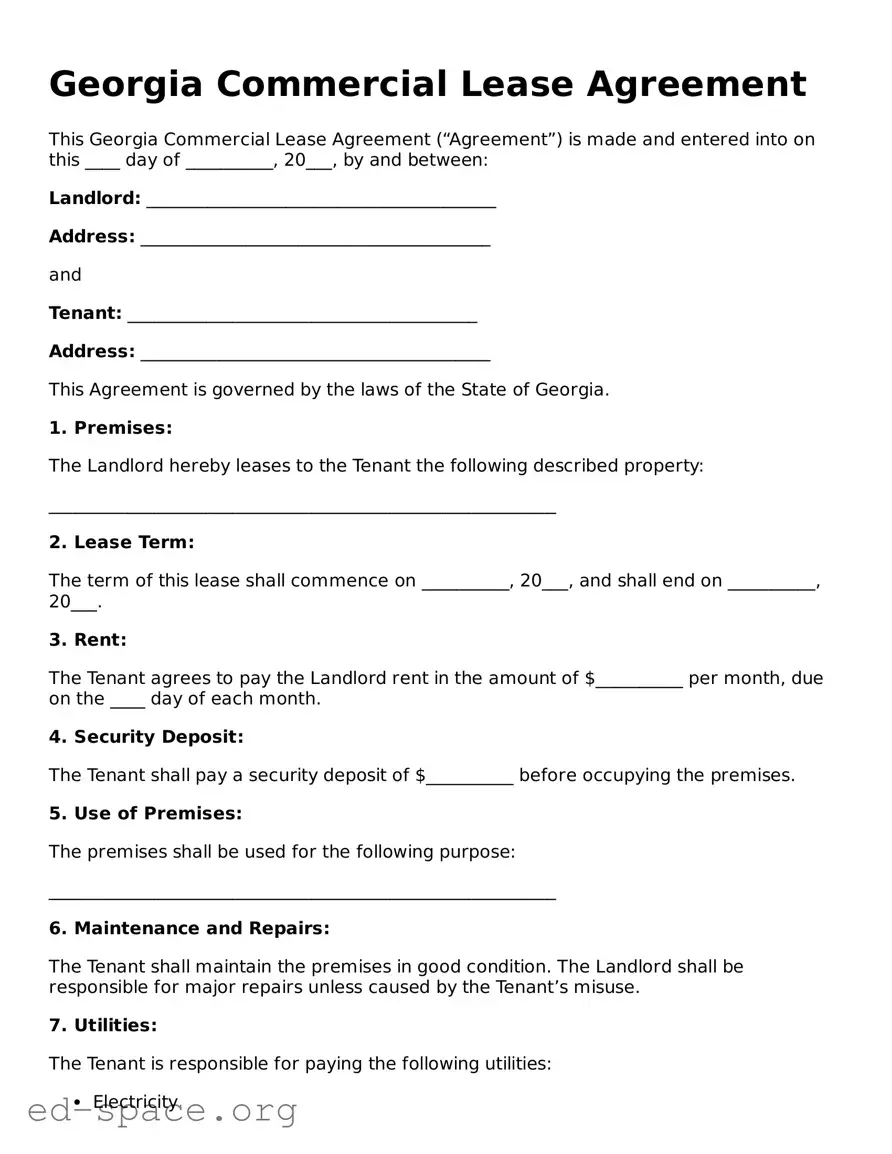
When entering into a commercial lease in Georgia, understanding the lease agreement form is crucial for both landlords and tenants. This document outlines the terms and conditions that govern the rental of commercial property, ensuring that both parties have a clear understanding of their rights and responsibilities. Key aspects of the Georgia Commercial Lease Agreement include the duration of the lease, the amount of rent, and payment terms. Additionally, it addresses security deposits, maintenance responsibilities, and the permissible uses of the property. It also outlines procedures for renewing or terminating the lease, as well as any restrictions on subleasing. By familiarizing yourself with these components, you can navigate the leasing process more effectively, protecting your interests and fostering a positive landlord-tenant relationship.
Georgia Commercial Lease Agreement
This Georgia Commercial Lease Agreement (“Agreement”) is made and entered into on this ____ day of __________, 20___, by and between:
Landlord: ________________________________________
Address: ________________________________________
and
Tenant: ________________________________________
Address: ________________________________________
This Agreement is governed by the laws of the State of Georgia.
1. Premises:
The Landlord hereby leases to the Tenant the following described property:
__________________________________________________________
2. Lease Term:
The term of this lease shall commence on __________, 20___, and shall end on __________, 20___.
3. Rent:
The Tenant agrees to pay the Landlord rent in the amount of $__________ per month, due on the ____ day of each month.
4. Security Deposit:
The Tenant shall pay a security deposit of $__________ before occupying the premises.
5. Use of Premises:
The premises shall be used for the following purpose:
__________________________________________________________
6. Maintenance and Repairs:
The Tenant shall maintain the premises in good condition. The Landlord shall be responsible for major repairs unless caused by the Tenant’s misuse.
7. Utilities:
The Tenant is responsible for paying the following utilities:
8. Termination:
Either party may terminate this Agreement by providing written notice of ____ days to the other party.
9. Governing Law:
This Agreement shall be governed by the laws of the State of Georgia.
IN WITNESS WHEREOF, the parties have executed this Agreement as of the date first above written.
Landlord Signature: ___________________________
Date: ________________
Tenant Signature: ___________________________
Date: ________________
| Fact Name | Description |
|---|---|
| Governing Law | The Georgia Commercial Lease Agreement is governed by the laws of the State of Georgia. |
| Parties Involved | The lease agreement typically involves a landlord (lessor) and a tenant (lessee). |
| Lease Duration | Lease terms can vary, often ranging from one year to multiple years. |
| Rent Payment | Details regarding rent amount, due dates, and payment methods are specified in the agreement. |
| Maintenance Responsibilities | The agreement outlines which party is responsible for property maintenance and repairs. |
| Termination Clause | Conditions under which the lease can be terminated by either party are included. |
Filling out the Georgia Commercial Lease Agreement form is an important step in securing a rental space for your business. This process requires attention to detail, as each section of the form must be completed accurately to ensure both parties understand their rights and responsibilities. Below are the steps to guide you through filling out the form.
What is a Georgia Commercial Lease Agreement?
A Georgia Commercial Lease Agreement is a legal document that outlines the terms and conditions between a landlord and a tenant for renting commercial property in Georgia. This agreement specifies details such as the rental amount, lease duration, property use, and responsibilities of both parties. It serves to protect the interests of both the landlord and the tenant by clearly defining expectations and obligations.
What key elements should be included in the lease?
Essential elements of a Georgia Commercial Lease Agreement include the names of the landlord and tenant, a description of the property, the lease term (length of the lease), rental payment details (amount, due date, and payment method), security deposit information, maintenance responsibilities, and any clauses regarding renewal or termination of the lease. It may also include provisions for utilities, insurance requirements, and permissible uses of the property.
How long is a typical commercial lease in Georgia?
The duration of a commercial lease in Georgia can vary widely based on the needs of the tenant and landlord. Common lease terms range from one to five years, but longer leases are not unusual, especially for established businesses. Some leases may also include options for renewal, allowing tenants to extend their lease under agreed-upon conditions.
Can the lease be modified after signing?
Yes, a Georgia Commercial Lease Agreement can be modified after signing, but any changes must be documented in writing and signed by both parties. This ensures that all modifications are legally enforceable. It is advisable to keep a record of any amendments to avoid misunderstandings in the future.
What happens if the tenant defaults on the lease?
If a tenant defaults on the lease, which may include failing to pay rent or violating lease terms, the landlord has several options. They can issue a notice to the tenant to remedy the default, pursue eviction proceedings, or seek damages. The specific actions depend on the lease terms and Georgia law. It’s important for both parties to understand their rights and obligations in such situations.
Incomplete Information: Many individuals fail to provide all required details, such as the names of the parties involved, the property address, and the lease term. Omitting this information can lead to confusion and potential disputes later on.
Ignoring Terms and Conditions: Some people overlook the importance of thoroughly reading the lease terms. This includes understanding rent payment schedules, maintenance responsibilities, and any restrictions on property use. Ignoring these details can result in unintended violations.
Failure to Specify Rent Amount: A common mistake is not clearly stating the rent amount or the payment method. This can create misunderstandings between the landlord and tenant, leading to disputes over payments.
Not Including Renewal Terms: Many lease agreements lack clear renewal terms. Without specifying how and when the lease can be renewed, both parties may face uncertainty as the end of the lease approaches.
Neglecting Signatures: Finally, some individuals forget to sign the agreement or ensure that all necessary parties have signed. A lease without signatures is not legally binding, which can render the entire agreement ineffective.
When entering into a commercial lease agreement in Georgia, several other forms and documents may be necessary to ensure a smooth and legally compliant transaction. Each of these documents serves a specific purpose, helping both landlords and tenants understand their rights and responsibilities. Below is a list of commonly used documents that often accompany the Georgia Commercial Lease Agreement.
Understanding these additional documents can significantly enhance your leasing experience. They provide clarity and protection for both landlords and tenants, fostering a positive and productive business relationship. Always consider consulting with a professional to ensure that all necessary forms are completed correctly and comprehensively.
When filling out the Georgia Commercial Lease Agreement form, it is crucial to approach the process with care and attention to detail. Here are ten important dos and don'ts to consider:
By following these guidelines, you can help ensure that the leasing process is smooth and that your interests are adequately protected.
Understanding the Georgia Commercial Lease Agreement form can be challenging. Here are six common misconceptions that people often have about this document:
Many believe that all commercial leases follow a standard template. In reality, each lease can vary significantly based on the specific terms negotiated between the landlord and tenant.
Some individuals think that a verbal agreement is enough for a commercial lease. However, having a written lease is crucial as it provides clear terms and protections for both parties.
People often assume that only the rent is up for negotiation. In fact, many aspects of the lease, including maintenance responsibilities and lease duration, can also be negotiated.
There is a misconception that landlords do not need to disclose certain information in commercial leases. However, landlords must provide necessary disclosures about the property, such as zoning laws and safety regulations.
Some tenants believe that termination clauses are not important. These clauses can be critical as they outline the process for ending the lease and the conditions under which it can occur.
Many think that they can handle the lease negotiations themselves without legal help. Consulting with a legal professional can provide valuable insights and protect against potential issues.
By addressing these misconceptions, individuals can approach the Georgia Commercial Lease Agreement with a clearer understanding and make more informed decisions.
When filling out and using the Georgia Commercial Lease Agreement form, consider the following key takeaways:
Review the completed form carefully before signing. It is important that all parties understand their rights and obligations under the lease.