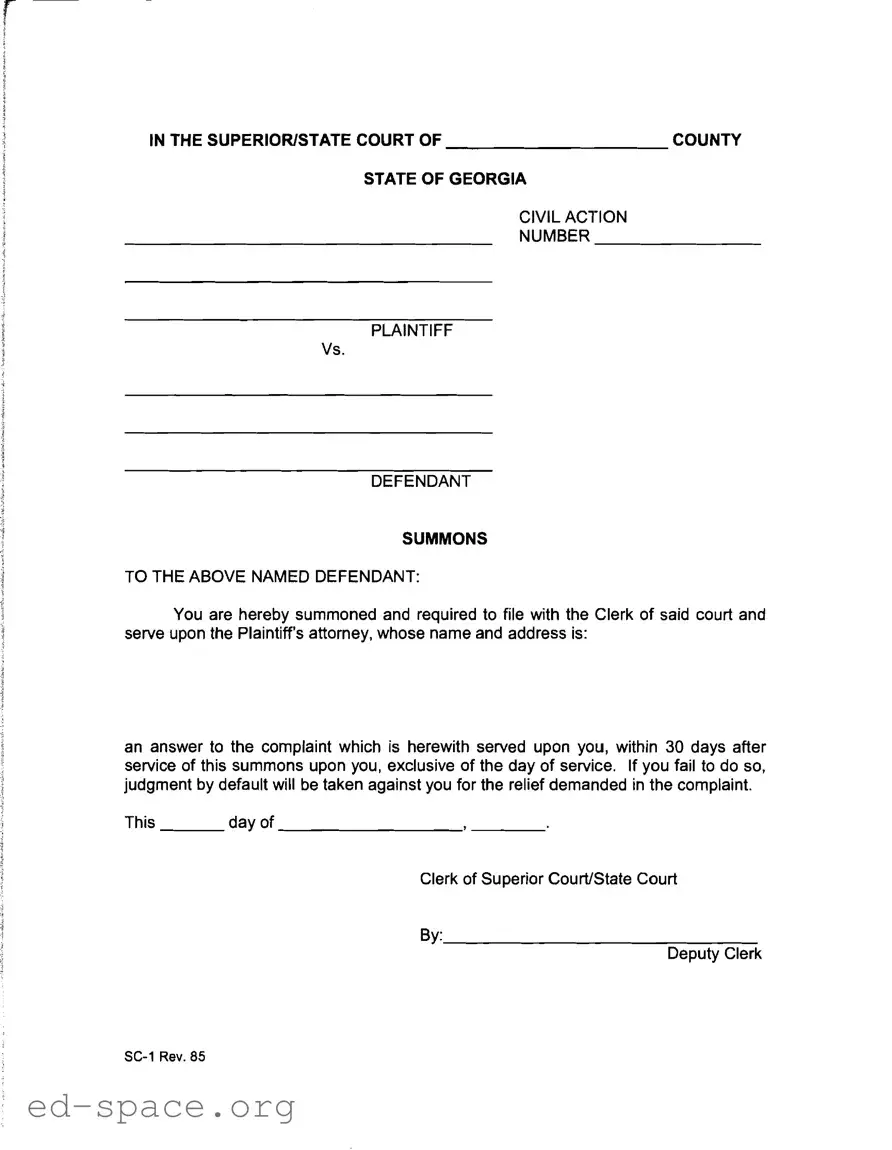
The Georgia Civil Summons form plays a crucial role in the legal process, particularly in civil actions initiated within the state. This form is issued by the Superior or State Court and serves as a formal notification to the defendant that a lawsuit has been filed against them. It contains essential information, including the names of the parties involved, the civil action number, and instructions for the defendant. The summons explicitly requires the defendant to respond to the complaint within 30 days, emphasizing the importance of timely action. Failure to respond can result in a default judgment, which may have significant legal consequences for the defendant. Additionally, the form includes spaces for the signature of the Clerk of Court and the Deputy Clerk, ensuring that it is properly authenticated. Overall, the Georgia Civil Summons is a vital document that facilitates the judicial process by ensuring that defendants are informed of legal actions and their responsibilities within the specified time frame.
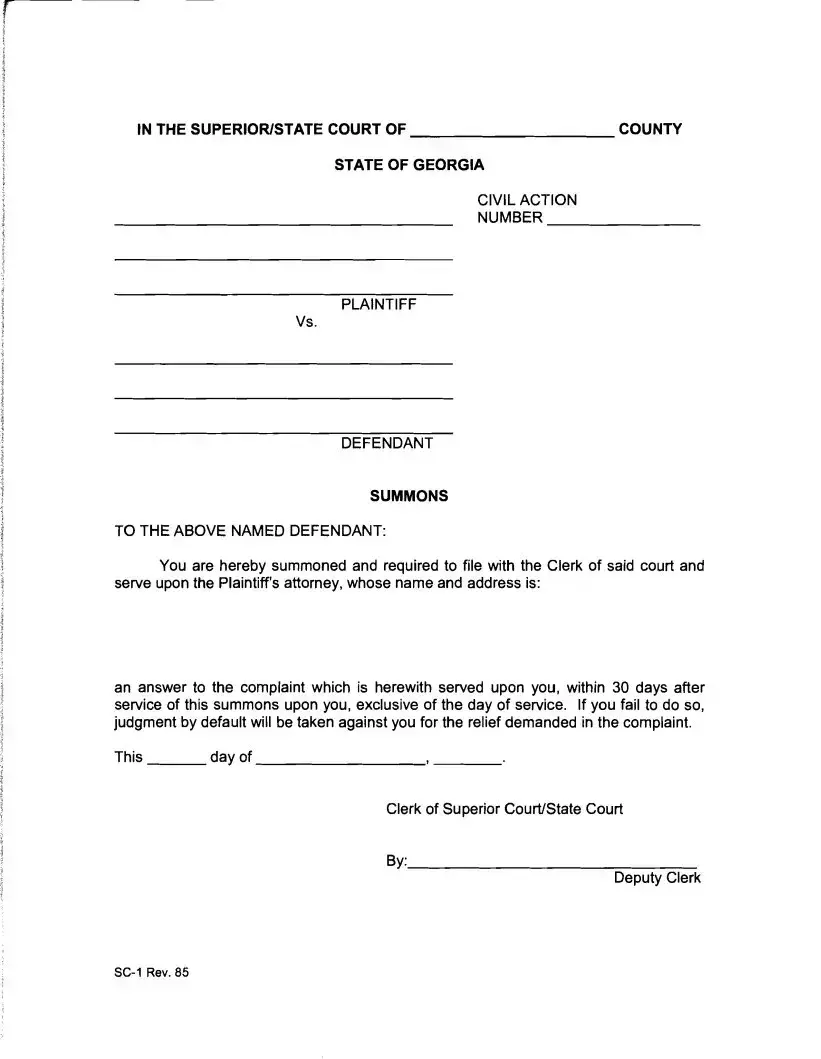
IN THE SUPERIOR/STATE COURT OF |
COUNTY |
STATE OF GEORGIA
CIVIL ACTION
NUMBER_
PLAINTIFF
Vs.
DEFENDANT
SUMMONS
TO THE ABOVE NAMED DEFENDANT:
You are hereby summoned and required to file with the Clerk of said court and serve upon the Plaintiff's attorney, whose name and address is:
an answer to the complaint which is herewith served upon you, within 30 days after service of this summons upon you, exclusive of the day of service. If you fail to do so, judgment by default will be taken against you for the relief demanded in the complaint.
This |
day of |
_ |
Clerk of Superior Court/State Court
By: |
_ |
Deputy Clerk
| Fact Name | Description |
|---|---|
| Governing Law | The Georgia Civil Summons form is governed by the Official Code of Georgia Annotated (O.C.G.A.) § 9-11-4. |
| Purpose | This form is used to notify a defendant that a civil action has been initiated against them in court. |
| Response Time | The defendant has 30 days to respond to the summons, excluding the day it was served. |
| Default Judgment | If the defendant does not respond within the specified time, a default judgment may be entered against them. |
| Clerk's Role | The Clerk of the Court is responsible for issuing the summons and maintaining court records. |
| Service Requirement | The summons must be served to the defendant, along with the complaint, to ensure they are aware of the legal action. |
| Attorney Information | The form requires the name and address of the plaintiff's attorney to facilitate communication. |
| Revision History | This specific version of the form is identified as SC-1 Rev. 85, indicating its revision year. |
Once the Georgia Civil Summons form is filled out, it must be filed with the appropriate court. Following this, the summons needs to be served to the defendant, who must respond within a specified timeframe. Proper completion of the form is essential to ensure that the legal process proceeds smoothly.
What is a Georgia Civil Summons?
A Georgia Civil Summons is a legal document that notifies a defendant that a lawsuit has been filed against them. It requires the defendant to respond to the complaint within a specific timeframe. This document is an essential part of the legal process, ensuring that the defendant is aware of the legal action and has the opportunity to defend themselves.
What should I do upon receiving a Civil Summons?
If you receive a Civil Summons, it is important to take it seriously. You must file an answer with the Clerk of the court and serve it to the plaintiff's attorney within 30 days. The answer should address the claims made in the complaint. Failing to respond can result in a default judgment against you, meaning the court may rule in favor of the plaintiff without your input.
How long do I have to respond to a Civil Summons?
You have 30 days to respond to a Civil Summons. This period starts from the day you receive the summons. It is crucial to count the days carefully, excluding the day of service. If you miss this deadline, you may lose your right to contest the lawsuit.
What happens if I do not respond to the Civil Summons?
If you do not respond within the 30-day period, the plaintiff can request a default judgment against you. This means the court may grant the plaintiff the relief they are seeking without hearing your side of the case. A default judgment can have serious consequences, including financial penalties or loss of property.
Can I contest the Civil Summons?
Yes, you can contest the Civil Summons by filing an answer that addresses the claims made in the complaint. In your answer, you can present your defenses and any counterclaims you may have. It is advisable to seek legal advice to ensure your response is appropriate and complete.
Where do I file my response to the Civil Summons?
You must file your response with the Clerk of the Superior or State Court in the county where the lawsuit was filed. Make sure to keep a copy of your filed response for your records. You should also serve a copy of your response to the plaintiff's attorney as indicated in the summons.
Failing to include the correct court name. Ensure you specify whether it is the Superior or State Court of Georgia.
Not filling in the county where the court is located. This information is crucial for proper jurisdiction.
Leaving the civil action number blank. This number helps identify the case and should be filled out accurately.
Not providing the plaintiff's attorney's name and address. This information is necessary for the defendant to respond appropriately.
Overlooking the 30-day response period. Defendants must understand they have 30 days to respond, excluding the day of service.
Neglecting to sign the form. A signature is essential for the document to be considered valid.
Using incorrect formatting for dates. Dates should be clearly written to avoid confusion.
Forgetting to indicate the date of service. This date is important for calculating the response period.
Submitting the form without verifying all information is accurate. Double-checking can prevent delays and complications.
When engaging in a civil action in Georgia, several forms and documents may accompany the Georgia Civil Summons form. Each of these documents serves a specific purpose and plays a critical role in the legal process. Below is a list of commonly used forms that you may encounter.
Understanding these forms can help individuals navigate the complexities of the civil litigation process in Georgia. Each document plays a vital role in ensuring that the rights of all parties are respected and that the legal proceedings are conducted fairly.
The Georgia Civil Summons form serves as a crucial document in legal proceedings, particularly in civil cases. It shares similarities with several other legal documents that also facilitate communication and action in court cases. Below is a list of documents that are comparable to the Georgia Civil Summons form:
When filling out the Georgia Civil Summons form, it's important to follow certain guidelines to ensure accuracy and compliance. Here are some things you should and shouldn't do:
Understanding the Georgia Civil Summons form is crucial for anyone involved in a legal dispute. However, there are several misconceptions that can lead to confusion. Here are five common misunderstandings:
Many people think that receiving a summons is not a serious matter. In reality, it is an official legal document that requires your attention. Ignoring it can lead to a default judgment against you.
Some believe they can take their time in responding to a summons. However, the form clearly states that you must file an answer within 30 days. Missing this deadline can have serious consequences.
While it is the defendant's responsibility to respond, the plaintiff also has obligations. The plaintiff must ensure that the summons and complaint are properly served. Both parties play a role in the process.
A summons is not a court order. It is a notification that a legal action has been initiated. A court order comes later in the process, usually after a judgment has been made.
Some think they can simply disregard the summons if they believe the claims are false. This is a mistake. You must formally respond to contest the claims. Ignoring the summons will not make it go away.
Being informed about these misconceptions can help you navigate the legal process more effectively. Take any summons seriously and seek legal advice if needed.
Filling out and using the Georgia Civil Summons form is an important step in the legal process. Here are some key takeaways to keep in mind:
By following these takeaways, you can navigate the Civil Summons process more effectively.