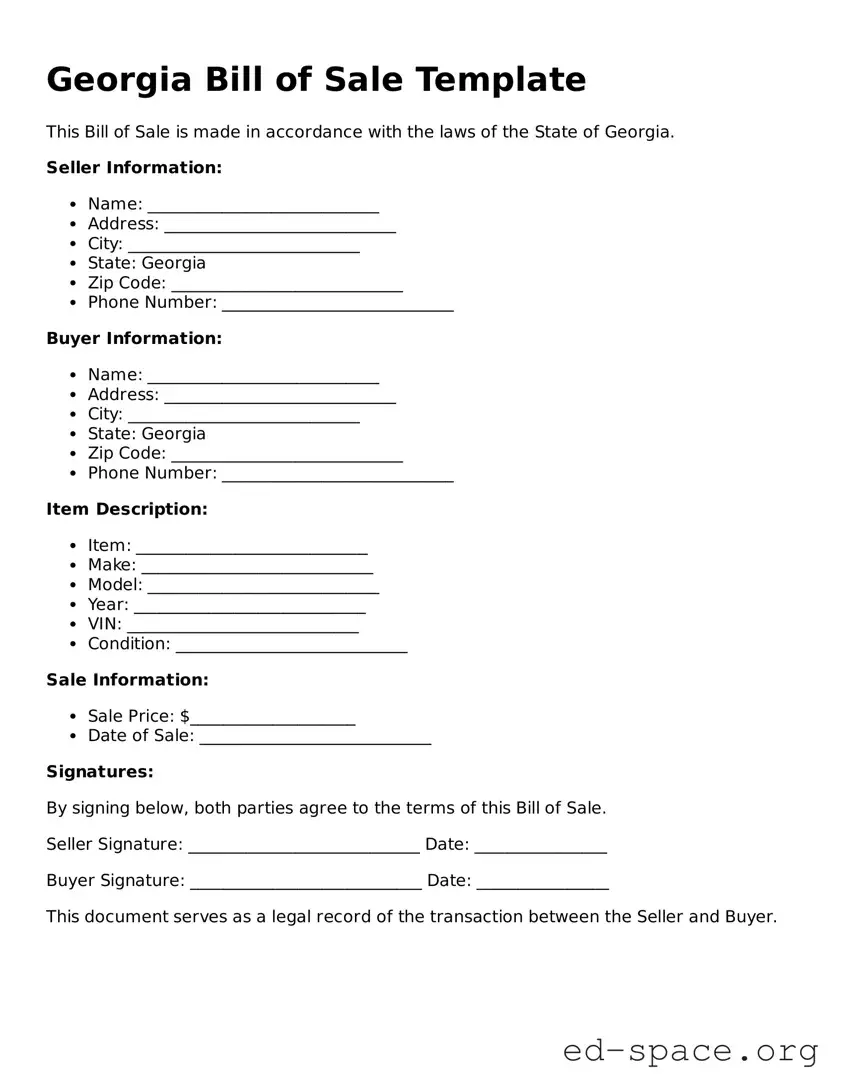
The Georgia Bill of Sale form serves as a crucial document in the transfer of ownership for various types of personal property, including vehicles, boats, and other tangible assets. This form not only provides a written record of the transaction but also protects the interests of both the buyer and the seller. Essential details such as the names and addresses of both parties, a description of the item being sold, and the sale price must be included. Additionally, the form often requires signatures to validate the agreement, making it a legally binding contract. In some cases, specific information related to the item, like its Vehicle Identification Number (VIN) for cars, may also be necessary. Understanding the components and requirements of the Georgia Bill of Sale can help ensure a smooth transaction and avoid potential disputes in the future.
Georgia Bill of Sale Template
This Bill of Sale is made in accordance with the laws of the State of Georgia.
Seller Information:
Buyer Information:
Item Description:
Sale Information:
Signatures:
By signing below, both parties agree to the terms of this Bill of Sale.
Seller Signature: ____________________________ Date: ________________
Buyer Signature: ____________________________ Date: ________________
This document serves as a legal record of the transaction between the Seller and Buyer.
| Fact Name | Description |
|---|---|
| Purpose | The Georgia Bill of Sale form is used to document the transfer of ownership of personal property from one individual to another. |
| Types of Property | This form can be used for various types of property, including vehicles, boats, and equipment. |
| Governing Law | The form is governed by Georgia state law, specifically the Official Code of Georgia Annotated (O.C.G.A. § 10-1-200 et seq.). |
| Required Information | Essential details include the names and addresses of the buyer and seller, a description of the item, and the sale price. |
| Notarization | While notarization is not mandatory for all transactions, having the document notarized can provide additional legal protection. |
Once you have the Georgia Bill of Sale form in hand, you’re ready to start filling it out. Make sure to have all necessary information available, such as details about the buyer, seller, and the item being sold. Follow these steps to complete the form accurately.
After completing the form, ensure that both parties keep a copy for their records. This document serves as proof of the transaction and may be needed for future reference.
What is a Georgia Bill of Sale form?
A Georgia Bill of Sale form is a legal document used to transfer ownership of personal property from one person to another in the state of Georgia. This form provides proof of the transaction and details about the item being sold, including its description, the sale price, and the names of both the buyer and seller. It serves as a receipt for the buyer and a record for the seller, helping to protect both parties in the event of future disputes.
Do I need a Bill of Sale for every transaction in Georgia?
While a Bill of Sale is not legally required for every transaction, it is highly recommended for significant purchases, such as vehicles, boats, or expensive personal property. Having a Bill of Sale can help clarify the terms of the sale and provide evidence of ownership. For vehicles, Georgia law specifically requires a Bill of Sale for title transfers, so it’s crucial to have one when buying or selling a car.
What information should be included in a Georgia Bill of Sale?
A comprehensive Georgia Bill of Sale should include several key pieces of information. First, it should identify the buyer and seller by name and address. Second, it should provide a detailed description of the item being sold, including its make, model, year, and any identifying numbers, like a VIN for vehicles. The sale price should also be clearly stated, along with the date of the transaction. Finally, both parties should sign the document to make it legally binding.
Can I create my own Bill of Sale in Georgia?
Yes, you can create your own Bill of Sale in Georgia. There are many templates available online that can help guide you in drafting one. Just ensure that all necessary information is included and that both parties sign the document. However, if you feel uncertain about the process, consulting a legal professional can provide additional peace of mind and ensure that your Bill of Sale meets all legal requirements.
Incomplete Information: Many people forget to fill out all required fields. This includes the names and addresses of both the buyer and seller, as well as the details of the item being sold. Leaving any section blank can lead to confusion or disputes later on.
Incorrect Item Description: Providing an inaccurate description of the item can create problems. It’s essential to include the make, model, year, and any identifying numbers, such as a VIN for vehicles. This ensures both parties are clear about what is being sold.
Failure to Sign: A common oversight is not signing the document. Both the buyer and seller must sign the Bill of Sale to make it valid. Without signatures, the document lacks legal standing.
Not Including the Sale Price: Some individuals forget to list the sale price. This is crucial, as it establishes the agreed-upon amount for the transaction. Omitting this detail can lead to misunderstandings.
Not Keeping Copies: After completing the Bill of Sale, it’s important to keep copies for both parties. Failing to do so can result in a lack of documentation if any issues arise in the future.
Ignoring State Requirements: Each state may have specific requirements for a Bill of Sale. Ignoring these can lead to complications, especially if the transaction involves a vehicle or other regulated items. Always check Georgia’s regulations to ensure compliance.
When completing a transaction in Georgia, several documents may accompany the Bill of Sale to ensure a smooth process. Each of these forms serves a specific purpose and helps protect both the buyer and seller.
Using these documents alongside the Georgia Bill of Sale can help facilitate a clear and secure transaction. Each form plays a vital role in protecting the interests of both parties involved.
The Bill of Sale is a vital document in transactions involving the transfer of ownership of goods or property. However, several other documents serve similar purposes in various contexts. Here are seven documents that share similarities with the Bill of Sale:
Each of these documents plays a crucial role in ensuring clarity and legality in transactions, just as the Bill of Sale does. Understanding their similarities can help individuals navigate various types of agreements effectively.
When filling out the Georgia Bill of Sale form, attention to detail is crucial. Here are some essential dos and don'ts to guide you through the process.
By following these guidelines, you can help ensure that the transaction goes smoothly and is legally binding. Take the time to get it right.
When it comes to the Georgia Bill of Sale form, several misconceptions can lead to confusion. Understanding these can help ensure that transactions are conducted smoothly and legally. Here are five common misconceptions:
Many people believe that a Bill of Sale must always be notarized to be valid. In Georgia, notarization is not required for most transactions. However, having a notarized document can add an extra layer of protection and credibility.
While it is commonly used for buying and selling vehicles, a Bill of Sale can be used for various personal property transactions. This includes items like boats, trailers, and even furniture.
Some believe that a Bill of Sale is set in stone once signed. In reality, both parties can agree to amend the document if needed, as long as both parties sign the changes.
This misconception overlooks the fact that a properly completed Bill of Sale serves as a legal contract. It outlines the terms of the sale and can be enforced in court if disputes arise.
While there are common elements that should be included, such as the names of the buyer and seller, the format of a Bill of Sale can vary. As long as it contains the necessary information, it can be tailored to fit the needs of the parties involved.
When dealing with the Georgia Bill of Sale form, there are several important points to consider. Understanding these can help ensure a smooth transaction whether you are buying or selling a vehicle, personal property, or other items.
By keeping these key takeaways in mind, individuals can navigate the process of using the Georgia Bill of Sale form more effectively.