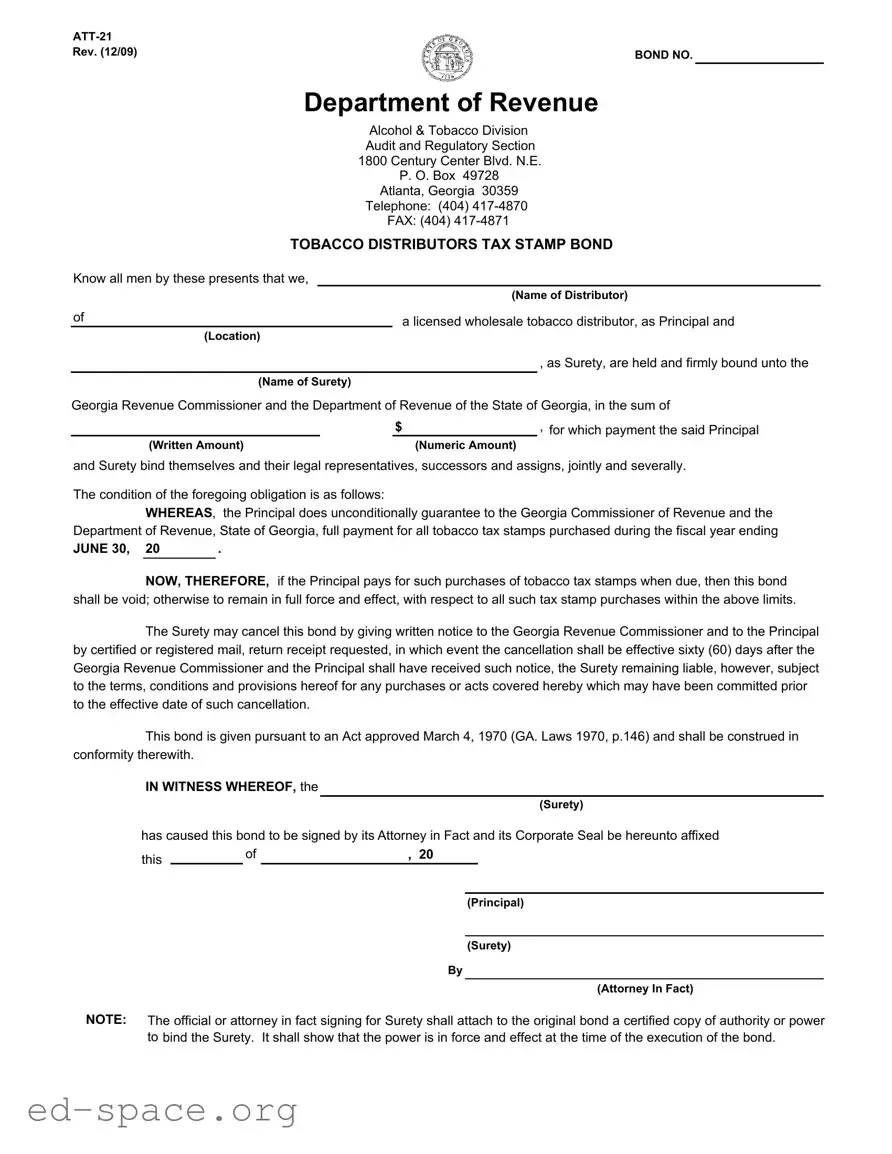
The Georgia ATT 21 form plays a crucial role in the regulation of tobacco distribution within the state. This form serves as a Tobacco Distributors Tax Stamp Bond, which is essential for licensed wholesale tobacco distributors. It establishes a financial guarantee from the distributor, known as the Principal, to the Georgia Revenue Commissioner and the Department of Revenue. This guarantee ensures that the distributor will make full payment for all tobacco tax stamps purchased during a specified fiscal year. The bond amount is determined by the distributor and the Surety, who agrees to back the Principal's financial obligation. If the distributor fulfills their payment responsibilities, the bond becomes void; however, it remains in effect if payments are not made. Additionally, the Surety has the right to cancel the bond with proper notification, ensuring a structured process is in place for all parties involved. The ATT 21 form underscores the importance of compliance within the tobacco industry, reflecting the state's commitment to maintaining regulatory standards while supporting legitimate business operations.

|
|
Rev. (12/09) |
BOND NO. |
|
Department of Revenue
Alcohol & Tobacco Division
Audit and Regulatory Section
1800 Century Center Blvd. N.E.
P. O. Box 49728
Atlanta, Georgia 30359
Telephone: (404)
FAX: (404)
TOBACCO DISTRIBUTORS TAX STAMP BOND
Know all men by these presents that we,
(Name of Distributor)
of |
|
a licensed wholesale tobacco distributor, as Principal and |
|||
(Location) |
|
|
|||
|
|
|
|
|
, as Surety, are held and firmly bound unto the |
(Name of Surety) |
|
|
|||
Georgia Revenue Commissioner and the Department of Revenue of the State of Georgia, in the sum of |
|||||
|
|
$ |
|
, for which payment the said Principal |
|
(Written Amount) |
(Numeric Amount) |
||||
and Surety bind themselves and their legal representatives, successors and assigns, jointly and severally.
The condition of the foregoing obligation is as follows:
WHEREAS, the Principal does unconditionally guarantee to the Georgia Commissioner of Revenue and the Department of Revenue, State of Georgia, full payment for all tobacco tax stamps purchased during the fiscal year ending
JUNE 30, 20 |
. |
|
|
|
|
NOW, THEREFORE, if the Principal pays for such purchases of tobacco tax stamps when due, then this bond shall be void; otherwise to remain in full force and effect, with respect to all such tax stamp purchases within the above limits.
The Surety may cancel this bond by giving written notice to the Georgia Revenue Commissioner and to the Principal by certified or registered mail, return receipt requested, in which event the cancellation shall be effective sixty (60) days after the Georgia Revenue Commissioner and the Principal shall have received such notice, the Surety remaining liable, however, subject to the terms, conditions and provisions hereof for any purchases or acts covered hereby which may have been committed prior to the effective date of such cancellation.
This bond is given pursuant to an Act approved March 4, 1970 (GA. Laws 1970, p.146) and shall be construed in conformity therewith.
IN WITNESS WHEREOF, the
(Surety)
has caused this bond to be signed by its Attorney in Fact and its Corporate Seal be hereunto affixed
this |
|
of |
, 20 |
|
|
|
(Principal)
(Surety)
By
(Attorney In Fact)
NOTE: The official or attorney in fact signing for Surety shall attach to the original bond a certified copy of authority or power to bind the Surety. It shall show that the power is in force and effect at the time of the execution of the bond.
| Fact Name | Description |
|---|---|
| Purpose | The Georgia ATT 21 form serves as a bond for licensed wholesale tobacco distributors, ensuring payment for tobacco tax stamps purchased during a fiscal year. |
| Governing Law | This bond is governed by an Act approved on March 4, 1970, as stated in the Georgia Laws 1970, page 146. |
| Parties Involved | The bond involves three parties: the Principal (the tobacco distributor), the Surety (the bonding company), and the Georgia Revenue Commissioner. |
| Cancellation Terms | The Surety can cancel the bond by providing written notice to the Georgia Revenue Commissioner and the Principal, with a 60-day notice period before cancellation takes effect. |
| Liability | Both the Principal and Surety are jointly and severally liable for the bond amount, ensuring that obligations are met even if one party defaults. |
Completing the Georgia ATT 21 form requires careful attention to detail. This form is a bond that ensures payment for tobacco tax stamps. The following steps will guide you through filling out the form accurately.
What is the Georgia ATT 21 form?
The Georgia ATT 21 form is a Tobacco Distributor Tax Stamp Bond. It serves as a financial guarantee from licensed wholesale tobacco distributors to the Georgia Revenue Commissioner and the Department of Revenue. Essentially, it ensures that distributors will pay for all tobacco tax stamps purchased during a specified fiscal year. This bond is crucial for maintaining compliance with state regulations regarding tobacco sales.
Who needs to complete the ATT 21 form?
Any licensed wholesale tobacco distributor operating in Georgia must complete the ATT 21 form. This includes businesses that distribute tobacco products and are required to purchase tax stamps. By filling out this form, distributors commit to fulfilling their tax obligations to the state, thereby ensuring a smooth operation within the regulatory framework.
What are the key components of the ATT 21 form?
The ATT 21 form includes several important components. It identifies the principal (the distributor) and the surety (the bonding company). The form specifies the bond amount, which represents the financial guarantee for tax stamp purchases. Additionally, it outlines the conditions under which the bond remains valid, primarily hinging on the distributor’s timely payment for tax stamps. If payments are made as agreed, the bond becomes void; if not, it remains enforceable.
How can a surety cancel the ATT 21 bond?
A surety can cancel the ATT 21 bond by providing written notice to both the Georgia Revenue Commissioner and the principal. This notice must be sent via certified or registered mail, and the cancellation takes effect 60 days after both parties receive the notification. It’s important to note that the surety remains liable for any obligations incurred prior to the cancellation date, ensuring that all past purchases are still covered.
What should be attached to the ATT 21 form upon submission?
When submitting the ATT 21 form, it is essential to attach a certified copy of the authority or power of attorney for the individual signing on behalf of the surety. This document must confirm that the signer has the legal authority to bind the surety to the obligations outlined in the bond. Ensuring this documentation is in place is critical for the validity of the bond and compliance with state requirements.
Failing to include the full name of the distributor, which is essential for identification.
Not providing the correct location of the surety, leading to potential delays in processing.
Omitting the sum amount for the bond, which is required for financial accountability.
Writing the amount in words and numbers incorrectly, causing confusion and errors.
Not signing the bond by the Attorney in Fact, which is necessary for legal validity.
Failing to attach a certified copy of the authority or power to bind the surety, which is a critical requirement.
Not providing the date of execution, which can affect the bond's enforceability.
Ignoring the need for return receipt requested when sending cancellation notices, leading to disputes.
Leaving out the fiscal year ending date, which is crucial for determining the bond's term.
Using incorrect mailing addresses for the Georgia Revenue Commissioner, which can result in lost communications.
The Georgia ATT 21 form is a crucial document for tobacco distributors in the state, serving as a bond that guarantees payment for tobacco tax stamps. In addition to the ATT 21 form, several other forms and documents are often utilized to ensure compliance with state regulations. Below is a list of these documents, each serving a specific purpose in the regulatory framework.
These documents collectively support the regulatory framework governing tobacco distribution in Georgia. Compliance with these requirements is essential for maintaining a lawful business operation and ensuring the timely payment of taxes owed to the state.
The Georgia ATT 21 form is a Tobacco Distributors Tax Stamp Bond. It shares similarities with several other documents related to bonds and financial obligations. Here’s a list of seven documents that are similar to the ATT 21 form:
When completing the Georgia ATT 21 form, there are specific actions to take and avoid to ensure the process goes smoothly. Below is a list of dos and don’ts.
Following these guidelines can help avoid delays and ensure compliance with Georgia's regulations regarding tobacco tax stamps.
Misconceptions about the Georgia ATT 21 form can lead to confusion among tobacco distributors. Here are eight common misunderstandings:
Understanding these misconceptions can help ensure that tobacco distributors comply with state regulations and avoid potential penalties.
When filling out and using the Georgia ATT 21 form, keep these key takeaways in mind: