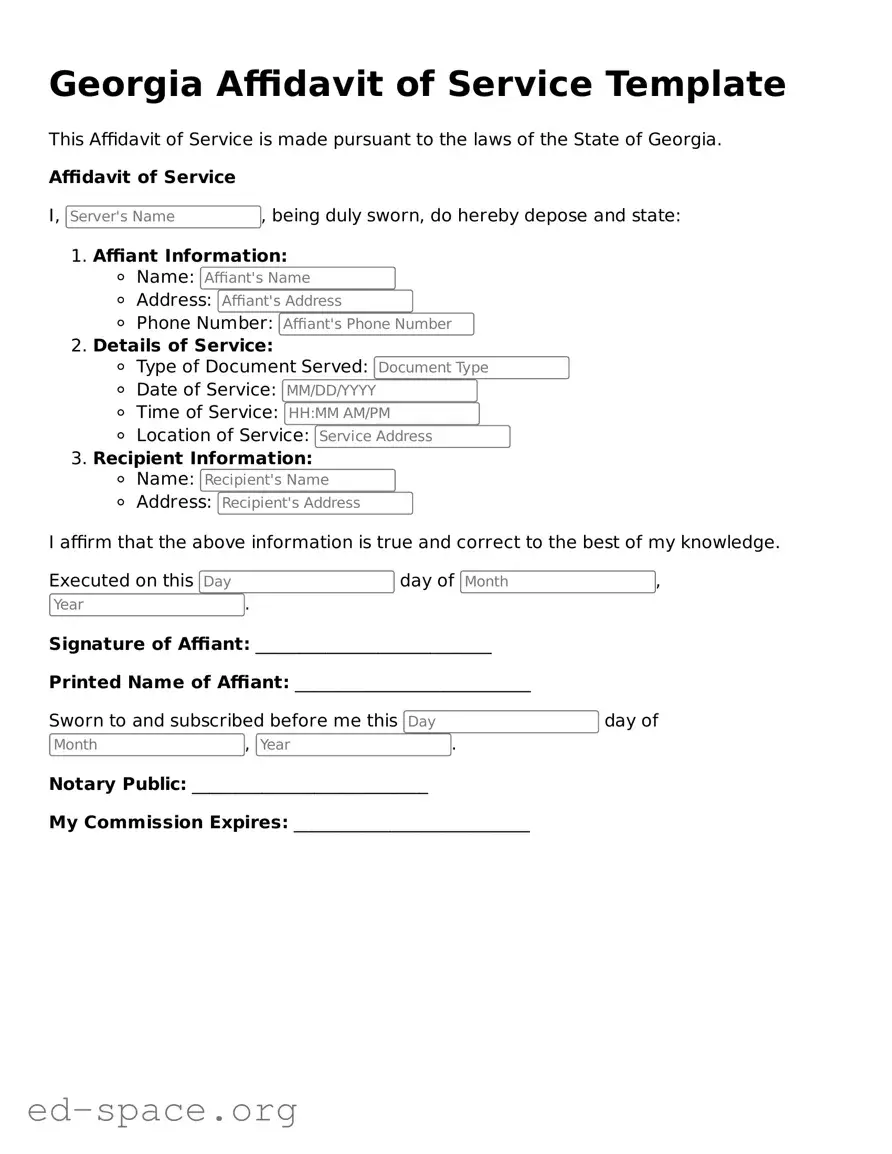
The Georgia Affidavit of Service form plays a crucial role in the legal process, ensuring that all parties involved in a case are properly notified. This document serves as proof that legal papers, such as summons or complaints, have been delivered to the appropriate individuals. It outlines essential details, including the date and method of service, the name of the person served, and the address where the service took place. Additionally, the form requires the signature of the individual who performed the service, affirming that the information provided is accurate. Understanding how to correctly fill out and file this affidavit is vital for maintaining the integrity of legal proceedings in Georgia. By adhering to the requirements set forth by the state, individuals can help ensure that their cases proceed smoothly and that all parties receive the necessary notifications in a timely manner.
Georgia Affidavit of Service Template
This Affidavit of Service is made pursuant to the laws of the State of Georgia.
Affidavit of Service
I, , being duly sworn, do hereby depose and state:
I affirm that the above information is true and correct to the best of my knowledge.
Executed on this day of , .
Signature of Affiant: ___________________________
Printed Name of Affiant: ___________________________
Sworn to and subscribed before me this day of , .
Notary Public: ___________________________
My Commission Expires: ___________________________
| Fact Name | Details |
|---|---|
| Purpose | The Georgia Affidavit of Service form is used to confirm that legal documents have been properly served to a party. |
| Governing Law | The form is governed by the Official Code of Georgia Annotated (O.C.G.A.) § 9-11-4, which outlines service of process requirements. |
| Who Can Serve | Any adult who is not a party to the case can serve the documents and complete the affidavit. |
| Filing Requirement | The completed affidavit must be filed with the court to prove that service has been executed. |
| Contents of the Form | The form typically includes details such as the date of service, method of service, and the identity of the person served. |
After you have gathered the necessary information and documents, you are ready to fill out the Georgia Affidavit of Service form. This form is crucial for confirming that legal documents have been delivered to the appropriate parties. Following these steps will help ensure that you complete the form accurately.
Once you have completed the form, you will need to file it with the court. Make sure to keep a copy for your records, as it may be needed for future reference in your case.
What is the Georgia Affidavit of Service form?
The Georgia Affidavit of Service form is a legal document used to confirm that a person has been served with legal papers. This form provides proof that the individual received the necessary documents, which is a crucial step in many legal proceedings.
Who is responsible for completing the Affidavit of Service?
The person who serves the legal documents is responsible for completing the Affidavit of Service. This could be a process server, a sheriff, or even a friend or family member, as long as they are not involved in the case.
What information is required on the Affidavit of Service?
The form typically requires details such as the name and address of the person served, the date and time of service, and a description of the documents served. Additionally, the server must provide their own name and signature, affirming that the information is true.
Is the Affidavit of Service mandatory?
Yes, filing an Affidavit of Service is often mandatory in legal proceedings. Courts require this document to ensure that all parties have been properly notified of the legal actions being taken against them.
How do I file the Affidavit of Service?
Once completed, the Affidavit of Service must be filed with the court where the case is pending. This may involve submitting the document in person or electronically, depending on the court’s rules.
What happens if I do not file the Affidavit of Service?
Failing to file the Affidavit of Service can lead to delays in your case or even dismissal of your claims. The court may require proof of service before proceeding, so it is important to ensure this document is filed correctly and on time.
Can I serve documents myself?
Yes, you can serve documents yourself if you are not a party to the case. However, it is often advisable to use a professional process server to ensure that service is done correctly and to avoid any potential disputes about the service process.
What if the person refuses to accept the documents?
If the person refuses to accept the documents, the server can still complete the Affidavit of Service by noting the refusal. In some cases, alternative methods of service may be allowed, such as service by mail or publication, depending on the circumstances.
How long do I have to serve the documents?
The time frame for serving documents varies depending on the type of case. Generally, service should be completed within a specific period after filing the complaint, often within 30 days. It’s important to check the rules applicable to your case.
Can I contest the Affidavit of Service?
Yes, you can contest the Affidavit of Service if you believe you were not properly served. This usually involves filing a motion with the court and providing evidence to support your claim. It’s advisable to seek legal assistance in such situations.
Inaccurate Information: One common mistake is providing incorrect or incomplete information about the individual being served. This can include misspellings of names, incorrect addresses, or missing details about the service itself.
Failure to Sign and Date: Another frequent error is neglecting to sign and date the affidavit. This step is crucial, as an unsigned document may be considered invalid and could delay legal proceedings.
Not Including Witness Information: Individuals often forget to include details about the witness who observed the service. This information is important for verifying that the service was carried out according to legal requirements.
Using Incorrect Format: Submitting the affidavit in an incorrect format can lead to rejection. Each court may have specific requirements regarding how the affidavit should be presented, including the layout and any necessary attachments.
When dealing with legal matters in Georgia, the Affidavit of Service is an important document that verifies a party has been properly served with legal papers. However, several other forms and documents may accompany this affidavit to ensure that the legal process proceeds smoothly. Here’s a list of some common forms you might encounter:
Understanding these documents can significantly aid in navigating the legal process. Each form plays a unique role in ensuring that all parties are informed and that the case proceeds according to the law. Being familiar with these documents can make a challenging situation a bit easier to manage.
When filling out the Georgia Affidavit of Service form, it is important to follow certain guidelines to ensure accuracy and compliance. Here are five things to keep in mind:
Understanding the Georgia Affidavit of Service form can be tricky. Here are four common misconceptions that people often have:
While it may seem easy to deliver documents, only certain individuals can officially serve legal papers in Georgia. Typically, a process server or a sheriff is required to ensure that the service is valid.
Some people believe that filing an Affidavit of Service is not necessary. However, this document is crucial as it provides proof that the legal documents were delivered properly, which is essential for the court's records.
Many think they can file the Affidavit of Service whenever they want. In reality, it must be filed promptly after the service has been completed to avoid delays in the legal process.
Some assume that the Affidavit of Service form is uniform throughout Georgia. In fact, different courts may have specific requirements or forms, so it's important to check with the relevant court for the correct version.
When filling out and using the Georgia Affidavit of Service form, it is important to understand the following key points: