The Georgia Affidavit of Residency form serves as an essential document for individuals who need to verify their residency status within the state. This form is often required for various purposes, such as enrolling children in public schools, applying for certain government benefits, or establishing eligibility for in-state tuition rates at public colleges and universities. By completing the affidavit, individuals affirm their current address and provide necessary details about their living situation. The form typically includes sections for personal information, such as the affiant's name, address, and the duration of residency. Additionally, it may require signatures from witnesses or a notary public to validate the information provided. Understanding the importance and requirements of the Georgia Affidavit of Residency can help ensure a smooth process when navigating bureaucratic necessities.
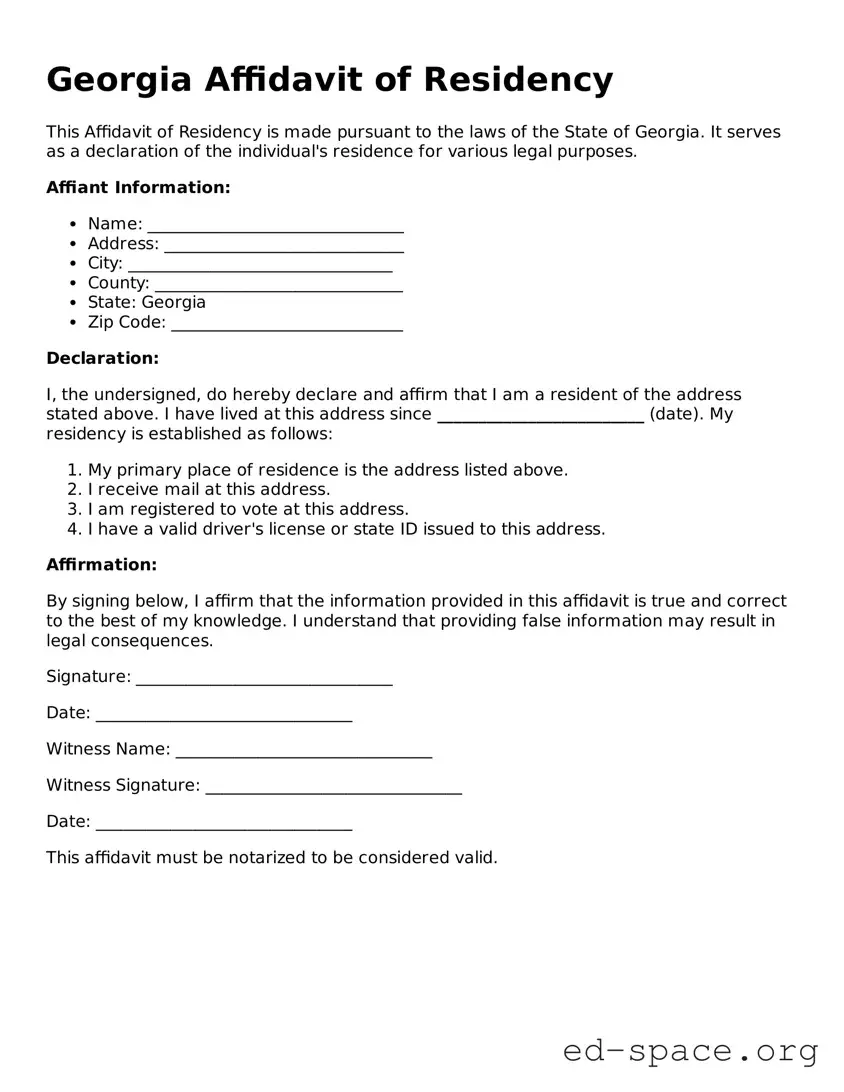
Georgia Affidavit of Residency
This Affidavit of Residency is made pursuant to the laws of the State of Georgia. It serves as a declaration of the individual's residence for various legal purposes.
Affiant Information:
Declaration:
I, the undersigned, do hereby declare and affirm that I am a resident of the address stated above. I have lived at this address since _________________________ (date). My residency is established as follows:
Affirmation:
By signing below, I affirm that the information provided in this affidavit is true and correct to the best of my knowledge. I understand that providing false information may result in legal consequences.
Signature: _______________________________
Date: _______________________________
Witness Name: _______________________________
Witness Signature: _______________________________
Date: _______________________________
This affidavit must be notarized to be considered valid.
| Fact Name | Description |
|---|---|
| Purpose | The Georgia Affidavit of Residency form is used to verify a person's residency status in the state of Georgia. |
| Governing Law | This form is governed by Georgia law, specifically O.C.G.A. § 20-2-690.1. |
| Who Uses It | Individuals may use this form when applying for certain services, such as enrolling in school or obtaining a driver's license. |
| Signature Requirement | The form must be signed in the presence of a notary public to ensure its validity. |
| Information Needed | Applicants must provide their name, address, and other personal details to complete the form. |
| Notarization | Notarization is essential. It adds an extra layer of authenticity to the affidavit. |
| Filing | Once completed, the form should be filed with the appropriate agency or institution requiring proof of residency. |
| Validity | The affidavit remains valid as long as the residency status remains unchanged. |
Once you have the Georgia Affidavit of Residency form, you will need to fill it out carefully. This process involves providing accurate information regarding your residency status. After completing the form, you will typically submit it to the appropriate authority as required.
What is the Georgia Affidavit of Residency form?
The Georgia Affidavit of Residency form is a legal document used to verify an individual's residence in the state of Georgia. This form is often required for various purposes, such as enrolling a child in school, applying for certain public benefits, or establishing residency for voting. It helps confirm that the individual resides at the specified address, providing necessary details about their living situation.
Who needs to complete the Affidavit of Residency?
This form is typically required for parents or guardians of children who are enrolling in public schools. Additionally, individuals seeking to establish residency for legal purposes, such as voting or obtaining a driver's license, may also need to complete this affidavit. It serves as proof of residency, which is often a prerequisite for accessing various services and benefits.
What information is required on the form?
The Affidavit of Residency form generally requires the individual's name, the address of residence, and the date of occupancy. It may also ask for the names of any family members living at the same address. Additionally, the form often includes a section for the signature of the individual completing the affidavit, affirming that the information provided is true and accurate.
How do I obtain the Georgia Affidavit of Residency form?
The form can usually be obtained from the official Georgia Department of Education website or local school district offices. Some organizations may also provide the form online for easy access. It’s important to ensure that you are using the most current version of the form, as requirements can change over time.
Is there a fee associated with the Affidavit of Residency?
Typically, there is no fee to complete the Affidavit of Residency form itself. However, certain agencies or organizations may have their own policies regarding fees for processing or submitting the form. It’s advisable to check with the specific entity requiring the affidavit for any potential costs involved.
What happens if the information on the affidavit is found to be false?
If the information provided on the Affidavit of Residency is found to be false, there can be serious consequences. This may include penalties such as fines, legal action, or even loss of eligibility for certain benefits. It is crucial to provide accurate and truthful information when completing the form to avoid any legal repercussions.
Failing to provide accurate personal information. Many individuals overlook the importance of ensuring that their name, address, and other details are correct. Inaccuracies can lead to complications in verification.
Not signing the form. A common oversight is submitting the affidavit without a signature. This omission renders the document invalid and can delay the residency verification process.
Using outdated information. Some people mistakenly fill out the form with previous addresses or outdated contact information. It is crucial to use current details to avoid confusion.
Ignoring the notary requirement. The affidavit often requires notarization. Failing to have the document notarized can result in rejection by the intended authority.
Providing insufficient proof of residency. Individuals may not include necessary supporting documents, such as utility bills or lease agreements, which can substantiate their claim of residency.
Overlooking deadlines. Some applicants submit their forms late, missing critical deadlines for residency verification. Staying aware of timelines is essential for a smooth process.
Not reading the instructions thoroughly. Many people rush through the form without fully understanding the requirements. Carefully reviewing the instructions can prevent errors and ensure compliance.
When completing the Georgia Affidavit of Residency form, you may need to provide additional documents to support your claim of residency. These documents help establish your address and confirm your identity. Below are some common forms and documents that are often used alongside the Affidavit of Residency.
Having these documents ready can streamline the process of completing the Affidavit of Residency. It is important to ensure that all supporting materials are accurate and up-to-date to avoid any complications.
When filling out the Georgia Affidavit of Residency form, it is essential to approach the task with care. Here are some important dos and don'ts to keep in mind:
By following these guidelines, you can navigate the process more smoothly and avoid common pitfalls associated with completing the affidavit.
When it comes to the Georgia Affidavit of Residency form, many people have misconceptions that can lead to confusion or mistakes. Understanding the truth behind these myths can help ensure that the form is completed correctly and serves its intended purpose. Here are five common misconceptions:
While it is commonly used by students to establish residency for school enrollment, the form can also be utilized by anyone needing to prove their residence for various legal purposes, such as obtaining a driver's license or registering to vote.
This is not true. The person completing the affidavit must provide supporting documentation to verify their residency. This may include utility bills, lease agreements, or other official documents that show their name and address.
Not all situations require notarization. While some instances may call for a notarized affidavit, many can be completed without this step. It’s important to check the specific requirements for your situation.
This is a misconception. If there are errors or changes in residency, individuals can file a new affidavit to update their information. Keeping records current is essential for maintaining accurate residency status.
In reality, the affidavit may need to be renewed or updated periodically, especially if there are changes in living arrangements or if it is being used for specific time-sensitive purposes, such as school enrollment.
By clarifying these misconceptions, individuals can better navigate the process of completing the Georgia Affidavit of Residency form and ensure that they meet all necessary requirements.
Filling out and using the Georgia Affidavit of Residency form is an important process for establishing residency in the state. Here are some key takeaways to consider: