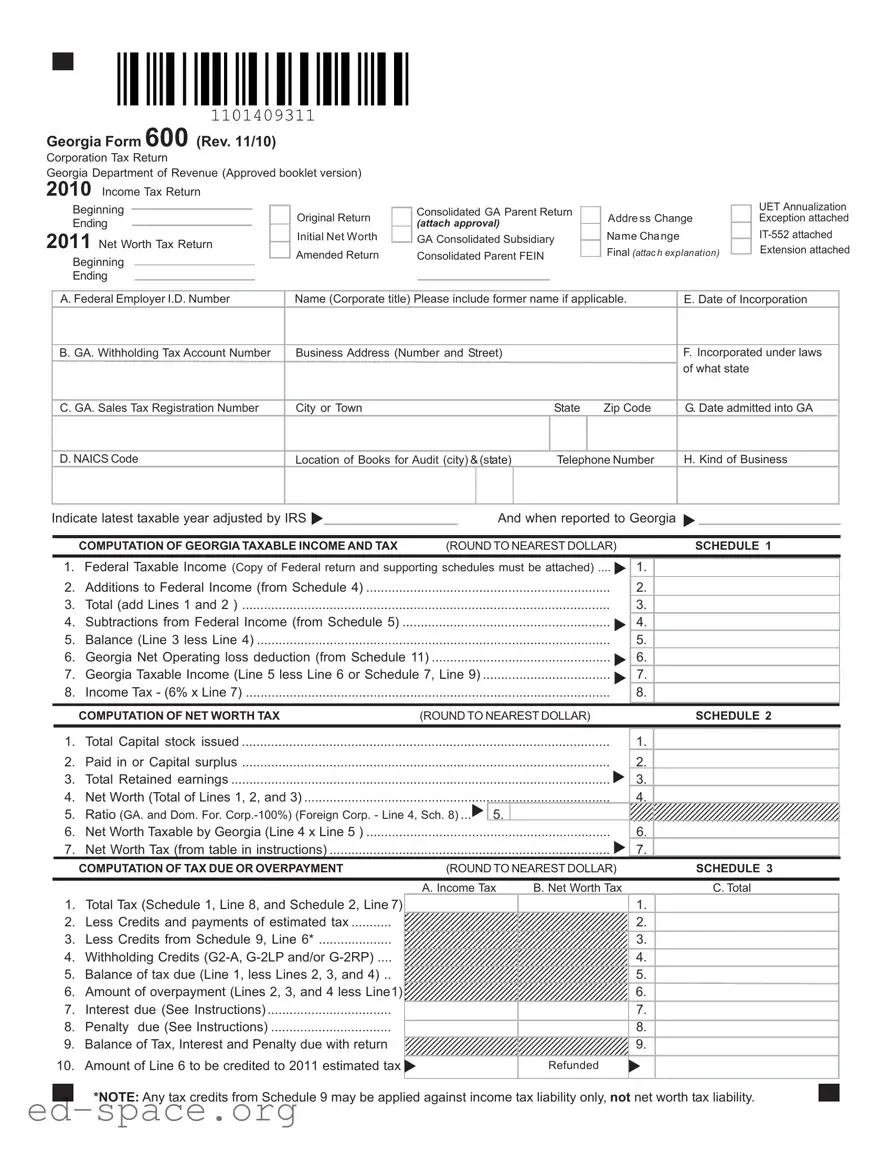
The Georgia Form 600 is a crucial document for corporations operating within the state, serving as the official Corporation Tax Return. This form is designed to report both income and net worth taxes, ensuring compliance with Georgia's tax laws. Corporations must provide essential information, including their Federal Employer Identification Number (FEIN), business address, and details about their incorporation. The form requires a comprehensive computation of Georgia taxable income, which involves adjustments to federal taxable income through various schedules. These schedules detail additions and subtractions from federal income, as well as the computation of net worth tax. Additionally, corporations can claim tax credits and report any overpayments. The form also includes sections for apportionment of income and net operating loss deductions, which can significantly impact a corporation's tax liability. Accurate completion of the Georgia Form 600 is vital for maintaining good standing with the Georgia Department of Revenue and for the financial health of the corporation.
Georgia Form 600 (Rev. 11/10)
Corporation Tax Return
Georgia Department of Revenue (Approved booklet version)
2010 Income Tax Return
Beginning
Ending
2011 Net Worth Tax Return
Beginning
Ending
Original Return
Initial Net Worth
Amended Return
Consolidated GA Parent Return
(attach approval)
GA Consolidated Subsidiary Consolidated Parent FEIN
|
|
|
UET Annualization |
Address Change |
|
|
Exception attached |
Name Change |
|
||
|
|||
Final (attach explanation) |
|
Extension attached |
|
|
|
||
A. Federal Employer I.D. Number |
Name (Corporate title) Please include former name if applicable. |
E. Date of Incorporation |
|
|
|
|
|
B. GA. Withholding Tax Account Number |
Business Address (Number and Street) |
F. Incorporated under laws |
|
|
|
of what state |
|
C. GA. Sales Tax Registration Number
City or Town |
State |
Zip Code |
G. Date admitted into GA
D. NAICS Code
Location of Books for Audit (city) &(sta te ) |
Telephone Number |
H. Kind of Business
Indicate latest taxable year adjusted by IRS |
|
|
And when reported to Georgia |
||
|
COMPUTATION OF GEORGIA TAXABLE INCOME AND TAX |
(ROUND TO NEAREST DOLLAR) |
SCHEDULE 1 |
||
1. |
Federal Taxable Income (Copy of Federal return and supporting schedules must be attached) .... |
1. |
|||
2. |
Additions to Federal Income (from Schedule 4) |
|
|
2. |
|
3. |
Total (add Lines 1 and 2 ) |
|
|
3. |
|
4. |
Subtractions from Federal Income (from Schedule 5) |
|
|
4. |
|
5. |
Balance (Line 3 less Line 4) |
|
|
5. |
|
6. |
Georgia Net Operating loss deduction (from Schedule 11) |
|
6. |
||
7. |
Georgia Taxable Income (Line 5 less Line 6 or Schedule 7, Line 9) |
|
7. |
||
8. |
Income Tax - (6% x Line 7) |
|
|
8. |
|
|
COMPUTATION OF NET WORTH TAX |
(ROUND TO NEAREST DOLLAR) |
SCHEDULE 2 |
||
1. |
Total Capital stock issued |
|
|
1. |
|
2. |
Paid in or Capital surplus |
|
|
2. |
|
3. |
Total Retained earnings |
|
|
3. |
|
4. |
Net Worth (Total of Lines 1, 2, and 3) |
|
|
4. |
|
5. |
Ratio (GA. and Dom. For. |
5. |
|
||
6. |
Net Worth Taxable by Georgia (Line 4 x Line 5 ) |
|
|
6. |
|
7. |
Net Worth Tax (from table in instructions) |
|
|
7. |
|
|
COMPUTATION OF TAX DUE OR OVERPAYMENT |
(ROUND TO NEAREST DOLLAR) |
SCHEDULE 3 |
||
|
|
A. Income Tax |
B. Net Worth Tax |
C. Total |
|
1. |
Total Tax (Schedule 1, Line 8, and Schedule 2, Line 7) |
|
|
|
1. |
2. |
Less Credits and payments of estimated tax |
|
|
|
2. |
3. |
Less Credits from Schedule 9, Line 6* |
|
|
|
3. |
4. |
Withholding Credits |
|
|
|
4. |
5. |
Balance of tax due (Line 1, less Lines 2, 3, and 4) .. |
|
|
|
5. |
6. |
Amount of overpayment (Lines 2, 3, and 4 less Line1) |
|
|
|
6. |
7. |
Interest due (See Instructions) |
|
|
|
7. |
8. |
Penalty due (See Instructions) |
|
|
|
8. |
9. Balance of Tax, Interest and Penalty due with return |
|
|
|
9. |
|
10. |
Amount of Line 6 to be credited to 2011 estimated tax |
|
|
Refunded |
|
*NOTE: Any tax credits from Schedule 9 may be applied against income tax liability only, not net worth tax liability.
Georgia Form 600/2010 (Corporation) Name_______________________________________FEIN____________________
|
ADDITIONS TO FEDERAL TAXABLE INCOME |
(ROUND TO NEAREST DOLLAR) |
|
SCHEDULE 4 |
|
1. |
State and municipal bond interest (other than Georgia or political subdivision thereof) |
..................... |
1. |
|
|
2. |
Net income or net profits taxes imposed by taxing jurisdictions other than Georgia |
2. |
|
||
3. |
Expense attributable to tax exempt income |
|
3. |
|
|
4. |
Net operating loss deducted on Federal return |
|
4. |
|
|
5. |
Federal deduction for income attributable to domestic production activities (IRC Section 199) |
5. |
|
||
6. |
Intangible expenses and related interest cost |
|
6. |
|
|
7. |
Captive REIT expenses and costs |
|
7. |
|
|
8. |
Other Additions (Attach Schedule) |
|
8. |
|
|
9. |
TOTAL - Enter also on LINE 2, SCHEDULE 1 |
|
9. |
|
|
|
SUBTRACTIONS FROM FEDERAL TAXABLE INCOME |
(ROUND TO NEAREST DOLLAR) |
|
SCHEDULE 5 |
|
1. |
Interest on obligations of United States (must be reduced by direct and indirect interest expense) . |
1. |
|
||
2. |
|
||||
2. |
Exception to intangible expenses and related interest cost (Attach |
|
|
||
|
|
||||
3. |
Exception to captive REIT expenses and costs (Attach |
|
3. |
|
|
|
|
||||
4. |
Other Subtractions (Must Attach Schedule) |
|
4. |
|
|
|
|
|
|||
5. |
TOTAL - Enter also on LINE 4, SCHEDULE 1 |
|
5. |
|
|
|
|
|
|||
|
APPORTIONMENT OF INCOME |
|
|
|
SCHEDULE 6 |
|
|
A. WITHIN GEORGIA |
B. EVERYWHERE |
|
C. DO NOT ROUND |
|
|
|
|
|
COL (A)/ COL (B) |
|
|
|
|
|
COMPUTE TO SIX DECIMALS |
1. Gross receipts from business |
1. |
|
|
|
|
|
|
|
|
||
2. |
Georgia Ratio (Divide Column A by Column B) |
2. |
|
|
|
|
COMPUTATION OF GEORGIA NET INCOME |
(ROUND TO NEAREST DOLLAR) |
|
SCHEDULE 7 |
|
1. |
Net business income (Schedule 1, Line 5) |
|
1. |
|
|
2. |
Income allocated everywhere (Must Attach Schedule) |
|
2. |
|
|
3. |
Business income subject to apportionment (Line 1 less Line 2) |
3. |
|
||
4. |
Georgia Ratio (Schedule 6, Column C) |
4. |
|
|
|
5. |
Net business income apportioned to Georgia (Line 3 x Line 4) |
5. |
|
||
6. |
Net income allocated to Georgia (Attach Schedule) |
|
6. |
|
|
7. |
Total of Lines 5 and 6 |
|
7. |
|
|
8. |
Less: net operating loss apportioned to GA. (from Schedule 11) |
8. |
|
||
9. |
Georgia taxable income (Enter also on Schedule 1, Line 7 ) |
............................................................... |
9. |
|
|
|
COMPUTATION OF GEORGIA NET WORTH RATIO |
(TO BE USED BY FOREIGN CORPS ONLY) |
SCHEDULE 8 |
||
1.Total value of property owned (Total assets from Federal balance sheet)
2.Gross receipts from business ............................................................
3.Totals (Line 1 plus Line 2) .................................................................
4.Georgia Ratio (Divide Line 3A by 3B) .................................................
A. Within Georgia |
B.TotalEverywhere |
C. GA. ratio (A/B) |
1. |
|
|
2. |
|
|
3. |
|
|
4. |
|
|
A copy of the Federal Return and supporting Schedules must be attached, otherwise this return shall be deemed incomplete. No extension of time for filing will be allowed unless a copy of the request for a Federal extension or Form
Make check payable to: Georgia Department of Revenue
Mail to: Georgia Department of Revenue, Processing Center, P.O. Box 740397, Atlanta, Georgia
Georgia Public Revenue Code Section
my/our knowledge and belief it is true, correct, and complete. If prepared by a person other than taxpayer, their declaration is based on all information of which they |
||||||||
have any knowledge. |
|
|
|
|
|
|
Checktheboxto |
|
Email Address: |
|
|
|
|
|
|
|
authorize the |
|
|
|
|
|
|
|
|
Georgia |
|
|
|
|
|
|
|
|
Department of |
|
|
|
|
|
|
|
|
Revenue to discuss |
|
|
|
|
|
|
|||
SIGNATURE OF OFFICER |
DATE |
|
SIGNATURE OF INDIVIDUAL OR FIRM PREPARING THE RETURN the contents of this |
|||||
tax return with the named preparer.
TITLE |
IDENTIFICATION OR SOCIAL SECURITY NUMBER |

Georgia Form 600/2010 (Corporation) Name_______________________________________FEIN____________________
CLAIMED TAX CREDITS |
(ROUND TO NEAREST DOLLAR) |
SCHEDULE 9 |
See pages 14 through 19 for a list of available credits and their applicable codes. You must list the appropriate credit type code in the space provided. If you claim more than four credits, attach a schedule. Enter the total of the additional schedule on Line 5. If the tax credit is flowing or being assigned into this corporation from another corporation, please enter the name and FEIN of the corporation where the tax credit originated. If the credit originated with the corporation filing this return, enter “Same” in the spaces for corporation and FEIN.
|
Credit Type Code |
|
Corporation Name |
|
FEIN |
|
Amount of Credit |
|
|
|
|
|
|
|
|
1. |
|
|
|
|
|
1. |
|
2. |
|
|
|
|
|
2. |
|
3. |
|
|
|
|
|
3. |
|
4. |
|
|
|
|
|
4. |
|
5. |
Enter the total from attached schedule(s) |
|
5. |
|
|||
6. |
...............................Enter the total of Lines 1 through 5 here and on Schedule 3, Line 3, Page 1 |
6. |
|
||||
|
|
|
|
|
|
||
|
ASSIGNED TAX CREDITS |
|
(ROUND TO NEAREST DOLLAR) |
|
SCHEDULE 10 |
||
Georgia Code Section
1)A corporation that is a member of the taxpayer’s affiliated group within the meaning of Section 1504(a) of the Internal Revenue Code; or
2)An entity affiliated with a corporation, business, partnership, or limited liability company taxpayer, which entity:
(a)Owns or leases the land on which a project is constructed;
(b)Provides capital for construction of the project; and
(c)Is the grantor or owner under a management agreement with a managing company for the project.
No carryover attributable to the unused portion of any previously claimed or assigned credit may be assigned or reassigned, except if the assignor and the recipient of an assigned tax credit cease to be affiliated entities, then any carryover attributable to the unused portion of the credit is transferred back to the assignor of the credit. The assignor is permitted to use any such carryover and also shall be permitted to assign the carryover to one or more affiliated entities, as if such carryover were an income tax credit for which the assignor became eligible in the taxable year in which the carryover was transferred back to the assignor. In the case of any credit that must be claimed in installments in more than one taxable year, the election under this subsection may be made on an annual basis with respect to each such installment. For additional information, please refer to Georgia Code Section
If the corporation filing this return is assigning tax credits to other affiliates, please provide detail below specifying where the tax credits are being assigned.
All assignments of credits must be made before the statutory due date (including extensions) per O.C.G.A. §
|
Credit Type Code |
Corporation Name |
FEIN |
|
Amount of Credit |
1. |
|
|
|
1. |
|
2. |
|
|
|
2. |
|
3. |
|
|
|
3. |
|
4. |
|
|
|
4. |
|
If this corporation and its affiliates to whom credits are being assigned are filing as part of a Georgia consolidated return, you must provide the name and FEIN of the corporation under which the consolidated Georgia return is being filed to ensure that the tax credits are properly applied.
Corporation: ____________________________________________ FEIN __________________

Georgia Form 600/2010 (Corporation) Name_______________________________________FEIN____________________
GA NOL Carry Forward Worksheet |
(ROUND TO NEAREST DOLLAR) |
SCHEDULE 11 |
|||
|
|
|
|
|
|
For calendar year or fiscal year beginning |
|
and ending |
|
|
|
1.
2.
3.
4.
5.
6.
7.
8.
9.
10.
11.
12.
13.
14.
15.
16.
17.
18.
19.
20.
A |
B |
C |
D |
E |
F |
Loss Year |
Loss Amount |
Income Year |
NOL Utilized |
Balance |
Remaining NOL |
|
|
|
|
|
|
|
|
|
|
|
|
|
|
|
|
|
|
|
|
|
|
|
|
|
|
|
|
|
|
|
|
|
|
|
|
|
|
|
|
|
|
|
|
|
|
|
|
|
|
|
|
|
|
|
|
|
|
|
|
|
|
|
|
|
|
|
|
|
|
|
|
|
|
|
|
|
|
|
|
|
|
|
|
|
|
|
|
|
|
|
|
|
|
|
|
|
|
|
|
|
|
|
|
|
|
|
|
|
|
|
|
|
|
|
|
|
|
|
|
|
|
|
|
|
|
1.NOL Carry Forward Available to Current Year (Enter on Schedule 1, Line 6 or Schedule 7, Line 8)
2.Current Year Income / (Loss)
3.NOL Carry Forward Available to Next Year (Subtract Line 2 from Line 1)
INSTRUCTIONS
Column A:List the loss year(s).
Column B:List the loss amount for the tax year listed in Column A.
Columns C& D:List the years in which the losses were utilized and the amount utilized each year.
Column E:List the balance of the NOL after each year has been applied.
Column F: List the remaining NOL applicable to each loss year.
Total the remaining NOL (Col. F) and enter in the space at the bottom of the worksheet for “NOL Carry Forward Available to Current Year”. Then insert “Current Year Income / (Loss)” in the space provided and compute the “NOL Carry Forward Available to Next Year” in the last space. DO NOT check the box for IT 552 on the return if Schedule 11 is used.
Create photocopies as needed. See example worksheet on page 9.

GEORGIA NOL CARRY FORWARD WORKSHEET EXAMPLE
1.
2.
3.
4.
5.
6.
7.
8.
9.
10.
11.
12.
13.
14.
15.
16.
17.
18.
19.
20.
A |
|
B |
C |
|
D |
|
E |
|
F |
Loss Year |
Loss Amount |
Income Year |
|
NOL Utilized |
|
Balance |
Remaining NOL |
||
1994 |
$ |
225,351 |
1996 |
$ |
49,052 |
$ |
176,299 |
|
|
1994 |
|
|
1997 |
$ |
39,252 |
$ |
137,047 |
|
|
1994 |
|
|
1998 |
$ |
26,880 |
$ |
110,167 |
|
|
1994 |
|
|
2000 |
$ |
59,504 |
$ |
50,663 |
$ |
50,663 |
1999 |
$ |
86,280 |
|
|
|
|
|
$ |
86,280 |
2001 |
$ |
116,287 |
|
|
|
|
|
$ |
116,287 |
2002 |
$ |
18,765 |
|
|
|
|
|
$ |
18,765 |
2003 |
$ |
52,711 |
|
|
|
|
|
$ |
52,711 |
2004 |
$ |
35,972 |
|
|
|
|
|
$ |
35,972 |
|
|
|
|
|
|
|
|
|
|
|
|
|
|
|
|
|
|
|
|
|
|
|
|
|
|
|
|
|
|
|
|
|
|
|
|
|
|
|
|
|
|
|
|
|
|
|
|
|
|
|
|
|
|
|
|
|
|
|
|
|
|
|
|
|
|
|
|
|
|
|
|
|
|
|
|
|
|
|
|
|
|
|
|
|
|
|
|
|
|
|
|
|
|
|
|
|
|
|
|
|
|
|
|
|
|
|
|
|
|
1. NOL Carry forward Available to Current Year (Enter on Schedule 1, Line 6 or Schedule 7, Line 8) |
360,678 |
2. Current Year Income / (Loss) |
100,000 |
3. NOL Carry forward Available to Next Year (Subtract line 2 from line 1) |
260,678 |
INSTRUCTIONS
Column A: List the loss year(s).
Column B List the loss amount for the tax year listed in Column A.
Columns C& D:List the years in which the losses were utilized and the amount utilized each year.
Column E: List the balance of the NOL after each year has been applied.
Column F: List the remaining NOL applicable to each loss year.
Total the remaining NOL (Col. F) and enter in the space at the bottom of the worksheet for “NOL Carry forward Available to Current Year”. Then insert “Current Year Income / (Loss)” in the space provided and compute the “NOL Carry forward Available to Next Year” in the last space. Do not check the box for IT 552 on the return if schedule 11 is used. Create photocopies as needed.
Page 9
| Fact Name | Fact Description |
|---|---|
| Form Purpose | The Georgia Form 600 is used for filing corporation tax returns. |
| Governing Law | Georgia Public Revenue Code Section 48-7-20 governs the use of this form. |
| Revision Date | The current version of the form was revised in November 2010. |
| Filing Requirement | Corporations operating in Georgia must file this return annually. |
| Tax Types | The form calculates both income tax and net worth tax for corporations. |
| Attachments Needed | Federal tax return and supporting schedules must be attached when filing. |
| Tax Credits | Tax credits can be claimed and must be listed on Schedule 9 of the form. |
| Net Operating Loss | Schedule 11 is used to report and carry forward net operating losses. |
| Mailing Address | Returns must be mailed to the Georgia Department of Revenue, Processing Center. |
| Signature Requirement | The form must be signed by an officer of the corporation before submission. |
Completing the Georgia Form 600 requires careful attention to detail. This form is essential for filing corporate taxes in Georgia. Gather all necessary financial documents and information before starting. Ensure you have copies of your federal return, as well as any supporting schedules, since these will need to be attached to the form.
What is the Georgia Form 600?
The Georgia Form 600 is the Corporation Tax Return that corporations must file with the Georgia Department of Revenue. It is used to report income, calculate taxes owed, and provide necessary information about the corporation's financial activities. Corporations doing business in Georgia or those with income sourced from Georgia must complete this form annually.
Who needs to file the Georgia Form 600?
Any corporation that is incorporated in Georgia or does business within the state is required to file Form 600. This includes both domestic and foreign corporations that have income derived from Georgia sources. If your corporation meets these criteria, it is essential to file this form to comply with state tax laws.
What information is required on the Georgia Form 600?
The form requires various pieces of information, including the corporation's name, Federal Employer Identification Number (FEIN), business address, and the date of incorporation. Additionally, it asks for financial details such as federal taxable income, additions and subtractions to income, and calculations for both income tax and net worth tax. Supporting documents, like the federal tax return, must also be attached.
How is the tax calculated on the Georgia Form 600?
The tax is calculated based on the corporation's Georgia taxable income and net worth. For income tax, corporations must multiply their taxable income by the applicable tax rate, which is currently 6%. For the net worth tax, the corporation's total capital stock, paid-in surplus, and retained earnings are summed up to determine the net worth, which is then taxed according to the guidelines in the form's instructions.
What happens if a corporation needs to amend its Georgia Form 600?
If a corporation discovers an error after filing its Form 600, it can file an amended return. This involves completing the form again, marking it as an amended return, and providing the correct information. It’s important to explain the reason for the amendment and attach any necessary documentation to support the changes.
Are there any credits available on the Georgia Form 600?
Yes, corporations may be eligible for various tax credits that can reduce their tax liability. These credits are detailed in the form's instructions and may include incentives for job creation, investment in certain areas, or other economic development initiatives. Corporations must list these credits on Schedule 9 of the form and provide any required documentation.
What are the penalties for not filing the Georgia Form 600?
Failing to file the Georgia Form 600 can lead to penalties, including fines and interest on any unpaid taxes. The Georgia Department of Revenue expects timely and accurate submissions. If a corporation does not file or pay on time, it may face additional scrutiny and enforcement actions from the state.
Where do I submit the Georgia Form 600?
The completed Georgia Form 600 should be mailed to the Georgia Department of Revenue, Processing Center, at P.O. Box 740397, Atlanta, Georgia 30374-0397. It's essential to ensure that the form is sent well before the due date to avoid any late penalties. If filing electronically, follow the instructions provided by the Georgia Department of Revenue's online portal.
Inaccurate Information: One of the most common mistakes is providing incorrect details such as the Federal Employer Identification Number (FEIN) or the corporation's name. Ensure that all information matches the official documents to avoid delays.
Missing Attachments: Failing to attach required documents, like the federal tax return and supporting schedules, can render the form incomplete. Always double-check that all necessary attachments are included before submission.
Incorrect Tax Calculations: Errors in computing taxable income or tax due can lead to significant issues. It's essential to carefully follow the instructions for each line item and verify calculations to ensure accuracy.
Neglecting to Sign: A common oversight is forgetting to sign the return. The declaration must be signed by an authorized officer of the corporation to validate the submission.
Ignoring Deadlines: Submitting the form late can result in penalties. Be aware of the filing deadlines and ensure that the form is submitted on time, including any extensions if necessary.
The Georgia Form 600 is an essential document for corporations filing their tax returns in Georgia. However, it often works in conjunction with several other forms and documents that help provide a comprehensive view of a corporation's financial situation. Understanding these additional documents can streamline the filing process and ensure compliance with state tax regulations.
By familiarizing yourself with these additional forms and documents, you can navigate the complexities of corporate taxation in Georgia more effectively. Each document plays a vital role in ensuring accurate reporting and compliance with state tax laws. Proper preparation will not only help avoid penalties but also optimize tax liabilities.
When filling out the Georgia Form 600, it's crucial to follow specific guidelines to ensure accuracy and compliance. Here’s a helpful list of things you should and shouldn't do:
By adhering to these guidelines, you can navigate the complexities of the Georgia Form 600 with greater ease and confidence.
This form is specifically designed for corporations, but it may also apply to certain partnerships and other entities that file as corporations for tax purposes.
In fact, a copy of the federal tax return and supporting schedules must be attached to the Georgia 600 form for it to be considered complete.
While most corporations are required to file annually, some may qualify for exemptions based on income or other criteria.
Currently, this form must be filed in paper format. Electronic submission is not available.
An extension for the Georgia form does not automatically apply to federal tax deadlines. Separate requests must be made for federal extensions.
Even if payment is made, late filing can still incur penalties. Timely submission of the form is crucial to avoid these penalties.
The Georgia 600 form has different requirements and calculations than the federal return. Each must be completed separately.
Credits must be applied specifically against income tax liability and cannot be used to offset net worth tax liability.
A declaration under penalty of perjury is required, affirming that the information provided is true and complete.
Filling out and using the Georgia Form 600 is a critical process for corporations operating in Georgia. Here are key takeaways to ensure compliance and accuracy:
By following these takeaways, corporations can navigate the complexities of the Georgia Form 600 efficiently and accurately.