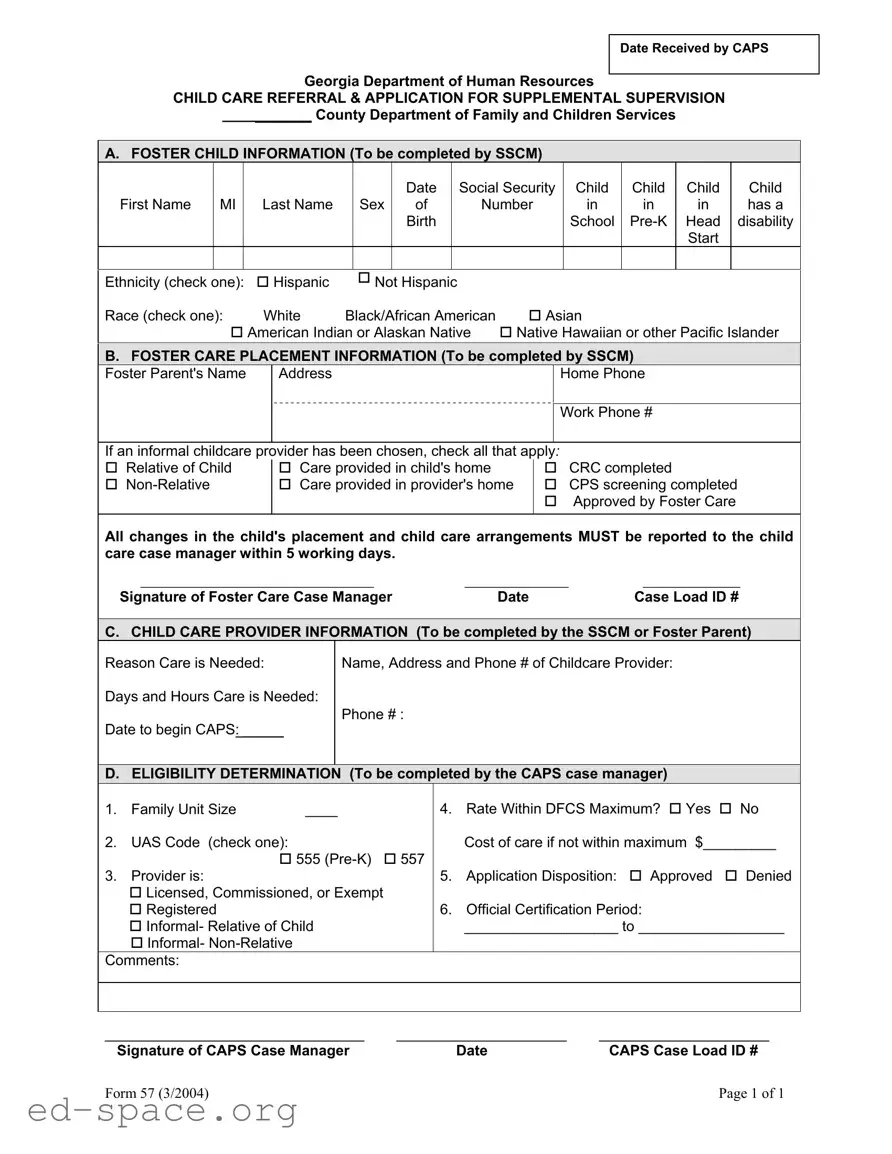
The Georgia 57 form serves as a crucial document in the process of securing supplemental supervision for foster children. This form is utilized by the Georgia Department of Human Resources and is specifically designed for the Child Care Referral and Application for Supplemental Supervision. It encompasses several key sections that collect vital information about the foster child, including personal details such as name, date of birth, and ethnicity. Additionally, it requires data regarding the foster care placement, such as the foster parent's contact information and the nature of the childcare arrangement. The form also addresses the eligibility determination process, where the case manager assesses the family unit size and the rate of care in relation to state maximums. Important signatures from both the foster care case manager and the CAPS case manager are required to finalize the application. Timely updates regarding any changes in the child's placement or childcare arrangements must be reported to ensure compliance with regulations. This structured approach aims to facilitate the effective management of childcare services for foster children in Georgia.
Date Received by CAPS
Georgia Department of Human Resources
CHILD CARE REFERRAL & APPLICATION FOR SUPPLEMENTAL SUPERVISION
___________ County Department of Family and Children Services
A. FOSTER CHILD INFORMATION (To be completed by SSCM)
First Name MI Last Name Sex
Date |
Social Security |
Child |
Child |
of |
Number |
in |
in |
Birth |
|
School |
|
|
|
|
|
Child
in
Head
Start
Child has a disability
Ethnicity (check one): |
Hispanic |
Not Hispanic |
|
Race (check one): |
White |
Black/African American |
Asian |
|
American Indian or Alaskan Native |
Native Hawaiian or other Pacific Islander |
|
B. FOSTER CARE PLACEMENT INFORMATION (To be completed by SSCM)
Foster Parent's Name
Address
Home Phone
|
|
|
Work Phone # |
|
|
|
|
If an informal childcare provider has been chosen, check all that apply: |
|
||
Relative of Child |
Care provided in child's home |
|
CRC completed |
Care provided in provider's home |
|
CPS screening completed |
|
|
|
|
Approved by Foster Care |
|
|
|
|
All changes in the child's placement and child care arrangements MUST be reported to the child care case manager within 5 working days.
____________________________________ |
________________ |
_______________ |
Signature of Foster Care Case Manager |
Date |
Case Load ID # |
C. CHILD CARE PROVIDER INFORMATION (To be completed by the SSCM or Foster Parent)
Reason Care is Needed:
Days and Hours Care is Needed:
Date to begin CAPS: _____
Name, Address and Phone # of Childcare Provider:
Phone # :
D. ELIGIBILITY DETERMINATION (To be completed by the CAPS case manager)
1. |
Family Unit Size |
____ |
|
4. |
Rate Within DFCS Maximum? |
Yes |
No |
|
2. |
UAS Code (check one): |
|
|
|
Cost of care if not within maximum $_________ |
|||
|
|
555 |
557 |
|
|
|
|
|
3. |
Provider is: |
|
|
5. |
Application Disposition: |
Approved |
Denied |
|
|
Licensed, Commissioned, or Exempt |
|
|
|
|
|
|
|
|
Registered |
|
|
6. |
Official Certification Period: |
|
|
|
|
Informal- Relative of Child |
|
|
___________________ to __________________ |
||||
|
Informal- |
|
|
|
|
|
|
|
Comments:
________________________________ |
_____________________ |
_____________________ |
Signature of CAPS Case Manager |
Date |
CAPS Case Load ID # |
Form 57 (3/2004) |
Page 1 of 1 |
| Fact Name | Description |
|---|---|
| Purpose | The Georgia 57 form is used for child care referral and application for supplemental supervision for foster children. |
| Governing Law | This form is governed by the Georgia Department of Human Services regulations regarding child welfare. |
| Completion | The form must be completed by the Social Services Case Manager (SSCM) or the foster parent, depending on the section. |
| Reporting Requirement | Any changes in the child's placement and child care arrangements must be reported within 5 working days to the child care case manager. |
The Georgia 57 form is a crucial document for foster care and childcare arrangements. Completing this form accurately is essential for ensuring that the necessary services are provided. Follow these steps to fill out the form properly.
What is the purpose of the Georgia 57 form?
The Georgia 57 form is used to apply for supplemental supervision for children in foster care. It serves as a referral and application for child care, ensuring that children receive the necessary support and supervision while in the care of foster parents or informal childcare providers.
Who is responsible for completing the Georgia 57 form?
The form is primarily completed by the Social Services Case Manager (SSCM) in collaboration with the foster parent. The SSCM gathers essential information about the child, the foster care placement, and the childcare provider.
What information is required in the child information section?
This section requires details about the child, including their name, date of birth, social security number, and whether they have a disability. Additionally, it asks for the child’s ethnicity and race, which helps in understanding the demographics of children in care.
What details must be provided about the foster care placement?
The foster care placement section requires the name and contact information of the foster parent. It also includes options for informal childcare providers, where the SSCM must check relevant boxes regarding the caregiver's relationship to the child and whether necessary screenings have been completed.
What are the responsibilities of the foster care case manager?
The foster care case manager is responsible for signing the form and ensuring that any changes in the child's placement or childcare arrangements are reported within five working days. This is crucial for maintaining accurate records and ensuring the child's welfare.
What information is needed from the childcare provider?
The form requires the name, address, and phone number of the childcare provider. Additionally, it asks for the reason care is needed, the days and hours care is required, and the start date for the CAPS program.
How is eligibility determined for childcare assistance?
Eligibility is assessed by the CAPS case manager, who evaluates family unit size, the UAS code, and whether the cost of care falls within the Department of Family and Children Services (DFCS) maximum rates. The form also indicates whether the childcare provider is licensed, registered, or informal.
What does the application disposition section indicate?
This section informs whether the application for childcare assistance has been approved or denied. It is crucial for foster parents to understand the outcome, as it directly affects the availability of childcare support.
What is the significance of the official certification period?
The official certification period indicates the timeframe during which the childcare assistance is valid. It is important for both the foster parents and the childcare provider to be aware of these dates to ensure continuous support and compliance with regulations.
Where can I find assistance if I have questions about the Georgia 57 form?
If you have questions about the Georgia 57 form or the application process, it is advisable to contact your local Department of Family and Children Services office. They can provide guidance and clarification on any aspect of the form and its requirements.
Incomplete Information: Failing to fill out all required fields can lead to delays. Each section must be completed thoroughly.
Incorrect Dates: Entering the wrong date for the child’s birth or the start date for care can cause issues with eligibility.
Missing Signatures: Not signing the form where indicated can result in the application being rejected. Ensure all necessary signatures are present.
Improper Ethnicity and Race Selection: Failing to accurately check the appropriate boxes for ethnicity and race can lead to complications in processing.
Not Reporting Changes: Any changes in the child’s placement or care arrangements must be reported within 5 working days. Ignoring this can affect the application.
Incorrect Contact Information: Providing outdated or incorrect contact information for the childcare provider can hinder communication and processing.
Failure to Include Disability Information: If the child has a disability, this must be noted. Omitting this information may affect eligibility for additional support.
Not Checking Provider Status: It’s crucial to accurately indicate whether the childcare provider is licensed, registered, or exempt. Misclassification can lead to denial.
Ignoring Maximum Rate Limits: Not checking if the cost of care exceeds the DFCS maximum can result in unexpected expenses and application denial.
Neglecting Comments Section: The comments section is an opportunity to clarify any special circumstances. Leaving it blank may lead to misunderstandings.
The Georgia 57 form is an important document used in the child care referral and application process for supplemental supervision. When dealing with child care arrangements, there are several other forms and documents that often accompany this application. Understanding these related documents can help streamline the process and ensure compliance with state regulations.
Familiarizing yourself with these forms can make navigating the child care system smoother and more efficient. Each document plays a vital role in ensuring the safety, well-being, and proper care of children in foster and child care settings.
The Georgia 57 form is a vital document used in the child care referral and application process for supplemental supervision in foster care settings. Several other documents share similar purposes or functions. Here’s a list of eight documents that resemble the Georgia 57 form:
When filling out the Georgia 57 form, it's important to follow certain guidelines to ensure the process goes smoothly. Here are six things you should and shouldn't do:
Understanding the Georgia 57 form can be challenging, and there are several misconceptions that often arise. Here are four common misunderstandings:
Clearing up these misconceptions can help families navigate the child care system more effectively and ensure that children receive the care they need.
When filling out and using the Georgia 57 form, keep these key takeaways in mind: