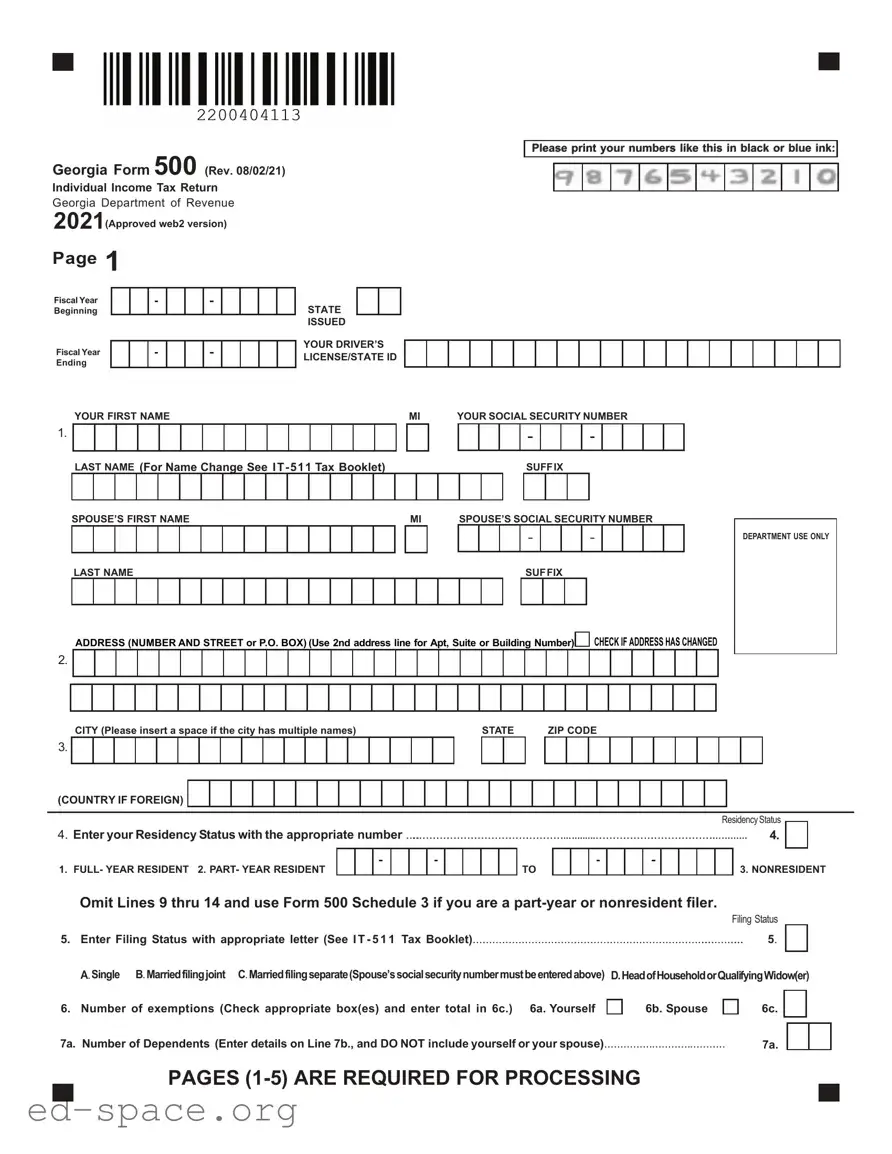
The Georgia Form 500 is a crucial document for individuals filing their state income tax returns. This form captures essential personal information, including names, addresses, and Social Security numbers for both the taxpayer and their spouse, if applicable. It also requires filers to indicate their residency status, which determines their tax obligations. Various sections of the form guide users through reporting their income, deductions, and credits. Notably, it differentiates between full-year residents, part-year residents, and nonresidents, each with specific instructions. The form facilitates calculations of adjusted gross income, standard or itemized deductions, and ultimately, the taxable income. Furthermore, it includes provisions for tax credits and prepayments, ensuring that taxpayers can account for any amounts withheld or paid throughout the year. Completing the Georgia Form 500 accurately is essential for proper tax processing and compliance with state regulations.

Georgia Form 500 (Rev. 08/02/21) Individual Income Tax Return
Georgia Department of Revenue
2021(Approved web2 version)
Please print your numbers like this in black or blue ink:
Page 1
Fiscal Year
Beginning
Fiscal Year
Ending
YOUR FIRST NAME
1.
STATE
ISSUED
YOUR DRIVER’S
LICENSE/STATE ID
MI |
YOUR SOCIAL SECURITY NUMBER |
|||||||||||||||
|
|
|
|
|
|
|
|
|
|
|
|
|
|
|
|
|
|
|
|
|
|
|
|
|
|
|
|
|
|
|
|
|
|
LAST NAME (For Name Change See |
SUFFIX |
||||||||||||||||||||||
|
|
|
|
|
|
|
|
|
|
|
|
|
|
|
|
|
|
|
|
|
|
|
|
SPOUSE’S FIRST NAME |
|
|
|
|
|
|
|
|
|
|
MI |
|
SPOUSE’S SOCIAL SECURITY NUMBER |
||||||||||||||||||||||||
|
|
|
|
|
|
|
|
|
|
|
|
|
|
|
|
|
|
|
|
|
|
|
|
|
|
|
|
|
|
|
|
|
|
|
|
|
|
|
|
|
|
|
|
|
|
|
|
|
|
|
|
|
|
|
|
|
|
|
|
|
|
|
|
|
|
|
|
|
|
|
|
|
|
|
|
LAST NAME |
|
|
|
|
|
|
|
|
|
|
|
|
|
|
|
|
|
|
SUFFIX |
||||||||||||||||||
|
|
|
|
|
|
|
|
|
|
|
|
|
|
|
|
|
|
|
|
|
|
|
|
|
|
|
|
|
|
|
|
|
|
|
|
|
|
ADDRESS (NUMBER AND STREET or P.O. BOX) (Use 2nd address line for Apt, Suite or Building Number) CHECK IF ADDRESS HAS CHANGED
2.
DEPARTMENT USE ONLY
CITY (Please insert a space if the city has multiple names) |
STATE |
ZIP CODE |
3.
(COUNTRY IF FOREIGN)
|
ResidencyStatus |
4. Enter your Residency Status with the appropriate number |
4. |
1. FULL- YEAR RESIDENT 2. PART- YEAR RESIDENT
TO
3. NONRESIDENT
Omit Lines 9 thru 14 and use Form 500 Schedule 3 if you are a
|
|
|
Filing Status |
|
||
5. |
Enter Filing Status with appropriate letter (See IT - 511 Tax Booklet) |
|
|
|
||
|
A.Single B.Marriedfilingjoint C.Marriedfilingseparate(Spouse’ssocialsecuritynumbermustbeenteredabove) |
|
|
|
||
|
D.HeadofHouseholdorQualifyingWidow(er) |
|
||||
|
|
|
|
|
|
|
6. |
Number of exemptions (Check appropriate box(es) and enter total in 6c.) 6a. Yourself |
6b. Spouse |
6c. |
|
|
|
7a. Number of Dependents (Enter details on Line 7b., and DO NOT include yourself or your spouse) |
|
7a. |
|
|
||
|
|
|||||
PAGES

Georgia Form 500
Individual Income Tax Return
Georgia Department of Revenue |
YOUR SOCIAL SECURITY NUMBER |
2021
Page 2
7b. Dependents (If you have more than 4 dependents, attach a list of additional dependents)
First Name, MI.
Social Security Number
First Name, MI.
Social Security Number
First Name, MI.
Social Security Number
First Name, MI.
Social Security Number
Last Name
Relationship to You
Last Name
Relationship to You
Last Name
Relationship to You
Last Name
Relationship to You
INCOME COMPUTATIONS
If amount on line 8, 9, 10, 13 or 15 is negative, use the minus sign
.....................................8. Federal adjusted gross income (From Federal Form 1040) |
8. |
|
|
, |
|
|
|
|
,.00
(Do not use FEDERAL TAXABLE INCOME) If the amount on Line 8 is $40,000 or more, or your gross income is less than your |
|
|
|
||||||||||||||
|
|
, |
|
|
|
, |
|
|
|
. |
00 |
||||||
9. Adjustments from Form 500 Schedule 1 (See |
9. |
|
|
|
|
|
|
|
|
||||||||
|
|
|
|
|
|
|
|
|
|
|
|||||||
|
|
|
|
|
|
|
|
|
, |
|
|
|
.00 |
||||
.............................10. Georgia adjusted gross income (Net total of Line 8 and Line 9) |
10. |
|
|
, |
|
|
|
|
|
|
|||||||
|
|
|
|
|
|
|
|
|
|
|
|
|
|
||||
..............11. Standard Deduction (Do not use FEDERAL STANDARD DEDUCTION) |
11a. |
|
|
|
|
|
, |
|
|
|
.00 |
||||||
(See |
|
|
|
11b. |
|
|
|
|
|
, |
|
|
|
.00 |
|||
b. Self: 65 or over? |
Blind? |
Total |
|
x 1,300= |
|
|
|
|
|
|
|
|
|||||
|
|
|
|
|
|
|
|
|
|||||||||
Spouse: 65 or over? |
Blind? |
|
|
|
11c. |
|
|
|
|
|
, |
|
|
|
.00 |
||
|
|
|
|
|
|
|
|
|
|
|
|||||||
c. Total Standard Deduction (Line 11a + Line 11b) |
|
|
|
|
|
|
|
|
|
|
|||||||
Use EITHER Line 11c OR Line 12c (Do not write on both lines)
12. Total Itemized Deductions used in computing Federal Taxable Income. If you use itemized deductions, you must include Federal Schedule A.
a. Federal Itemized Deductions (Schedule A- Form 1040) |
12a. |
b. Less adjustments: (See |
12b. |
c. Georgia Total Itemized Deductions |
12c. |
13. Subtract either Line 11c or Line 12c from Line 10; enter balance |
13. |
|
|
|
, |
|
|
|
, |
|
|
|
|
.00 |
|||
|
|
|
|
|
|
|
|
|
|
||||||
|
|
|
, |
|
|
|
, |
|
|
|
|
.00 |
|||
|
|
|
|
|
|
|
|
|
|
||||||
|
|
|
|
|
|
|
|
|
|
||||||
|
|
|
, |
|
|
|
|
, |
|
|
|
|
.00 |
||
|
|
|
|
|
|
|
|
|
|
|
|||||
|
|
|
, |
|
|
|
|
|
, |
|
|
|
|
.00 |
|
|
|
|
|
|
|
|
|
|
|
|
|
||||
|
|
|
|
|
|
|
|
|
|
|
|
||||
PAGES
| Fact Name | Description |
|---|---|
| Form Purpose | The Georgia Form 500 is used for filing individual income tax returns in the state of Georgia. |
| Governing Law | This form is governed by the Georgia Public Revenue Code, specifically Section 48-2-31. |
| Filing Status Options | Taxpayers can select from various filing statuses, including Single, Married Filing Joint, Married Filing Separate, and Head of Household. |
| Residency Status | Filers must indicate their residency status, which can be Full-Year Resident, Part-Year Resident, or Nonresident. |
| Required Pages | All pages of the form, specifically pages 1 through 5, are required for processing the tax return. |
Filling out the Georgia Form 500 is an important step in managing your individual income tax. Once you have completed the form, you'll submit it to the Georgia Department of Revenue for processing. Make sure to double-check your entries for accuracy, as this can affect your tax return outcome.
What is the Georgia Form 500?
The Georgia Form 500 is the Individual Income Tax Return used by residents, part-year residents, and non-residents to report their income and calculate their state tax obligations. This form is essential for individuals who earn income in Georgia and need to file their taxes with the Georgia Department of Revenue. It includes various sections where taxpayers report personal information, income details, deductions, and credits. Completing this form accurately ensures compliance with state tax laws and helps avoid potential penalties.
Who needs to file the Georgia Form 500?
Any individual who resides in Georgia, earns income in the state, or has a filing requirement must file the Georgia Form 500. This includes full-year residents, part-year residents, and non-residents who have Georgia-source income. If your income exceeds the minimum threshold set by the state, you are required to file. Additionally, if you want to claim a refund for any state taxes withheld, filing this form is necessary.
How do I determine my residency status on the form?
When filling out the Georgia Form 500, you will be asked to indicate your residency status. There are three options: full-year resident, part-year resident, and non-resident. A full-year resident lives in Georgia for the entire tax year. A part-year resident lives in Georgia for part of the year and may have income from other states. A non-resident earns income from Georgia sources but does not live in the state. Selecting the correct status is crucial, as it affects your tax calculations and eligibility for certain deductions and credits.
What should I do if I have dependents?
If you have dependents, you must list them on the Georgia Form 500. This includes entering their names, Social Security numbers, and their relationship to you. Dependents can impact your tax situation by allowing you to claim additional exemptions or credits, which can reduce your overall tax liability. Be sure to check the instructions for the form to ensure you meet the criteria for claiming dependents and to determine how many exemptions you can claim.
What happens if I owe taxes after filing?
If, after completing the Georgia Form 500, you find that you owe taxes, you will need to pay the amount due by the specified deadline to avoid penalties and interest. The form provides instructions on how to calculate your balance due. You can make your payment electronically or by mailing a check to the Georgia Department of Revenue. It's important to keep in mind that if you fail to pay the amount owed, you may face additional charges, so addressing any outstanding balance promptly is crucial.
Not using black or blue ink: It's essential to fill out the form using black or blue ink. Using other colors can make your form difficult to read and may delay processing.
Incorrect residency status: Ensure you select the right residency status. Choosing the wrong option can lead to filing complications.
Missing signatures: Both the taxpayer and spouse (if applicable) must sign the form. Missing signatures can result in the rejection of your return.
Omitting required pages: All pages of the form are necessary for processing. Failing to include any page can lead to delays.
Incorrect Social Security numbers: Double-check that all Social Security numbers are accurate. Errors can cause significant issues with your return.
Not including copies of required documents: If your income is $40,000 or more, or if there are discrepancies with your W-2s, you must attach copies of your Federal Form 1040.
Incorrectly calculating deductions: Make sure to use the correct Georgia standard deduction or itemized deductions. Errors in calculations can lead to incorrect tax liabilities.
Failing to report all income: Only include income on which Georgia tax was withheld. Be thorough in reporting W-2s and 1099s to avoid issues.
Ignoring the instructions: Always refer to the IT-511 Tax Booklet for guidance. Skipping instructions can result in mistakes that affect your tax return.
The Georgia Form 500 is a crucial document for individuals filing their state income taxes. However, several other forms and documents often accompany it to ensure a complete and accurate tax return. Below is a list of commonly used forms that may be required or beneficial when submitting your Georgia income tax return.
Using these forms in conjunction with the Georgia Form 500 can streamline the filing process and help ensure that all necessary information is accurately reported. By being thorough and organized, taxpayers can avoid potential issues and maximize their tax benefits.
The Georgia Form 500 is an important document used for filing individual income tax returns in Georgia. Several other forms share similarities with it, as they also serve specific purposes related to income tax filing and reporting. Below are five documents that are similar to the Georgia Form 500, along with explanations of their similarities:
Understanding these forms can help taxpayers navigate their tax obligations more effectively. Each document plays a unique role in the broader context of tax filing, ensuring that individuals can accurately report their income and claim any necessary deductions or credits.
When filling out the Georgia Form 500, there are important guidelines to follow. Below is a list of things you should and shouldn't do.
When it comes to the Georgia Form 500, there are several misconceptions that can lead to confusion during the filing process. Here’s a breakdown of eight common misunderstandings:
Many people believe that they can submit only certain pages of the form. However, all pages (1-5) are required for processing. Missing pages can delay your return or result in rejection.
Some assume that if their income is below $40,000, they don’t need to include their Federal Form 1040. In fact, if your income is $40,000 or more, or if your gross income is less than your W-2s, you must attach a copy of your Federal Form 1040.
Many individuals think there are only a few filing statuses available. In reality, there are multiple options, including Single, Married Filing Jointly, Married Filing Separately, Head of Household, and Qualifying Widow(er).
Some filers mistakenly believe they can apply the federal standard deduction. However, you must use the Georgia standard deduction, which is different from the federal one.
If you are a part-year resident or non-resident, you should not fill out all lines of the form. Instead, omit lines 9 through 14 and use Form 500 Schedule 3.
Some people think they only need to report income that has Georgia tax withheld. In fact, all income must be reported, including W-2s, 1099s, and other income sources.
Your social security number is essential for processing your tax return. Failing to include it can lead to delays or complications in your filing.
Some individuals think they can send their tax return without a signature. However, your signature is required to validate the return. If prepared by someone else, their information must also be included.
Understanding these misconceptions can help ensure a smoother filing experience and minimize potential issues with your Georgia Form 500.
Ensure accurate information: When filling out the Georgia 500 form, double-check that all names, Social Security numbers, and addresses are correct. Mistakes can lead to processing delays or issues with your tax return.
Understand your residency status: It is crucial to indicate your residency status accurately. Georgia has different tax rules for full-year residents, part-year residents, and nonresidents. Make sure to select the appropriate status on the form.
Include all necessary pages: All five pages of the Georgia 500 form must be submitted for processing. Omitting any page could result in delays or rejection of your return.
Document your income: Report only the income on which Georgia tax was withheld. Use W-2s, 1099s, and other relevant forms to ensure you report accurate figures.
Consider electronic filing: If you are claiming certain credits or if your return is more complex, electronic filing may be required. This method can streamline the process and reduce errors.